 Pyeongye
Artwork · 19th century · Théodore Géricault
LeoTurn on Magnifier at the lower right and move slowly across the painting.
Full screen opens it edge to edge.Tap the painting to fill the screen.
Spread two fingers to look closer.
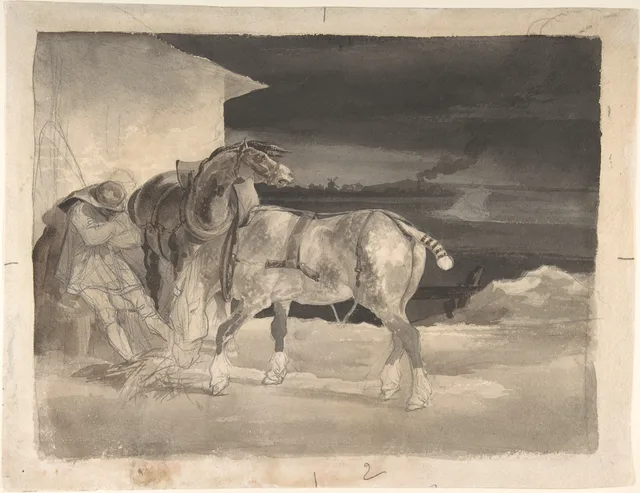
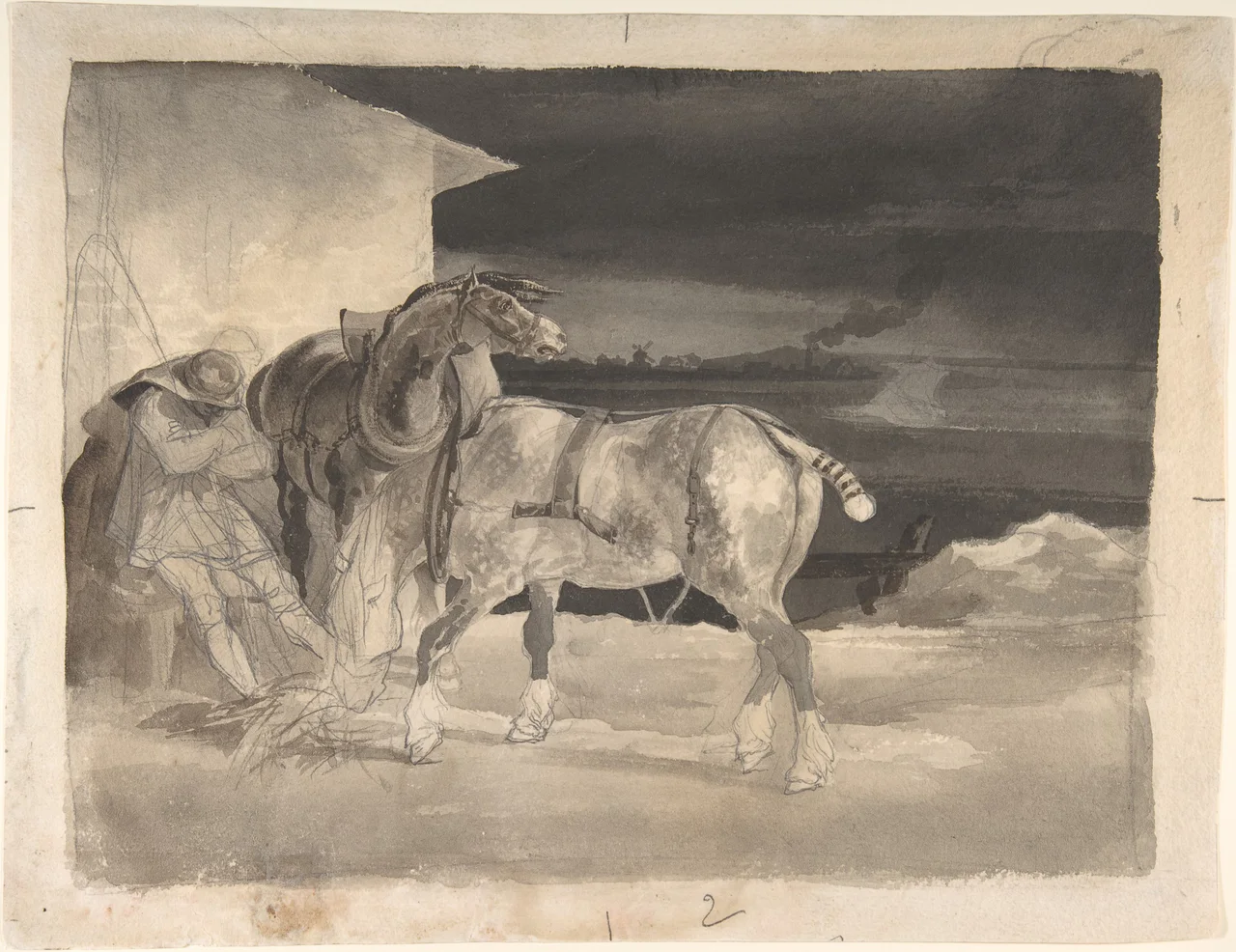
Two Draft Horses with a Sleeping Driver
Théodore Géricault1820–22Brush and brown and gray wash, over graphite29.9 × 38.2 cm
At a glance
- Two harnessed draft horses stand side by side while their driver, wrapped in a cloak, dozes against a wall with his arms folded.
- The French artist Théodore Géricault made this drawing in 1820 to 1822, brushing brown and gray washes over a pencil sketch.
- The horses are carefully finished in wash, but the driver is still mostly bare pencil, so you can see exactly where the artist put his effort.
Reading the picture
4 places to look closer
Tap a number on the painting to jump to its note, or a close-up to see that spot in the whole picture.
Zoom in on the driver at the left. He has pulled his wide-brimmed hat down low, folded his arms, and let his head drop. Look closely and you will see he is made almost entirely of pencil lines. Thin strokes crisscross his legs and cloak, and only a few patches of wash have been added.
Now look at the horse's head rising in the middle. It has swung its head around to look behind, and you can just see the white of its eye. The mane flies back in a few dark strokes of the brush. The driver is asleep, but this horse seems alert to something.
Zoom in on the tail of the gray horse on the right. The hair has been tied up and folded short, with brown bands wrapped around it. On the rump, pale wash spreads in blotches to make a dappled gray coat. The hard edges left where the wash dried become the spots in the hair.
Follow the horizon to the right of the horse's head. A tiny windmill stands with its sails spread, next to a row of low buildings in dark silhouette. Above them, Géricault laid broad strokes of deep gray wash, making the sky heavy, like evening or bad weather.
When it was painted
In 1820, Géricault, about twenty-nine, crossed the Channel to England. He was bringing his huge painting The Raft of the Medusa, which had hung at the Paris Salon the year before, to show in London. It went on display at the Egyptian Hall in Piccadilly, and people paid admission to see it.
Géricault had been obsessed with horses since he was young. He trained with Carle Vernet, a painter known for horses, and he loved to ride. In London, what caught his eye were the working draft horses, the drivers, the blacksmiths, and the poor people in the streets. In 1821 he published a series of lithographs of these London street scenes.
That same year he saw the races at Epsom and painted The Derby at Epsom, with horses stretched out as if flying above the ground. Photographs that froze a galloping horse's legs would not arrive for more than half a century. The dates of this drawing, 1820 to 1822, cover his time in England and the months just after.
His life after that was short. Back in Paris, he was hurt in falls from horses and his health gave way. He died in January 1824, at thirty-two. The Metropolitan Museum bought this drawing in 1996.
Look at the driver on the left again. Géricault finished the horses with care and left the sleeping man as a web of pencil lines.
Questions to think about
- Look for itHow many straps and buckles of harness can you find on the two horses?
- Why?Why do you think Géricault painted the horses more carefully than the driver?
- What about you?The horses that pull heavy loads and the driver who has dropped off to sleep have both worked a long day. How much attention do we pay today to the tiredness of people who drive and deliver late into the night?
Same period
Painted around the same time,
somewhere else
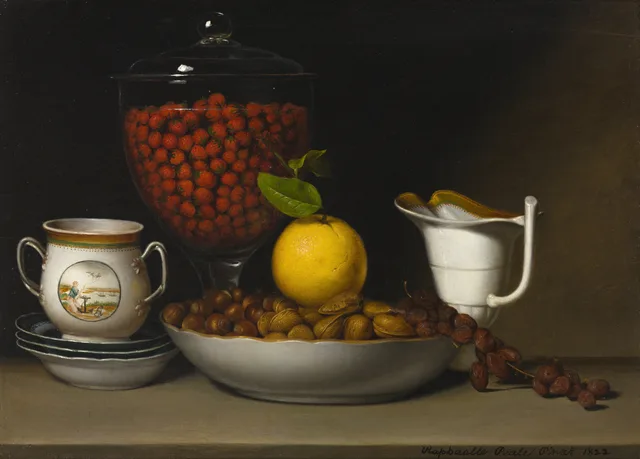 Still Life—Strawberries, Nuts, &c.Raphaelle Peale1822
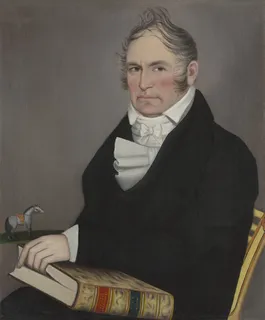 Cornelius AllertonAmmi Phillips1821–22
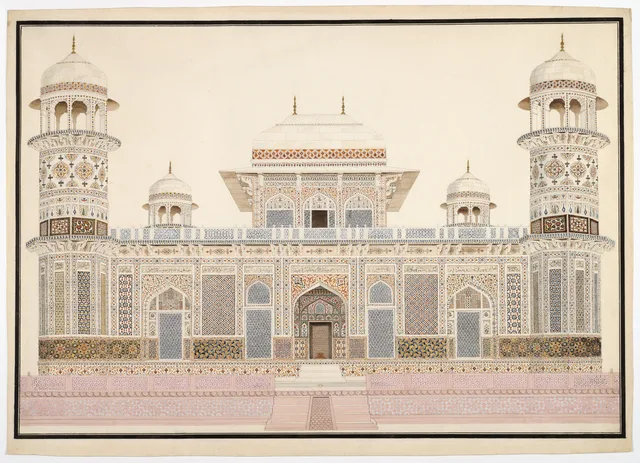 I'timad-ud-Daula's Tomb at AgraUnknown artist · Indiac. 1820
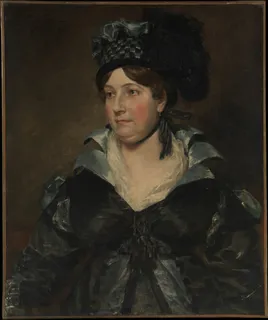 Mrs. James Pulham Sr. (Frances Amys, ca. 1766–1856)John Constable1818
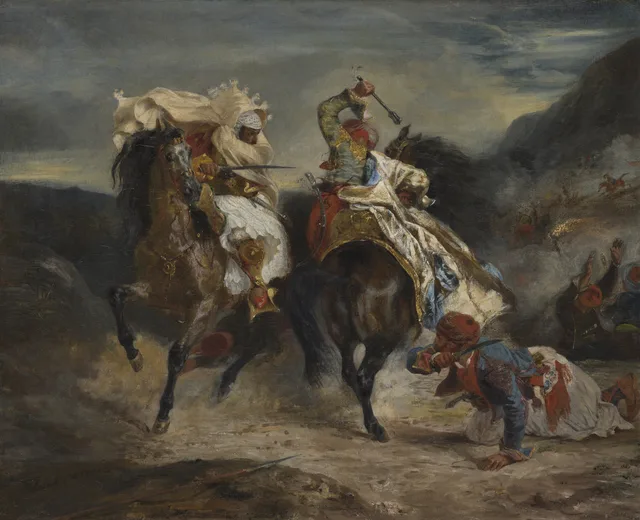 The Combat of the Giaour and HassanEugène Delacroix1826
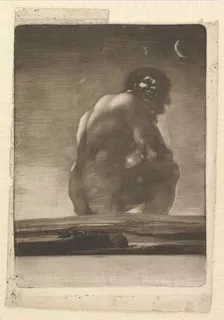 Seated GiantGoyaby 1818 (possibly 1814–18)
Too good to keep to yourself
This painting,
for someone who comes to mind
They open it at full size
and see every brushstroke.
About this work
- Artist
- Théodore Géricault · 1791–1824
- Date
- 1820–22
- Medium
- Brush and brown and gray wash, over graphite
- Size
- 29.9 × 38.2 cm
- Collection
- The Metropolitan Museum of Art
- Image
- Original long edge 3873px · shown at 2560px
- Original
- View on the museum's website ↗