 Pyeongye
Artwork · 19th century · Goya
LeoTurn on Magnifier at the lower right and move slowly across the painting.
Full screen opens it edge to edge.Tap the painting to fill the screen.
Spread two fingers to look closer.
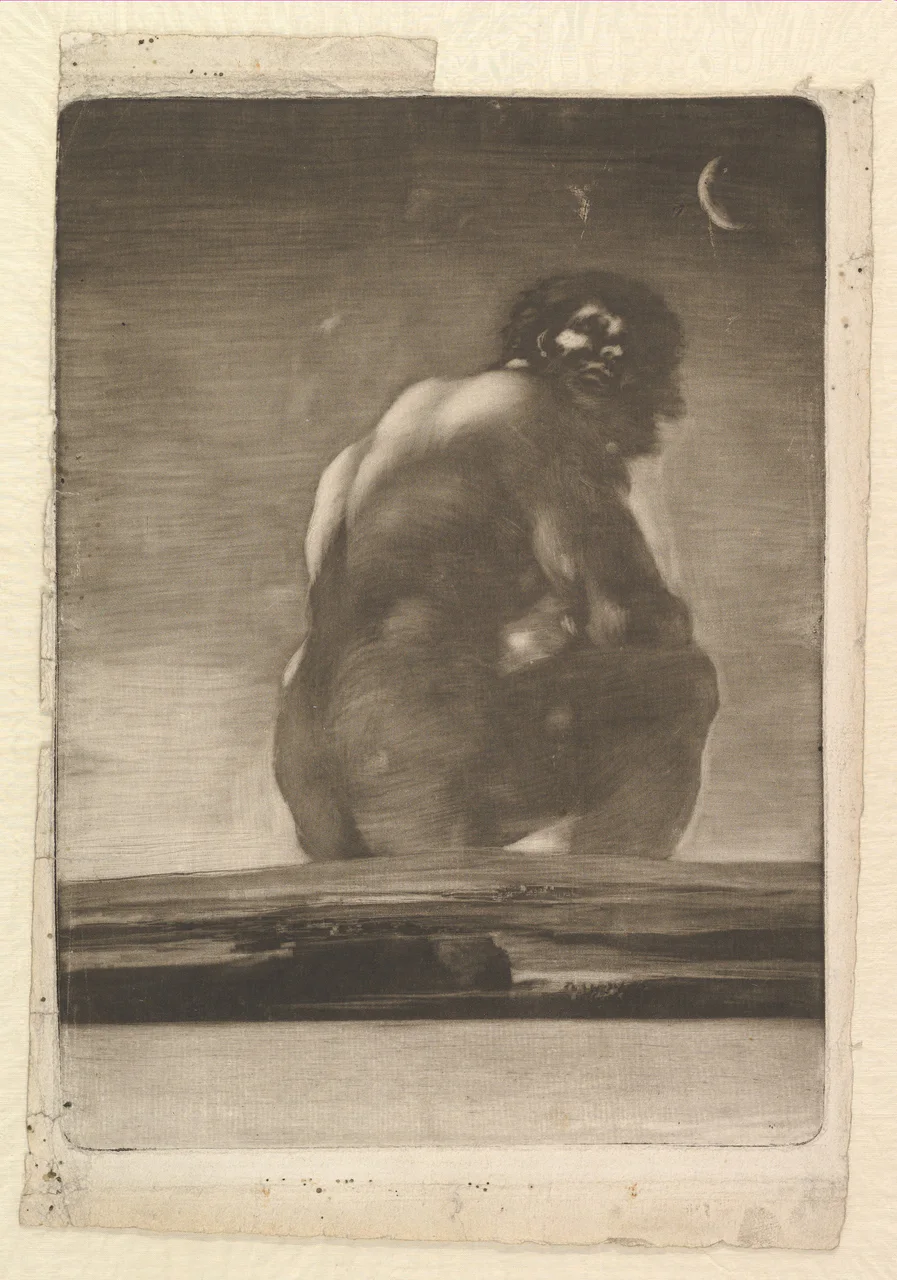
Seated Giant
Goyaby 1818 (possibly 1814–18)Burnished aquatint, scaper, roulette, lavis (along the top of the landscape and within the landscape)28.4 × 20.8 cm
At a glance
- A naked giant sits at the edge of the world with his back to us, turning to look over his shoulder, while a thin crescent moon hangs in the sky.
- The Spanish artist Francisco Goya made this print by 1818, possibly between 1814 and 1818.
- It is an aquatint, a print built from areas of light and dark rather than lines, and the giant seems to be scraped out of the darkness.
Reading the picture
4 places to look closer
Tap a number on the painting to jump to its note, or a close-up to see that spot in the whole picture.
Zoom in on the giant's face. Between the shaggy hair and beard, only his brow and the tip of his nose catch the light. He has turned his head to stare at something behind him. Whatever he is looking at, it is nowhere in the picture.
Find the crescent moon in the upper right. A thin curved sliver of light floats in the dark sky. It tells you it is night, and it hints at how tall the giant is, his head reaching up toward the moon.
Look at the giant's back and shoulders. A long streak of light runs down his left shoulder, and a single white patch glows lower down, to the right. The Met explains that Goya first darkened the whole plate with aquatint, then scraped the bright areas out of the metal to bring up the light.
Zoom in on the ground at the bottom. Beside a dark hill, a row of tiny shapes sits along the land. They could be rooftops in a village, or people. Next to these little marks, the giant's size feels dizzying.
When it was painted
In 1814, Goya was sixty-eight. He had been deaf for more than twenty years, ever since a serious illness in his mid-forties. In Madrid he had just lived through six years of war, as Napoleon's armies occupied Spain and Spaniards fought back.
During the war, Goya quietly etched a series of copper plates showing executions, famine, and piles of the dead. Today they are known as The Disasters of War. They were not published in his lifetime. The set finally appeared in 1863, thirty-five years after his death.
When King Ferdinand VII returned to the throne in 1814, Goya painted two large canvases of the Madrid uprising against the French and the executions that followed the next day. In 1815 the Inquisition called him in over his painting of the naked maja. In 1816 he published a set of prints of bullfighting, and in 1819 he bought a house outside Madrid and began covering its walls with his dark paintings.
Giants haunted this period of Goya's work. The Prado Museum owns a painting called The Colossus, showing a giant rising over a landscape. For a long time it was credited to Goya, but in 2008 the museum's researchers announced that it was most likely by his assistant Asensio Juliá. This print came to the Metropolitan Museum in 1935.
Look at the giant's eyes again. The giant this old artist made after the war does not fight or stride. He just sits, looking back at something we cannot see.
Questions to think about
- Look for itWhere on the giant's body does the light shine brightest?
- Why?Why do you think Goya turned the giant's back toward us instead of his face?
- What about you?People often describe overwhelming things, like war or disaster, as giants or monsters. What feels like this seated giant in our lives today?
Same period
Painted around the same time,
somewhere else
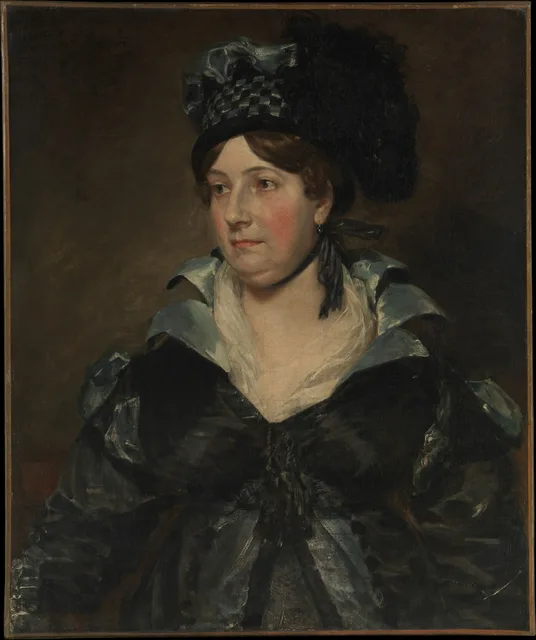 Mrs. James Pulham Sr. (Frances Amys, ca. 1766–1856)John Constable1818
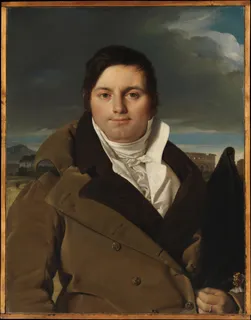 Joseph-Antoine Moltedo (born 1775)Jean Auguste Dominique Ingresca. 1810
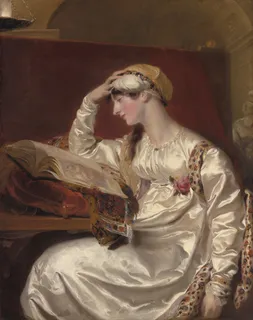 Isabella WolffSir Thomas Lawrence1803–15
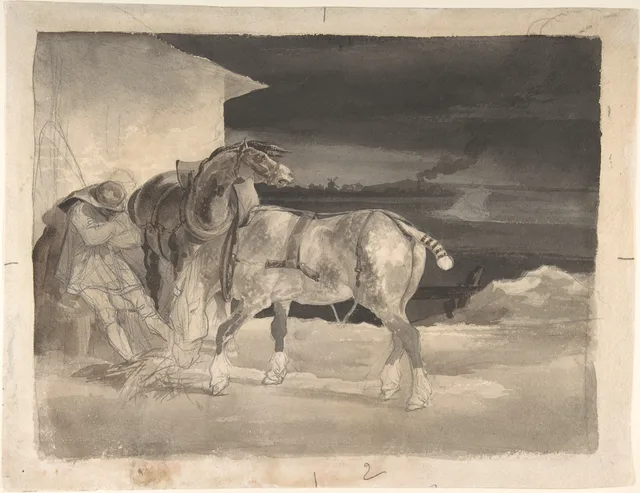 Two Draft Horses with a Sleeping DriverThéodore Géricault1820–22
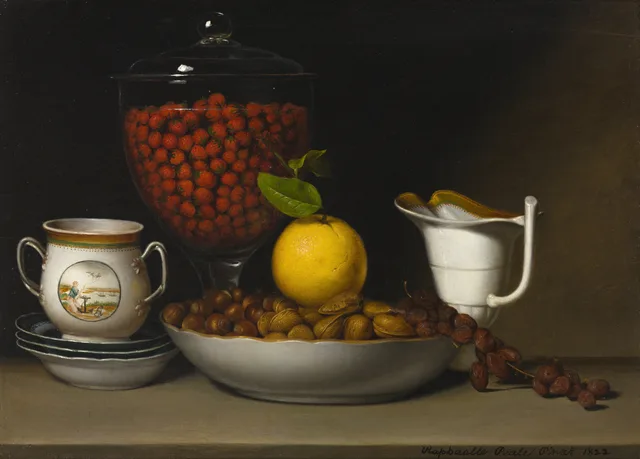 Still Life—Strawberries, Nuts, &c.Raphaelle Peale1822
 Cornelius AllertonAmmi Phillips1821–22
Too good to keep to yourself
This painting,
for someone who comes to mind
They open it at full size
and see every brushstroke.
About this work
- Artist
- Goya · 1746–1828
- Date
- by 1818 (possibly 1814–18)
- Medium
- Burnished aquatint, scaper, roulette, lavis (along the top of the landscape and within the landscape)
- Size
- 28.4 × 20.8 cm
- Collection
- The Metropolitan Museum of Art
- Image
- Original long edge 3616px · shown at 2560px
- Original
- View on the museum's website ↗