 Pyeongye
At a glance
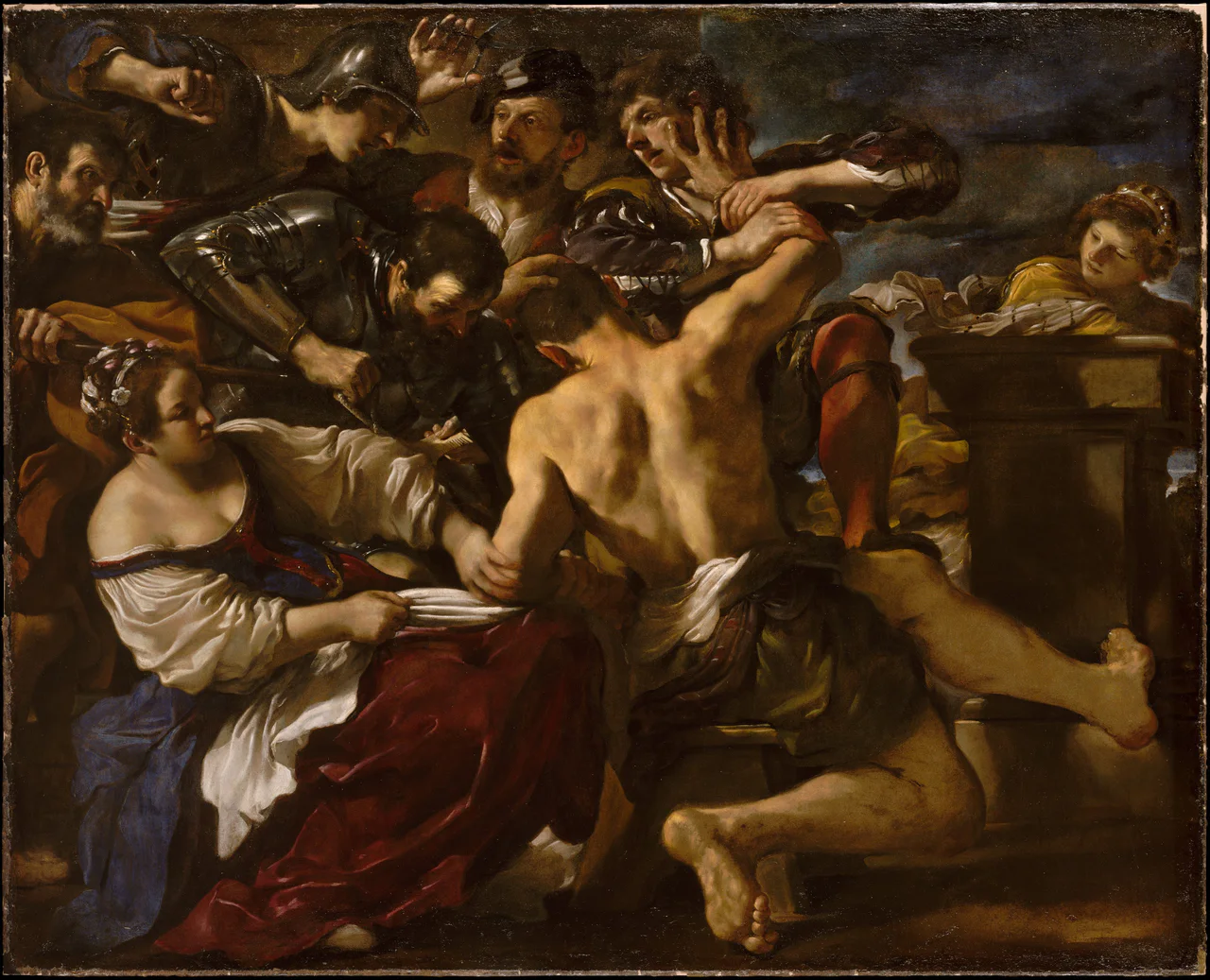
- Samson, the strongman of the Bible, has just lost his hair, and Philistine soldiers pile onto him all at once to take him prisoner.
- Guercino painted it in oil on canvas in 1619.
- On a canvas more than seven feet wide, close to ten people are tangled together, and Samson shows us his bare back instead of his face.
Reading the picture
5 places to look closer
Tap a number on the painting to jump to its note, or a close-up to see that spot in the whole picture.
Zoom in at the top center. Someone's hand holds a pair of iron shears high in the air. These are the shears that cut off the hair that gave Samson his strength.
Look at the young soldier at the upper right. Samson's huge hand shoves his face away, and the soldier's mouth hangs open in fear. But a rope is already wound around Samson's wrist. This is the last struggle of a man whose strength is draining away.
Zoom in near Delilah, the woman on the left. Right beside her, a hand is holding a comb. Delilah clutches a white cloth and twists her body as if trying to slip out of the fight. That comb tells us that a quiet moment of hair combing has just ended.
Look at the big foot at the bottom center. The sole of Samson's bare foot pushes out toward us. Guercino painted its creases, its calluses, even its grime. It is a hero's foot, but a very human one.
Zoom in beyond the wall on the right. A woman in a yellow dress leans on the wall and looks down at the struggle. While everyone else is caught up in the fight, she alone is quietly watching.
When it was painted
In 1619 the painter was twenty-eight and still working in Cento, a small town near Bologna. His real name was Giovanni Francesco Barbieri, but everyone called him Guercino, the squinter. He never spent long years in a famous master's studio. He learned largely on his own, studying an altarpiece by the Bolognese painter Ludovico Carracci that hung in a church in his hometown.
Word of the country painter spread fast. In a letter of 1617, Ludovico Carracci himself wrote with amazement about the young man's skill. That same year Alessandro Ludovisi, the archbishop of Bologna, gave him work too.
This canvas was painted for Cardinal Giacomo Serra, the pope's representative in nearby Ferrara. Its story comes from the Book of Judges. Delilah, paid by the Philistines, learned that Samson's strength lay in his hair, and it was cut off while he slept. Guercino chose the very next moment, when the soldiers pile on all at once.
Two years later his luck changed. In 1621 Archbishop Ludovisi was elected Pope Gregory XV, and he called Guercino to Rome. There the painter covered a ceiling in the Ludovisi villa with Aurora, the goddess of dawn, riding across the sky. When the pope died in 1623, Guercino went home to Cento.
The Metropolitan Museum of Art acquired the painting in 1984. After Rome, Guercino's style grew lighter and calmer. So this canvas, with a bare back and a huge dirty sole bursting out of the shadows, shows him as a young man. Look again at the light falling across Samson's back.
The painter
Guercino
1591–1666
When painting this, the artist was about 28 years old
All paintings by Guercino →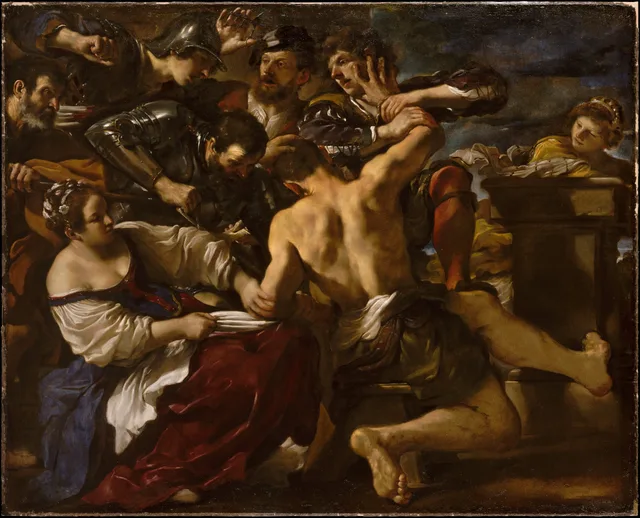
Questions to think about
- Look for itCan you find the ornaments in Delilah's hair?
- Why?Why do you think Guercino turned Samson's back to us instead of showing his face?
- What about you?Samson told his secret to the person closest to him and lost everything. Today, if a secret or personal information we shared with someone we trusted is sold for money, who is responsible?
Same period
Painted around the same time,
somewhere else
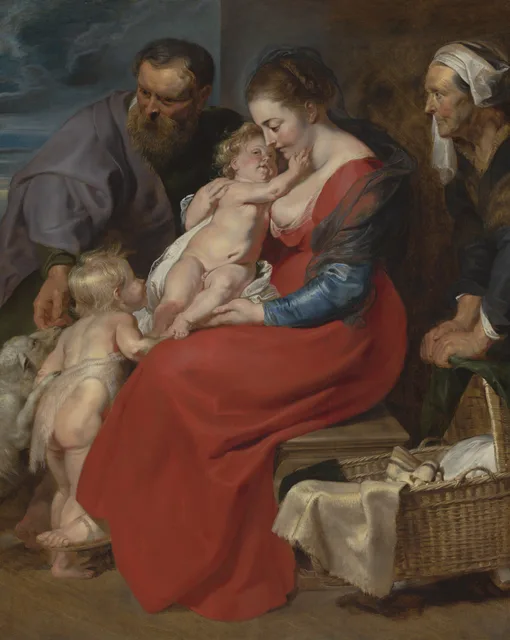 The Holy Family with Saints Elizabeth and John the BaptistPeter Paul Rubensc. 1615
 Merrymakers at ShrovetideFrans Halsca. 1616–17
 A Bouquet of FlowersClara Peetersca. 1612
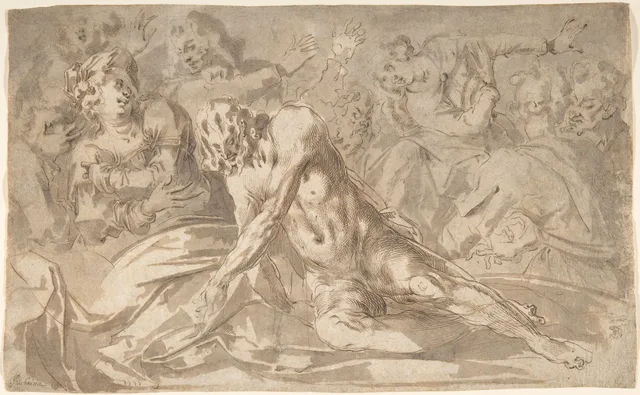 The Raising of LazarusJacques Bellangeca. 1606–8
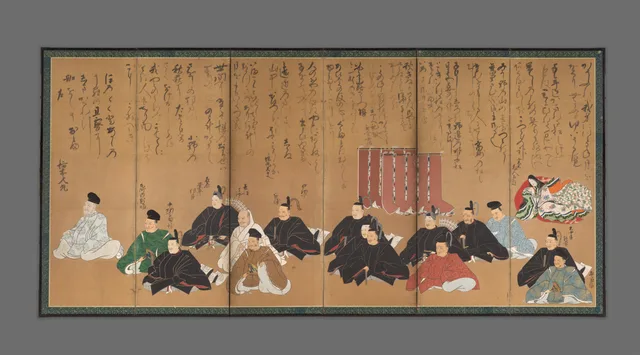 The Thirty-Six Poetic ImmortalsStudio of Kano Takanobuearly 17th century
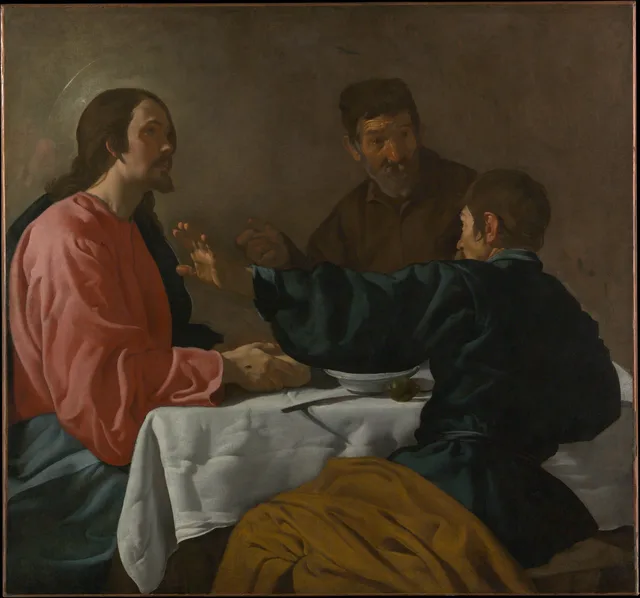 The Supper at EmmausVelázquez1622–23
Too good to keep to yourself
This painting,
for someone who comes to mind
They open it at full size
and see every brushstroke.
About this work
- Artist
- Guercino · 1591–1666
- Date
- 1619
- Medium
- Oil on canvas
- Size
- 191.1 × 236.9 cm
- Collection
- The Metropolitan Museum of Art
- Image
- Original long edge 3809px · shown at 2560px
- Original
- View on the museum's website ↗