 Pyeongye
Artwork · 17th century · Peter Paul Rubens
LeoTurn on Magnifier at the lower right and move slowly across the painting.
Full screen opens it edge to edge.Tap the painting to fill the screen.
Spread two fingers to look closer.
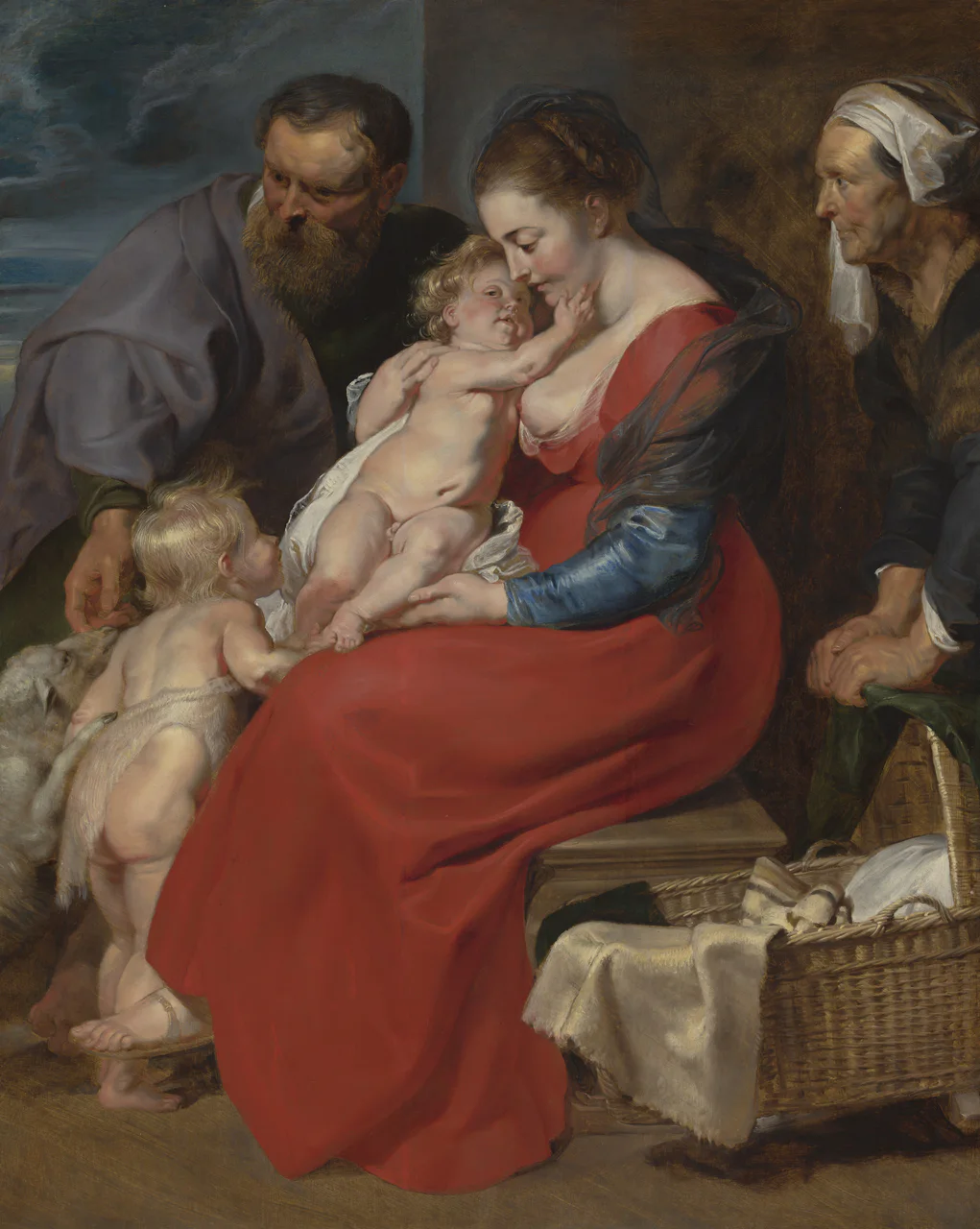
The Holy Family with Saints Elizabeth and John the Baptist
Peter Paul Rubensc. 1615Oil on panel114.5 × 91.5 cm
At a glance
- Mary holds the infant Jesus on her lap while Joseph, the elderly Elizabeth and the little John the Baptist gather around and watch.
- Peter Paul Rubens painted it in oil on a wooden panel around 1615, in Antwerp.
- This is a holy family with no halos at all, dressed in the clothes of Rubens's own Flanders, so they look like a family next door.
Reading the picture
5 places to look closer
Tap a number on the painting to jump to its note, or a close-up to see that spot in the whole picture.
Start with the two faces in the middle. The baby Jesus grabs his mother's chin with one hand and twists his head back. Mary lowers her eyes and leans in toward him. From the golden curls to the pink cheeks and nose, the skin is painted in soft, warm pinks and creams.
Zoom in at the left edge, under Joseph's hand. A young lamb pokes its head up and nuzzles his fingers. The lamb is a symbol pointing ahead to Jesus's sacrifice. In the middle of a tender family moment, Rubens quietly tucks in a hint of what is to come.
The blond child next to it is John the Baptist. He has his back to us, reaching toward Jesus, with a furry animal skin around his waist. That skin looks forward to the rough garment John would wear later, living in the wilderness. His chubby back and legs glow against Mary's red skirt.
The old woman at the upper right is Elizabeth, John's mother and Mary's cousin. She wears a white headcloth and looks at the baby in profile. Rubens did not hide the wrinkles around her eyes and mouth or her sagging cheek. Placed beside Mary's smooth young face, the difference in age is striking.
Look at the basket at the lower right. Inside the woven wicker are a white bundle of cloth and a striped cloth, with a heavy blanket draped over the front. It looks like a basket for laying a baby down. Even in a Bible scene, everyday household things from Rubens's world have found their way in.
When it was painted
In the autumn of 1608, word reached Rubens in Italy that his mother was gravely ill. He hurried home to Antwerp, but she had already died by the time he arrived. That ended nearly eight years in Italy, where he had studied the work of Michelangelo and Raphael.
He stayed, and his career took off fast. In 1609 Archduke Albert and Archduchess Isabella, the rulers of the Spanish Netherlands, made him their court painter. They let him keep living in Antwerp instead of moving to their court in Brussels. The same year he married Isabella Brant.
By about 1615, when he painted this picture, Rubens was in his late thirties. Two huge altarpieces for Antwerp churches, The Raising of the Cross and The Descent from the Cross, had made his name. In 1610 he had bought a large house in the city, and he ran a busy workshop with many assistants. His daughter Clara Serena had been born, and so had a son, Albert, named after the archduke.
Rubens had a head for business as well as a gift for painting. He had his assistants paint several more versions of this same composition, and he had engravings made after it. Prints could carry his name to places a single panel never would. A few years later he even obtained official privileges that stopped others from copying his prints without permission.
The painting already appears in a London catalogue of painters' works published in 1830, and the Art Institute of Chicago bought it in 1967. Now look again at the middle of the picture. Not one of these people looks out at us. The museum reads their interlocking glances as a chain that keeps leading back to Mary.
Questions to think about
- Look for itCan you follow each person's gaze and find out who is looking at whom?
- Why?Why do you think Rubens took away the halos and dressed these holy figures in the clothes of his own day?
- What about you?Rubens had assistants repeat a popular picture and spread it through prints. How is that like, or unlike, a popular design today being printed on all kinds of products?
Same period
Painted around the same time,
somewhere else
Too good to keep to yourself
This painting,
for someone who comes to mind
They open it at full size
and see every brushstroke.
About this work
- Artist
- Peter Paul Rubens · 1577–1640
- Date
- c. 1615
- Medium
- Oil on panel
- Size
- 114.5 × 91.5 cm
- Culture
- Flanders
- Collection
- The Art Institute of Chicago
- Image
- Original long edge 14808px · shown at 2560px
- Original
- View on the museum's website ↗