 Pyeongye
Artwork · 19th century · Jean-François Millet
LeoTurn on Magnifier at the lower right and move slowly across the painting.
Full screen opens it edge to edge.Tap the painting to fill the screen.
Spread two fingers to look closer.
At a glance
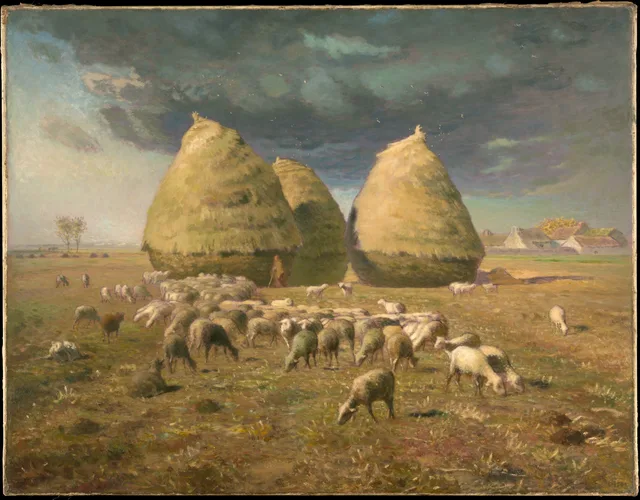
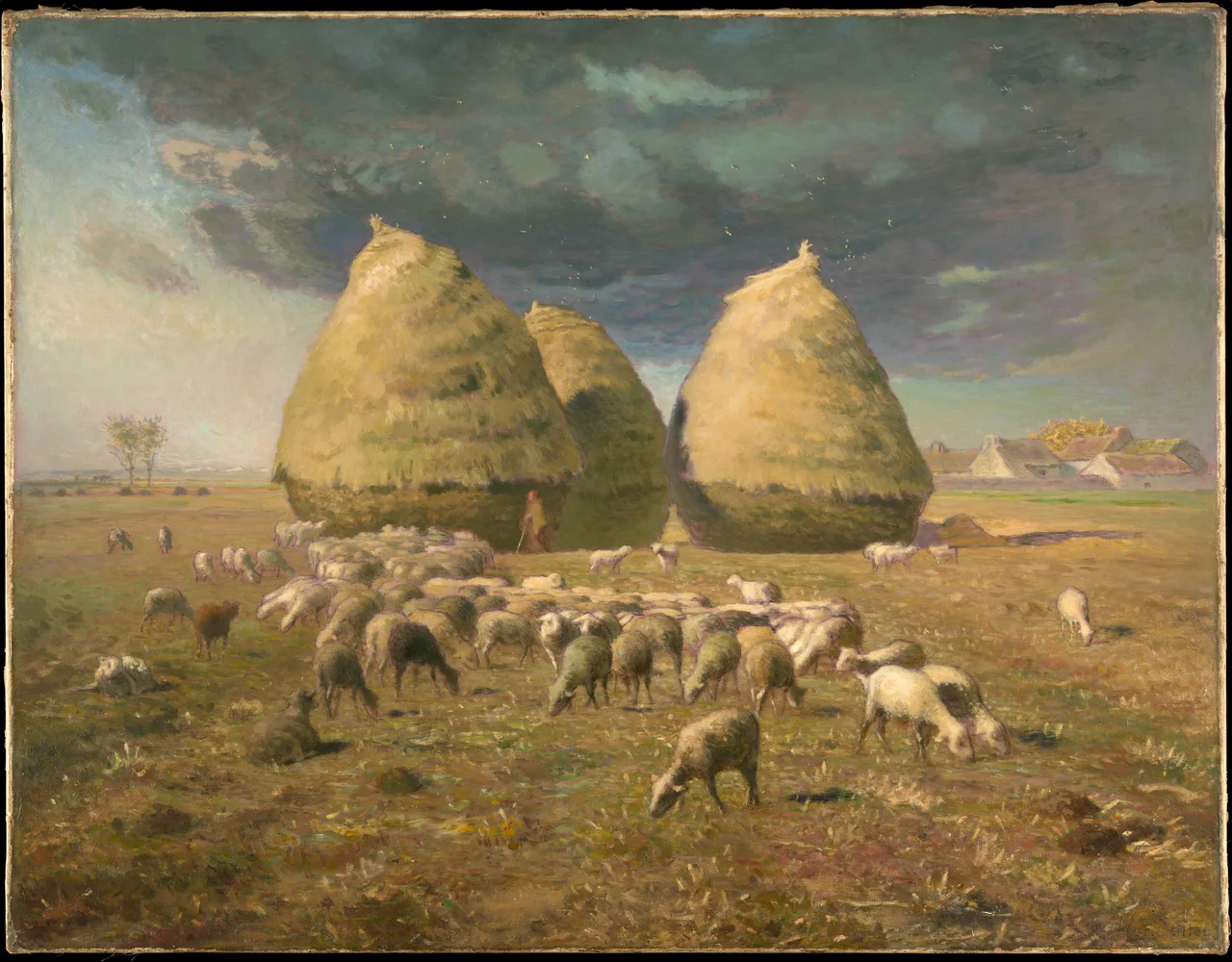
- Three huge haystacks stand in an autumn field while a flock of sheep grazes in front of them.
- Jean-François Millet, a French painter of farm life and farm work, made it around 1874.
- Dark clouds are rolling in, yet sunlight still falls on the hay, as if we are seeing the last bright moment before the rain.
Reading the picture
5 places to look closer
Tap a number on the painting to jump to its note, or a close-up to see that spot in the whole picture.
Zoom in on the shadow between the haystacks in the middle. A figure stands there leaning on a long staff. This is the shepherd watching the flock. Next to the giant stacks the person is so small that it is easy to miss them at first.
Look at the top of the haystack on the right. Dry grass has been twisted into a pointed knot at the peak. Around it, tiny white specks scatter across the dark sky. Are they birds, or bits of straw in the wind? The storm clouds are a heavy gray, mixed with touches of green and violet.
Zoom in on one sheep in the foreground. Its head is down in the grass, and it is far too busy eating to notice us. Millet dabbed its wool on with a thick brush, so it looks lumpy and solid, and a deep shadow lies across its back.
Move to the left. Among the white sheep, a single brown animal stands on its own. Below it, a dark animal lies down to rest. None of them face the same way, and that scattered, everyday mix makes the field feel alive.
Look far off to the right at the farm buildings. Behind their low roofs and white walls, a tree of yellow leaves flares up like a flame. That one patch of yellow is enough to tell you the season is autumn.
When it was painted
In 1868, Frédéric Hartmann, an industrialist from Alsace, gave Millet a big order: four paintings, one for each season of the year. Hartmann was also a patron of Millet's friend, the landscape painter Théodore Rousseau.
The Seasons stayed on Millet's easel, on and off, for about seven years. Life kept interrupting. When war broke out with Prussia in 1870, he took his family away from Barbizon to Cherbourg, in his home region of Normandy, and only later came back. This autumn scene dates from around 1874, near the end of the project.
By then Millet was approaching sixty and in poor health. He had finally won official honor, including the Legion of Honor in 1868, and in 1874 he was even asked to paint murals for the Panthéon in Paris. He never got to paint them. He died in Barbizon in January 1875.
Today the four Seasons live far apart. Spring is in the Musée d'Orsay in Paris, the buckwheat harvest of Summer is in the Museum of Fine Arts, Boston, and the woodcutters of Winter are in the National Museum in Cardiff, Wales. Autumn came to The Met in 1959 as a bequest from Lillian S. Timken.
The Met reads this as a field after the harvest is over: the gleaners have gone home, and only the sheep are left to graze. Look at the ground in front. The cut stubble is built up from many short strokes. Years after The Gleaners, Millet painted the same kind of field once the gleaning was done.
Questions to think about
- Look for itCan you find the shepherd standing in the shade of the haystacks?
- Why?Why do you think Millet made the person so small and put the haystacks right in the center?
- What about you?Someone cut and stacked all this hay by hand over the summer. How much do we really know about the farm work behind the food we eat today?
Same period
Painted around the same time,
somewhere else
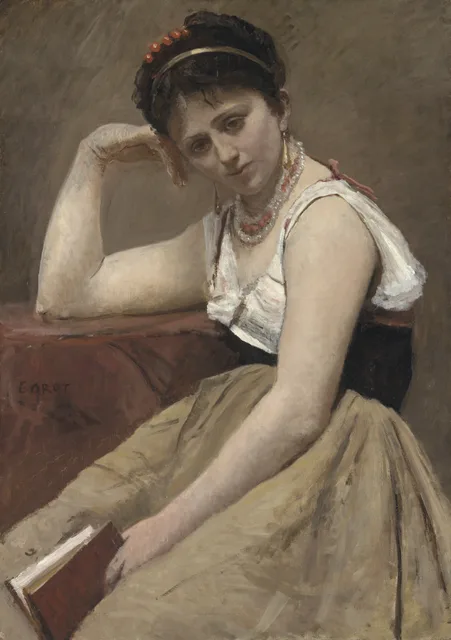 Interrupted ReadingCamille Corotc. 1870
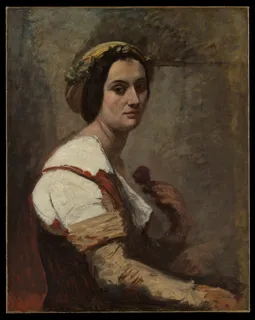 SibylleCamille Corotca. 1870
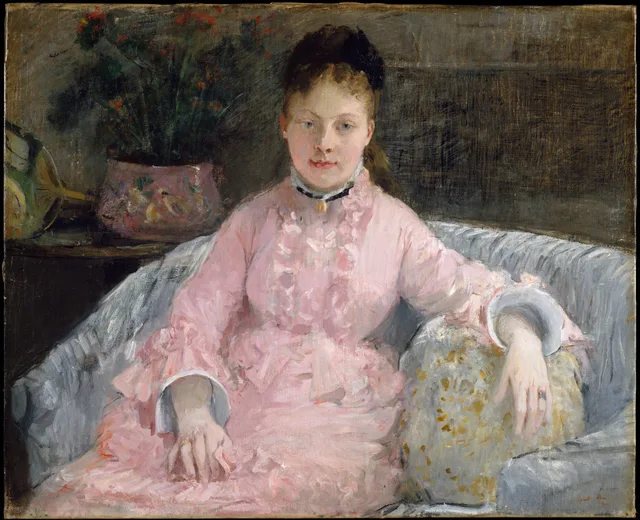 The Pink Dress (Albertie-Marguerite Carré, later Madame Ferdinand-Henri Himmes, 1854–1935)Berthe Morisotca. 1870
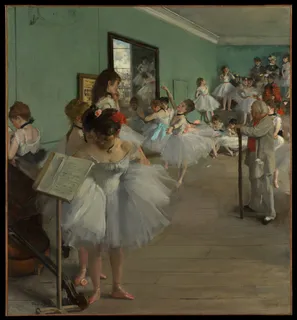 The Dance ClassEdgar Degas1874
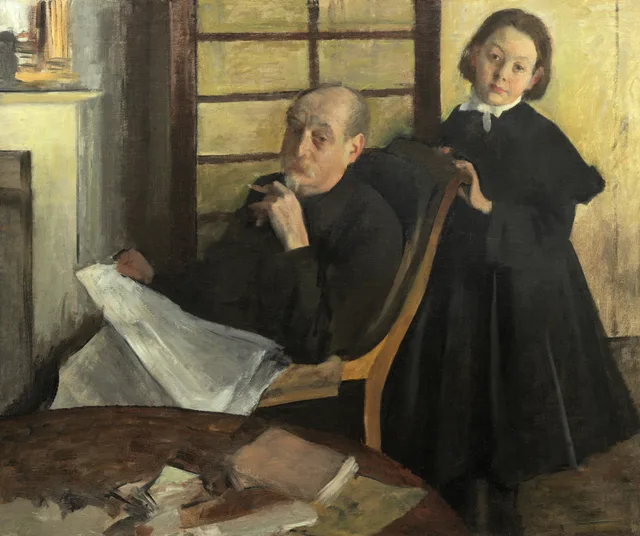 Henri Degas and His Niece Lucie Degas (The Artist's Uncle and Cousin)Edgar Degas1875–76
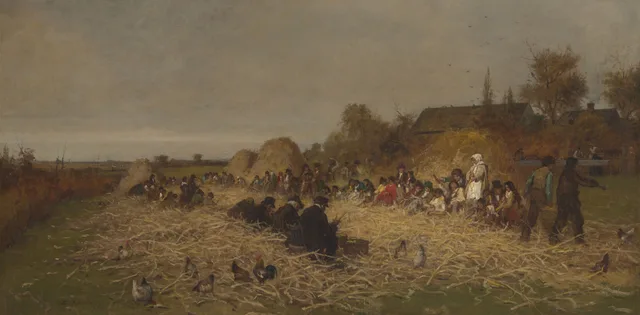 Husking Bee, Island of NantucketEastman Johnson1876
Too good to keep to yourself
This painting,
for someone who comes to mind
They open it at full size
and see every brushstroke.
About this work
- Artist
- Jean-François Millet · 1814–1875
- Date
- ca. 1874
- Medium
- Oil on canvas
- Size
- 85.1 × 110.2 cm
- Collection
- The Metropolitan Museum of Art
- Image
- Original long edge 3867px · shown at 2560px
- Original
- View on the museum's website ↗