 Pyeongye
Artwork · 19th century · Edgar Degas
LeoTurn on Magnifier at the lower right and move slowly across the painting.
Full screen opens it edge to edge.Tap the painting to fill the screen.
Spread two fingers to look closer.
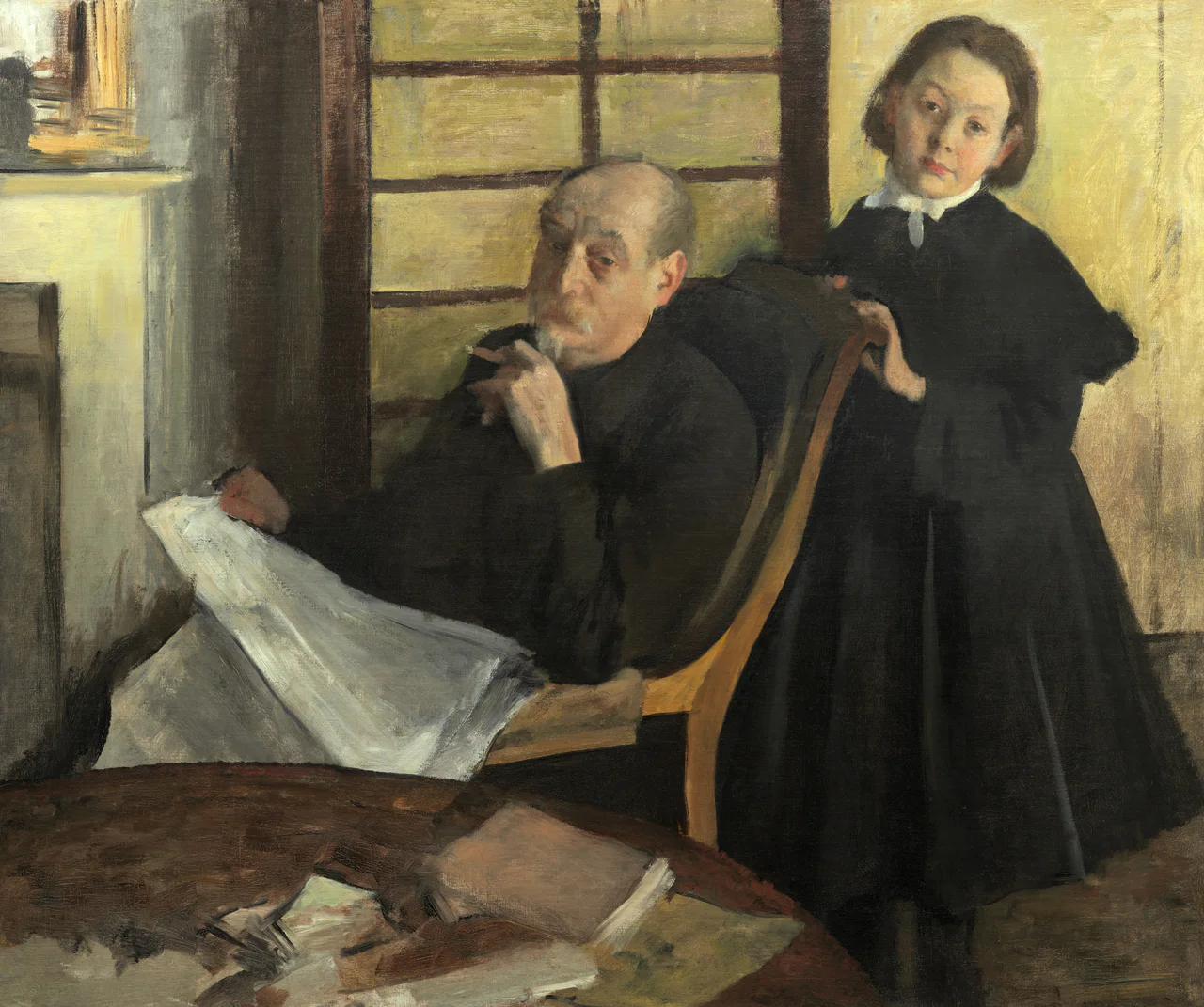
Henri Degas and His Niece Lucie Degas (The Artist's Uncle and Cousin)
Edgar Degas1875–76Oil on canvas99.8 × 119.9 cm
At a glance
- An old man with a newspaper and a young girl resting her hand on the back of his chair: Henri Degas and his niece Lucie.
- Painted by Edgar Degas in 1875–76. The sitters are the artist's own uncle and cousin.
- An orphaned child and the elderly relative now caring for her, still strangers to each other, shown through black mourning clothes and empty space.
Reading the picture
5 places to look closer
Tap a number on the painting to jump to its note, or a close-up to see that spot in the whole picture.
Start with Henri's face. His eyes are heavy and tired, and a cigarette sits between the fingers he holds to his chin. His gaze goes off to the front left, away from his niece. Is he lost in thought, or just worn out? The painting doesn't say.
Now zoom in on Lucie, at the upper right. She has a bob haircut and a white collar on her black dress, and her head tilts a little. She looks straight out at us. Her lips are pressed together. She is neither smiling nor crying.
Look at Lucie's hand. It rests lightly on the curved wooden back of her uncle's chair. Is she leaning on him, or keeping him at arm's length? That chair back also becomes a slanted line that splits the two of them apart.
Move left to the newspaper in Henri's hand. Degas built it from broad, quick strokes of white and gray, with not a single printed letter. The big open sheet seems to put one more layer between Henri and the girl beside him.
Zoom in on the table at the bottom. Brown strokes pile up roughly, and the papers on top never quite take shape. Thin paint and loose details like these suggest the picture was never finished. That means you can follow the path of the brush almost stroke by stroke.
When it was painted
In 1875 Degas, just past forty, spent four months in Naples. His father's side of the family lived there, and Italian relatives were nothing new to him. In his twenties he had painted his aunt's household in Florence in a large group portrait, The Bellelli Family.
This visit came in a hard season. His father had died the year before, in 1874. Afterward the family business turned out to be deep in debt, and for years Degas put his own money toward paying it off. That same spring of 1874, in Paris, he and his friends had opened the first Impressionist exhibition. A bold step for his art and a heavy loss at home landed in the same year.
The Naples house had its own mourning. Lucie, his young cousin, had lost both parents, and her elderly uncle Henri had taken her in. Degas seldom accepted portrait commissions. The people he chose to paint were mostly family and close friends, like these two.
The canvas was never finished, and it stayed with the family in Naples. It was still with them after Lucie grew up and became the Marchioness Guerrero de Balde. In 1926 it passed through the New York dealer Wildenstein to the Chicago collector Mrs. Lewis Larned Coburn, and in 1933 it entered the Art Institute of Chicago.
Now look again at the table at the bottom, piled with papers. The museum suggests that Degas painted from the far side of it, a third relative looking at the other two. A painter who had just lost his own father was standing right where we stand, looking at two people dressed in black.
Questions to think about
- Look for itHow many lines can you find in the picture that come between Henri and Lucie?
- Why?Why do you think Degas did not let the two of them look at each other?
- What about you?When a child suddenly loses their parents and goes to live with a relative they barely know, what kind of support should our communities offer today?
Same period
Painted around the same time,
somewhere else

Too good to keep to yourself
This painting,
for someone who comes to mind
They open it at full size
and see every brushstroke.
About this work
- Artist
- Edgar Degas · 1834–1917
- Date
- 1875–76
- Medium
- Oil on canvas
- Size
- 99.8 × 119.9 cm
- Culture
- France
- Collection
- The Art Institute of Chicago
- Image
- Original long edge 7182px · shown at 2560px
- Original
- View on the museum's website ↗