 Pyeongye
Artwork · 19th century · Eastman Johnson
LeoTurn on Magnifier at the lower right and move slowly across the painting.
Full screen opens it edge to edge.Tap the painting to fill the screen.
Spread two fingers to look closer.
At a glance
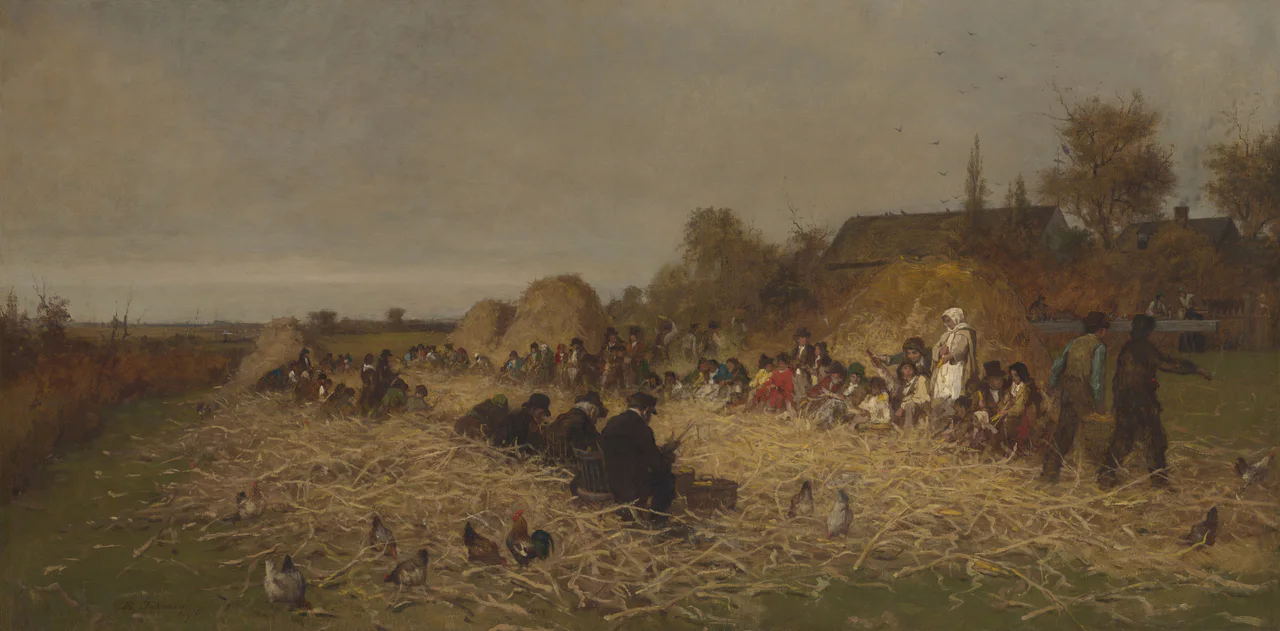
- Neighbors gather in an autumn field to strip the husks from a harvest of corn together.
- The American painter Eastman Johnson painted it in 1876, the hundredth year of the United States, on the island of Nantucket in Massachusetts.
- The canvas is about twice as wide as it is tall, and it holds dozens of lives: old people, adults, children, and even chickens.
Reading the picture
5 places to look closer
Tap a number on the painting to jump to its note, or a close-up to see that spot in the whole picture.
Zoom in among the crowd, right of center. A young woman stretches her arm out and holds up an ear of red corn. The Art Institute of Chicago explains that, by folk tradition, whoever found a red ear could kiss the person of their choice. Someone just below her tips his head back to look up at it.
Look at the figures in dark clothes near the front, in the middle. A white-haired man on a spindle-back chair and men in hats bend their heads over their work. Their backs are turned, so we barely see a face. Compared with the bright, noisy crowd behind them, they form a quiet, dark cluster.
Zoom in on the pile of stalks near the bottom. A rooster stands with his red comb up and his tail flashing green. Beside him a brown hen dips her head to peck at fallen kernels. Among the husks the people have tossed aside, the chickens are having a feast of their own.
Look at the two men walking away on the right. Their backs are to us, and they carry a big basket between them. One wears a vest over a blue shirt. The brushwork here is rough and fast, so they seem to be in motion.
Zoom in on the sky at the upper right. A flock of birds crosses the gray sky, and a few have settled on a rooftop. A thin, pointed tree shoots up in front of the house. The farmhouse beyond the field tells us where this gathering is taking place.
When it was painted
In 1876 Johnson was a well-known painter just past fifty. As a young man he had studied art in Düsseldorf, Germany, and in The Hague, in the Netherlands. Back in New York, he made his name with paintings of everyday American life.
In the 1870s he spent his summers on Nantucket, an island that had grown rich on whaling. Year after year he painted its people and its landscape. Island work such as corn husking and the cranberry harvest became some of his biggest subjects.
He worked toward this canvas in stages. A study called Corn Husking at Nantucket, from around 1875, now at the Metropolitan Museum of Art, is thought to be his final study for this painting.
That year the United States turned one hundred. The Art Institute explains that as factories and cities spread quickly, scenes of rural neighbors working side by side stirred a longing for an earlier time. The painting hung in the 1876 exhibition of the National Academy of Design in New York, and it went to the Centennial Exhibition in Philadelphia that same year. In 1878 it was shown at the Paris Universal Exposition.
In 1922 the brothers Honoré and Potter Palmer, of the Chicago Palmer family, gave the painting to the Art Institute of Chicago. Look again at the young woman holding up the red ear. In a country marking its first hundred years, Johnson hung this small bit of mischief right in the middle of the party.
The painter
Eastman Johnson
1824–1906
When painting this, the artist was about 52 years old
All paintings by Eastman Johnson →Questions to think about
- Look for itHow many people can you find holding a yellow ear of corn?
- Why?Why do you think Johnson put chickens and corn stalks, not people, in the spot closest to us?
- What about you?Neighbors once gathered to finish one family's work together. In your neighborhood today, what kinds of shared work are still left, and what has disappeared?
Same period
Painted around the same time,
somewhere else
Too good to keep to yourself
This painting,
for someone who comes to mind
They open it at full size
and see every brushstroke.
About this work
- Artist
- Eastman Johnson · 1824–1906
- Date
- 1876
- Medium
- Oil on canvas
- Size
- 69.6 × 138.2 cm
- Culture
- Nantucket Island
- Collection
- The Art Institute of Chicago
- Image
- Original long edge 16047px · shown at 2560px
- Original
- View on the museum's website ↗