 Pyeongye
Artwork · 16th century · Bernard van Orley
LeoTurn on Magnifier at the lower right and move slowly across the painting.
Full screen opens it edge to edge.Tap the painting to fill the screen.
Spread two fingers to look closer.
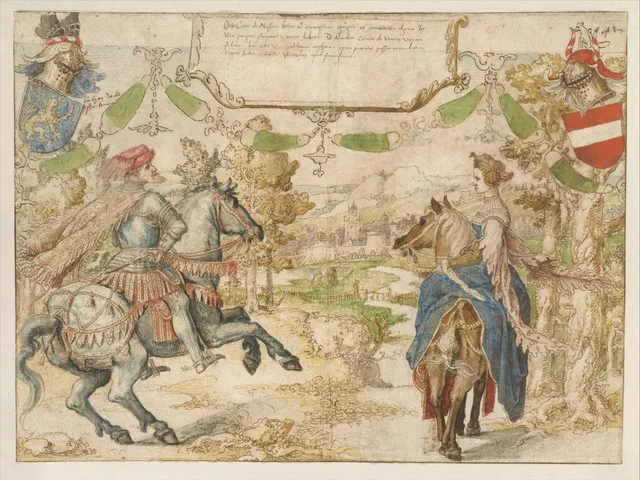
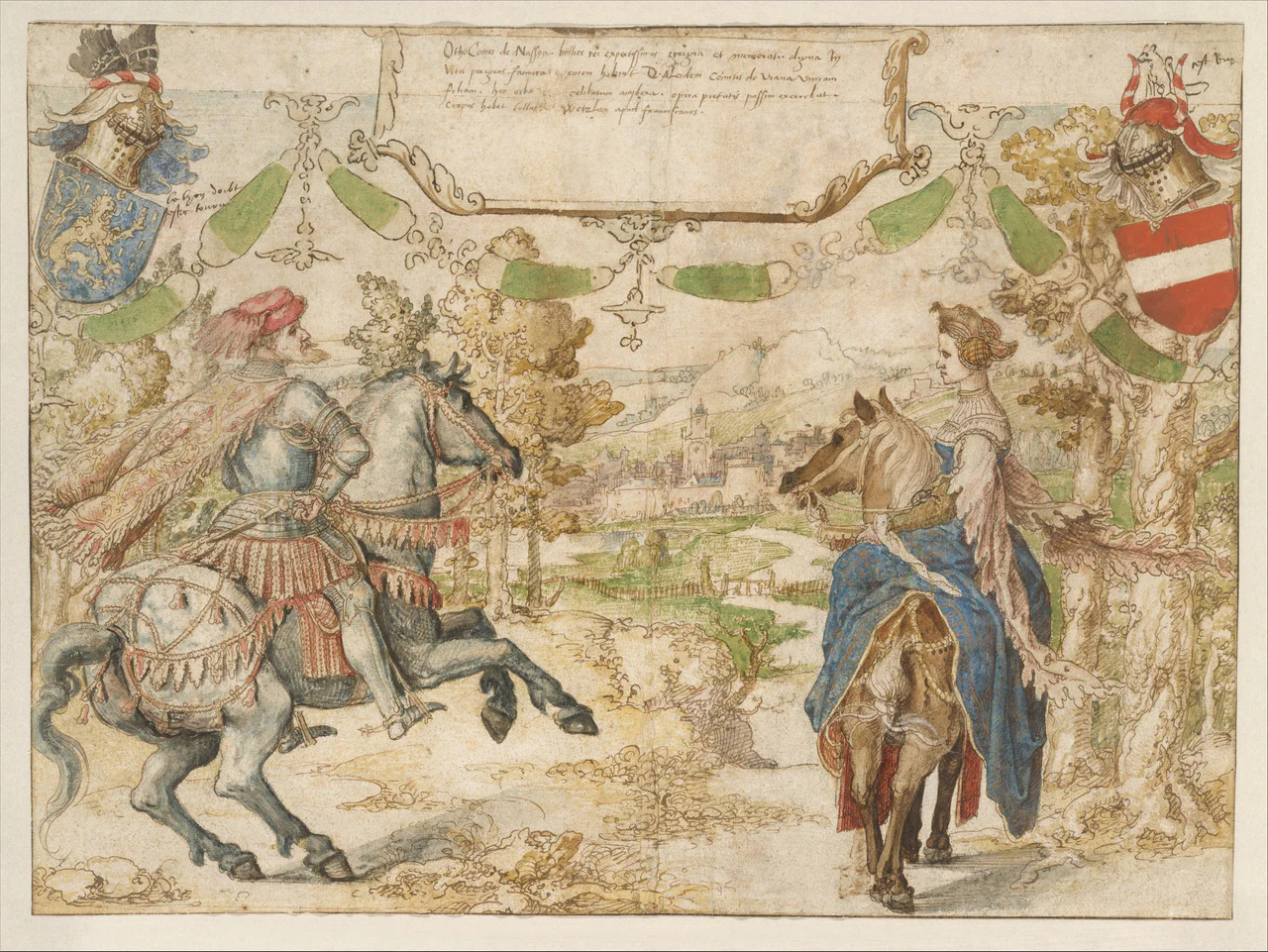
Otto, Count of Nassau and his Wife Adelheid van Vianen
Bernard van Orley1530–35Pen and brown ink, watercolor over black chalk (recto); tracing in black chalk of the figures on the recto (verso)35.6 × 48.3 cm
At a glance
- Count Otto of Nassau, in armor, and his wife Adelheid face each other on horseback in an open landscape.
- Bernard van Orley, a painter in Brussels, drew it in pen and brown ink with watercolor around 1530–35.
- It is a design for a tapestry series a noble family ordered to honor its ancestors. The tapestries are gone, and drawings like this one are what remain.
Reading the picture
5 places to look closer
Tap a number on the painting to jump to its note, or a close-up to see that spot in the whole picture.
Zoom in on the writing at the top. The first words, in Latin, read Otho Comes de Nassou, Otto, Count of Nassau. The second line names his wife Adelheid, and the last line mentions Wetzlar, a town near Frankfurt. The drawing tells you who these people are before you even look at them.
Look at the knight on the left. Otto wears a red cap and a beard, and he lifts his head toward his wife. Each joint of the armor at his shoulder and elbow is drawn line by line in brown ink. His gray horse rears up, front legs high, twisting its body.
Zoom in on Adelheid. She wears golden, net-like coils over her ears and a pleated collar right up to her chin. Her profile is upright and calm as she faces her husband. Her brown horse stands far more quietly than his.
Look at the shield in the top left corner. A golden lion rears up on a blue field, with a helmet set on top. Next to the shield someone has written a small note in French. In the opposite corner, a shield striped red and white makes the pair.
Zoom in on the castle in the distance between the two riders. Towers, walls and roofs are drawn in fine pen lines, touched with pale violet and blue. Green fields and trees spread below. Your eye travels out past the riders into the far landscape.
When it was painted
At the end of the 1520s, Count Henry III of Nassau placed a large order with Bernard van Orley in Brussels. Henry was a close advisor to Emperor Charles V. He wanted designs for eight tapestries celebrating the ancestors of his house. Count Otto in this drawing was one of his fourteenth-century forebears.
Van Orley was in his late thirties and one of the leading painters in Brussels. He served as court painter to two successive regents of the Habsburg Netherlands. He was also a sought-after tapestry designer, and in these same years he designed the hunting tapestries known as the Hunts of Maximilian.
Those years were not all smooth. In 1527 he was put on trial for heresy for listening to Lutheran sermons. Some of those tried with him were weavers.
The Nassau tapestries were woven in Brussels in the workshop of Willem de Moyen. According to the Metropolitan Museum, they were probably destroyed in a fire in 1760. This drawing and six others are now the only record of the commission.
This sheet came to light only shortly before the Met bought it in 1995. On the back, someone traced the figures from the front in black chalk.
Look again at the empty frame and green garlands across the top. A woven picture big enough to cover a wall began here, on a single sheet of paper.
Questions to think about
- Look for itHow are the two horses moving differently?
- Why?Why do you think the names and story of this couple were written right across the top of the design?
- What about you?Count Henry wanted ancestors from two centuries earlier woven into giant tapestries. If you wanted to keep your family's history today, how would you do it?
Same period
Painted around the same time,
somewhere else
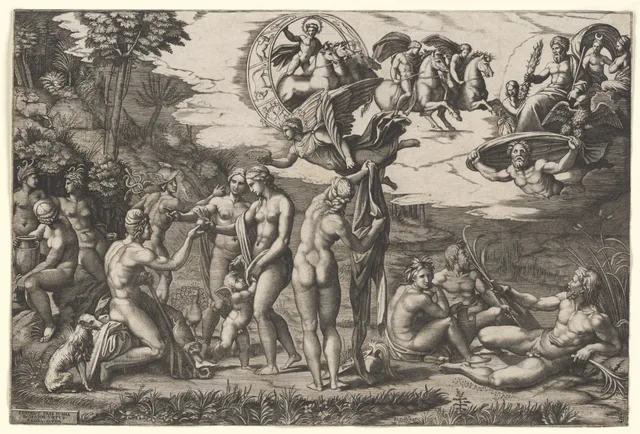 The Judgment of Paris: he is sitting at left with Venus, Juno and Pallas Athena, a winged victory above. In the upper section the Sun in his chariot preceeded by Castor and Pollux on horseback, at lower right two river gods and a naiad above whom Jupiter, an eagle, Ganymede, Diana and another goddessMarcantonio Raimondica. 1510–20
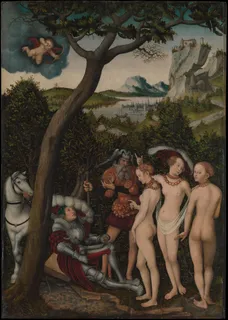 The Judgment of ParisLucas Cranach the Elderca. 1528
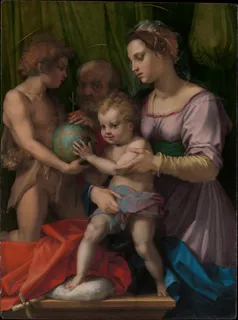 The Holy Family with the Young Saint John the BaptistAndrea del Sartoca. 1528
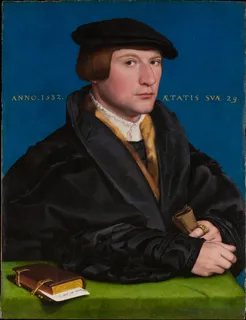 Hermann von Wedigh III (died 1560)Hans Holbein the Younger1532
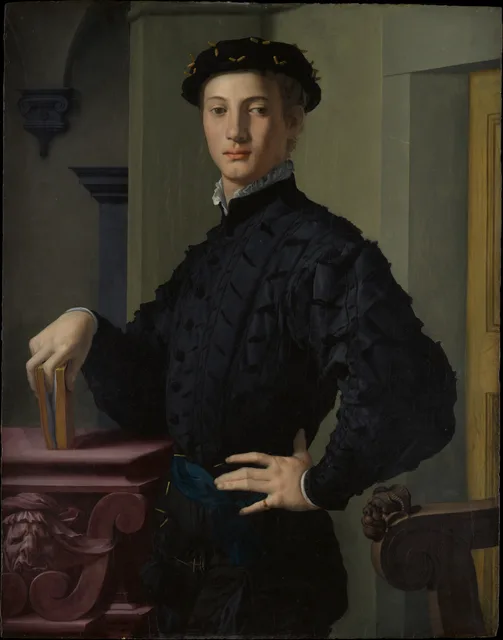 Portrait of a Young ManBronzino1530s
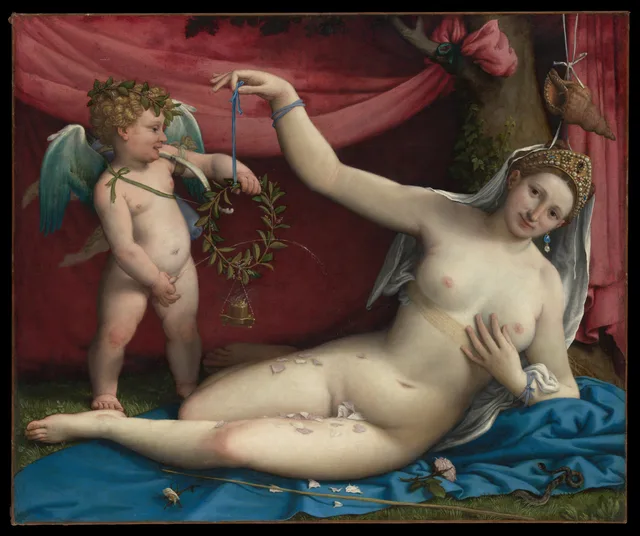 Venus and CupidLorenzo Lotto1520s
Too good to keep to yourself
This painting,
for someone who comes to mind
They open it at full size
and see every brushstroke.
About this work
- Artist
- Bernard van Orley · 1492–1542
- Date
- 1530–35
- Medium
- Pen and brown ink, watercolor over black chalk (recto); tracing in black chalk of the figures on the recto (verso)
- Size
- 35.6 × 48.3 cm
- Collection
- The Metropolitan Museum of Art
- Image
- Original long edge 3811px · shown at 2560px
- Original
- View on the museum's website ↗