 Pyeongye
Artwork · 16th century · Hans Holbein the Younger
LeoTurn on Magnifier at the lower right and move slowly across the painting.
Full screen opens it edge to edge.Tap the painting to fill the screen.
Spread two fingers to look closer.
At a glance
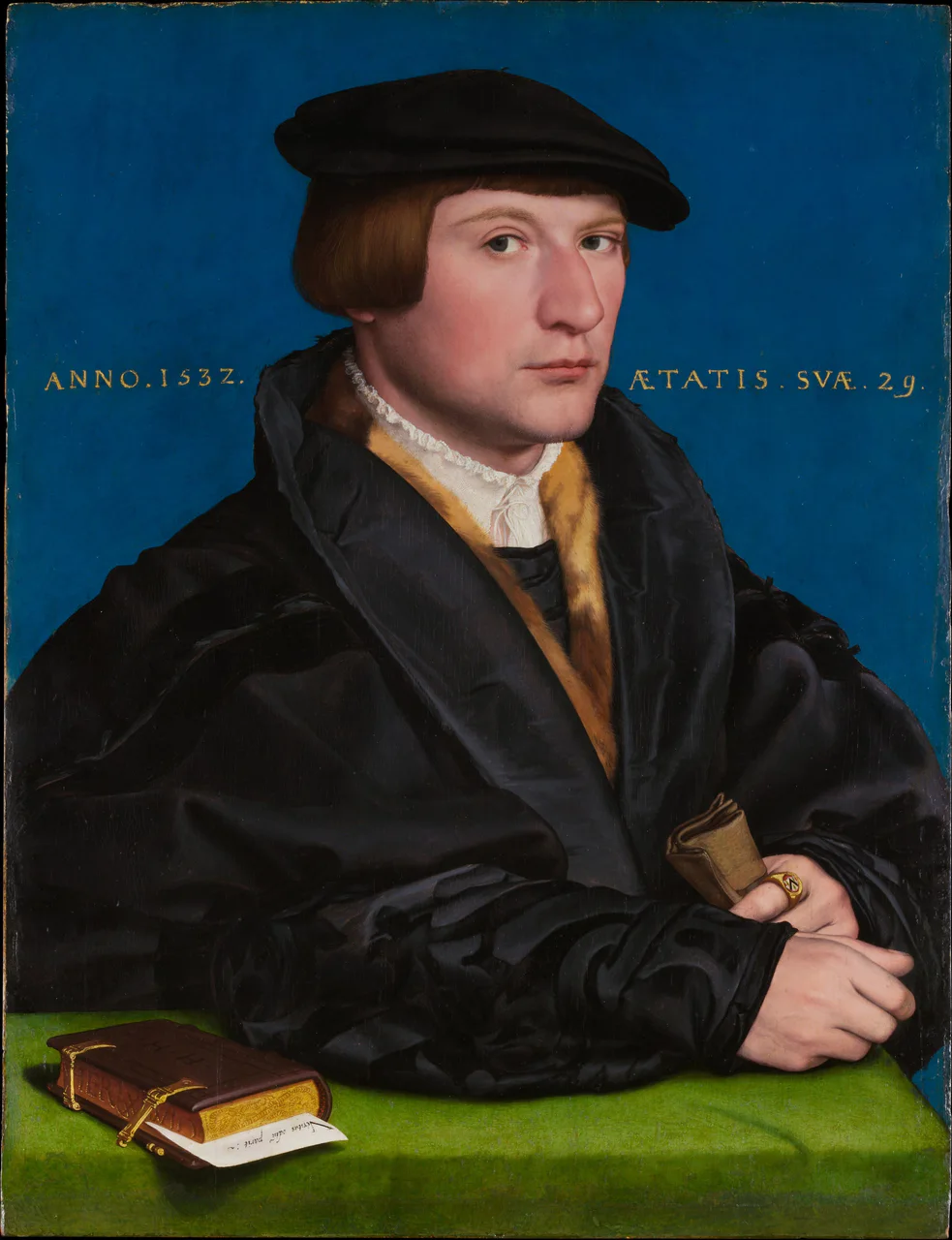
- A young man in a black cap and a fur-lined coat rests his arms on a green table and turns his eyes toward us.
- Hans Holbein the Younger painted him in London in 1532. The sitter is Hermann von Wedigh III, a German merchant, and the picture is oil on an oak panel.
- The panel is only about a foot wide, yet it holds a ring, gloves, a book, and a note, each one telling us something about this man.
Reading the picture
4 places to look closer
Tap a number on the painting to jump to its note, or a close-up to see that spot in the whole picture.
Zoom in on the face. The eyes slide a little to the side, and the lips are pressed shut. Straight-cut brown bangs cover the forehead, and a tiny ruffle trims the shirt collar. The paint is so smooth that you can hardly find a single brushstroke.
Look at the gold letters on the blue background at the right. In Latin they say that he was 29 years old. On the left, in the same gold, is the year 1532. The museum lists the materials of this picture as oil paint and gold.
Zoom in on the hands at the lower right. One hand holds a pair of folded leather gloves, and a fat gold ring sits on a finger. The round face of the ring shows a coat of arms with a pointed black shape like a mountain peak.
Zoom in on the book at the lower left. A slip of paper sticks out between its gilded pages. On it, in Latin, are the words "Veritas odium parit," which means truth breeds hatred. The line comes from a comedy by the Roman playwright Terence.
When it was painted
In 1532 Holbein came to London for the second time. He was about thirty-five. He had left his wife and young children behind in Basel. The Reformation had swept through that city, church images had been smashed, and orders for altarpieces had all but dried up.
He knew the way. On his first visit, in 1526, he carried a letter of introduction from the scholar Erasmus and found a welcome in the household of Thomas More, whose family he painted. Erasmus wrote to a friend that the arts were freezing in Basel and that the painter was off to England to earn some money. But in 1532 More resigned as Lord Chancellor and stepped away from court.
Holbein found new clients in the German merchants of the Steelyard, the Hanseatic trading base on the Thames. They spoke his language. Over that year and the next he painted them one by one, and they also hired him to paint two large allegories for their guildhall, The Triumph of Riches and The Triumph of Poverty.
Who is this young man? The coat of arms on his ring belongs to the Wedigh family of Cologne. The gold letters say he was twenty-nine in 1532. Putting those clues together, the Met identifies him as probably Hermann von Wedigh III, a member of the London Steelyard.
There is a second Holbein portrait of a Wedigh man, dated a year later, in Berlin. In the eighteenth century both panels were in the Schönborn collection in Vienna. This one later came to the Metropolitan Museum as a bequest of the New York collector Edward S. Harkness.
Look again at the ring. His name appears nowhere in the picture. A coat of arms smaller than a fingernail is what lets us know him, almost five hundred years later.
The painter
Hans Holbein the Younger
1497–1543
When painting this, the artist was about 35 years old
All paintings by Hans Holbein the Younger →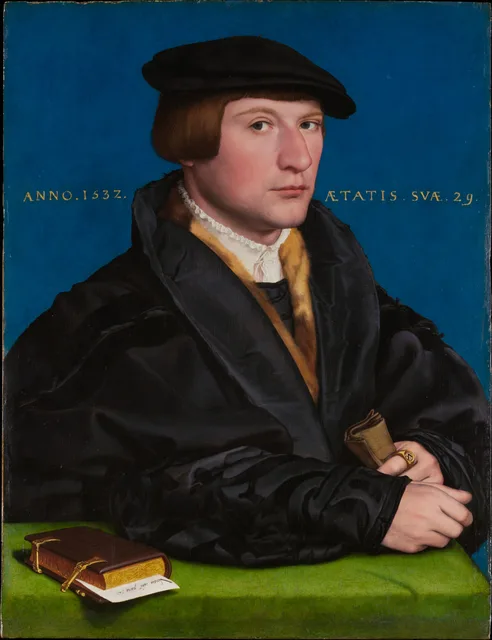
Questions to think about
- Look for itOn the blue background at the left, can you find and read the year the picture was made?
- Why?Why would a merchant choose the words "truth breeds hatred" to put into his own portrait?
- What about you?This man introduced himself through a ring, a book, and a note. If you could put just one object into your profile picture to show who you are, what would it be?
Same period
Painted around the same time,
somewhere else
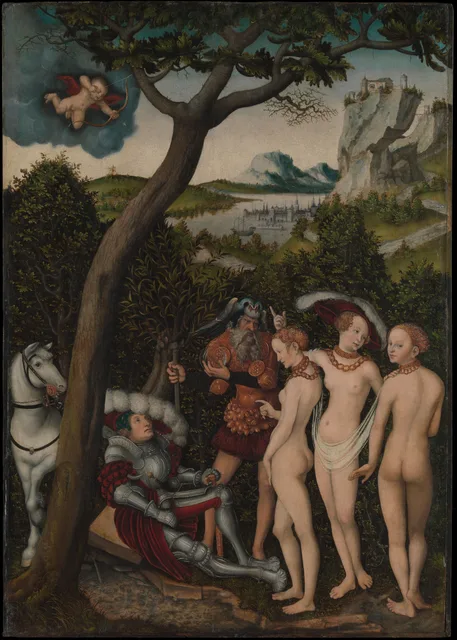 The Judgment of ParisLucas Cranach the Elderca. 1528
 The Holy Family with the Young Saint John the BaptistAndrea del Sartoca. 1528
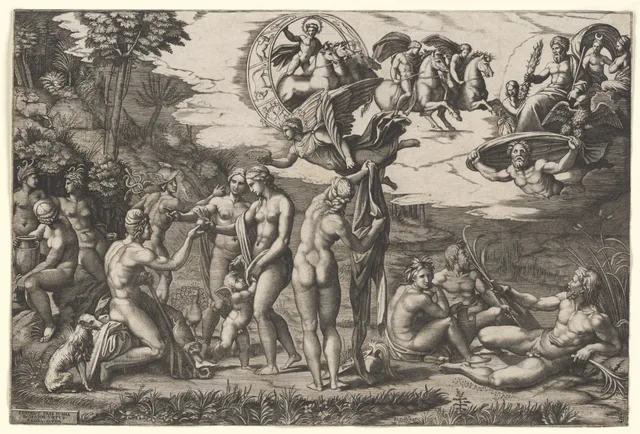 The Judgment of Paris: he is sitting at left with Venus, Juno and Pallas Athena, a winged victory above. In the upper section the Sun in his chariot preceeded by Castor and Pollux on horseback, at lower right two river gods and a naiad above whom Jupiter, an eagle, Ganymede, Diana and another goddessMarcantonio Raimondica. 1510–20
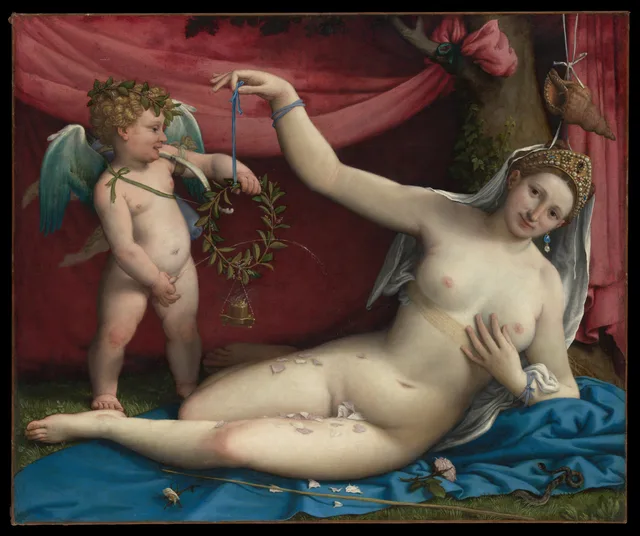 Venus and CupidLorenzo Lotto1520s
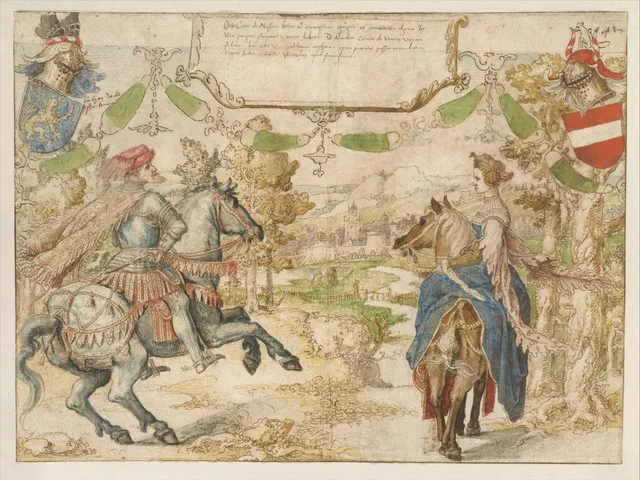 Otto, Count of Nassau and his Wife Adelheid van VianenBernard van Orley1530–35
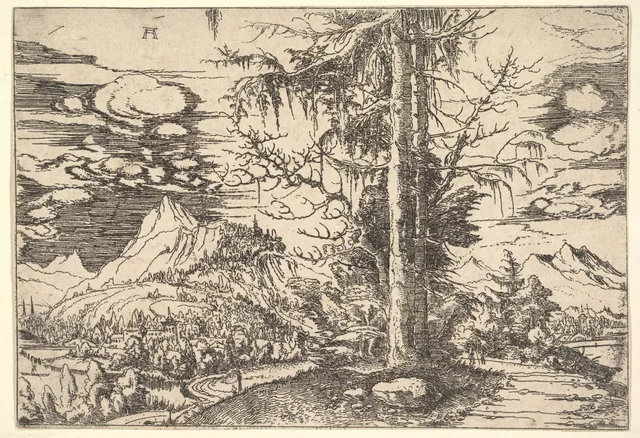 Landscape with a Double SpruceAlbrecht Altdorferca. 1521–22
Too good to keep to yourself
This painting,
for someone who comes to mind
They open it at full size
and see every brushstroke.
About this work
- Artist
- Hans Holbein the Younger · 1497–1543
- Date
- 1532
- Medium
- Oil and gold on oak
- Size
- 42.2 × 32.4 cm
- Collection
- The Metropolitan Museum of Art
- Image
- Original long edge 3813px · shown at 2560px
- Original
- View on the museum's website ↗