 Pyeongye
Artwork · 16th century · Lucas Cranach the Elder
LeoTurn on Magnifier at the lower right and move slowly across the painting.
Full screen opens it edge to edge.Tap the painting to fill the screen.
Spread two fingers to look closer.
At a glance
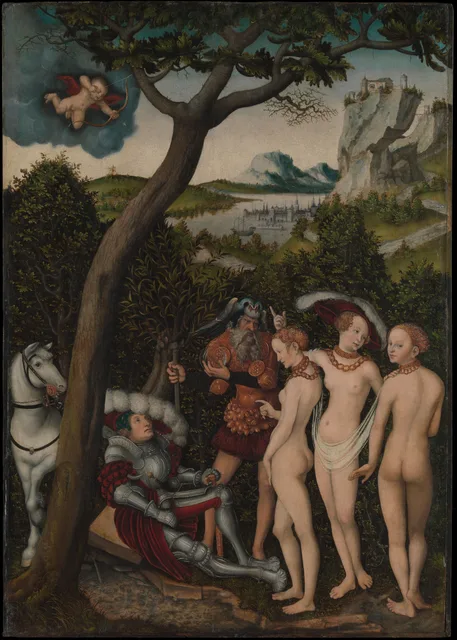
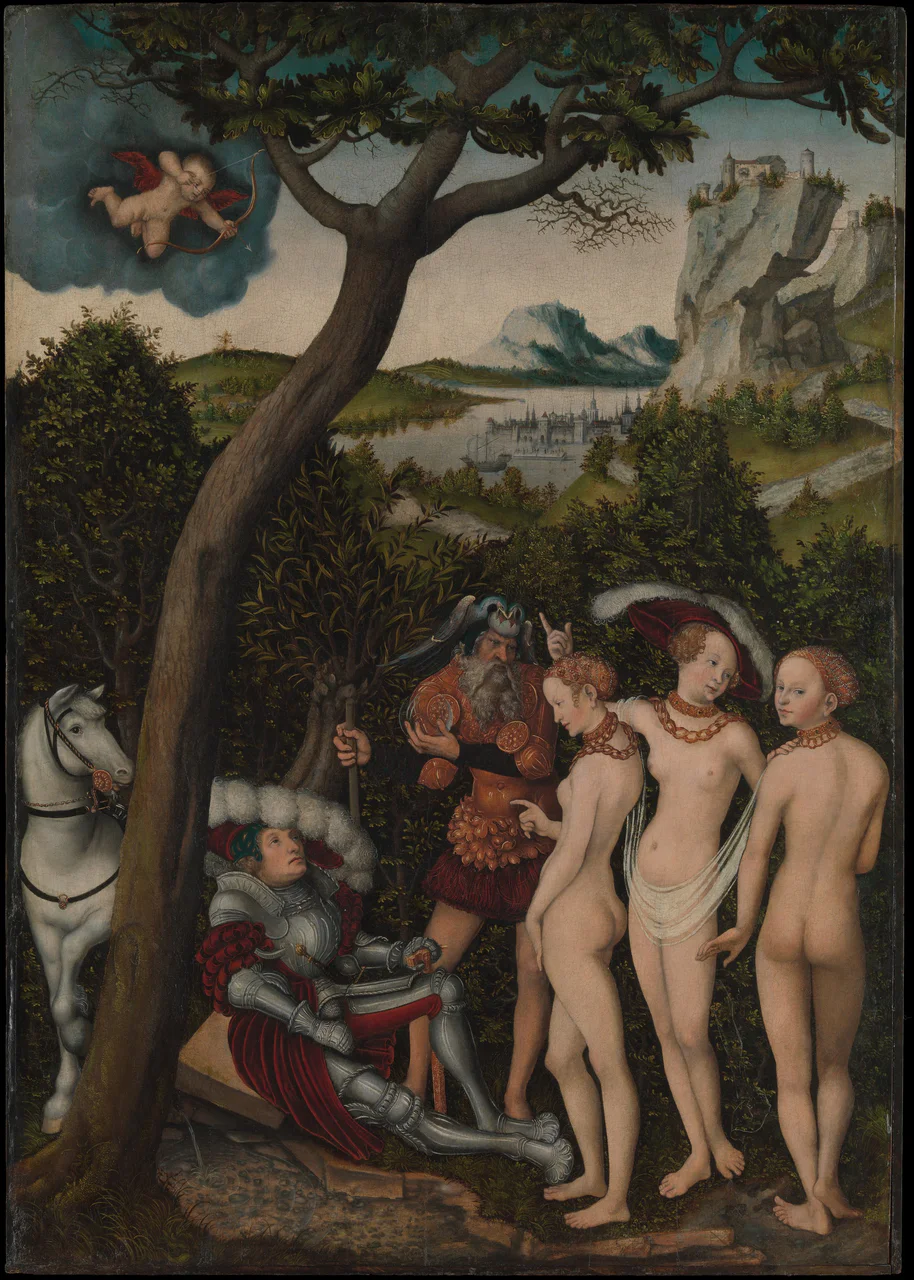
- A young man in armor sits under a tree, a bearded old man stands beside him, and three goddesses wait on the right. It is the Judgment of Paris from Greek myth.
- Lucas Cranach the Elder, court painter in Saxony, painted it around 1528, in oil on a beech wood panel.
- The story is ancient Greek, but the men are dressed like German knights of Cranach's own day, and the goddesses wear the jewelry of his court ladies.
Reading the picture
5 places to look closer
Tap a number on the painting to jump to its note, or a close-up to see that spot in the whole picture.
Zoom in on the young man in armor at the lower left. Over his shining silver armor he wears a red hat piled with white plumes. This is Paris, prince of Troy. He sits sprawled on the ground, gazing upward with a dazed look.
Now look at the bearded old man behind him. He is Mercury, messenger of the gods. His red armor is studded with round ornaments, and in one hand he holds a clear ball that looks like glass. In the myth, the prize for the most beautiful goddess was a golden apple. Here this clear ball stands in its place.
Zoom in on the necks and heads of the goddesses. The one in the middle wears a huge red hat trimmed with a feather, and around her neck she layers a jeweled collar and a heavy gold chain. Her curly hair is painted strand by strand. They wear almost nothing, yet their jewelry is as rich as a German noblewoman's.
Look up into the sky at the top left. A baby Cupid with red wings hovers in a cloud, drawing his bow. The story already tells us where love's arrow will land. Paris is about to choose Venus, the goddess of love.
Zoom in on the lakeside town in the distance. A walled town bristling with pointed towers sits on the water, and a sailing ship floats in front of it. On top of the rock to the right stands a castle. This looks less like Greece than like somewhere in Germany.
When it was painted
Around 1528, Cranach was in his mid-fifties. Since 1505 he had worked in Wittenberg as court painter to the Electors of Saxony. In 1508 the Elector granted him a coat of arms with a winged serpent, and that little snake became his signature.
By now Cranach was much more than a painter. In Wittenberg he ran a pharmacy, sold wine, and had a hand in printing books. He was also close to Martin Luther, who lived in the same town. In 1525 he stood as a witness at Luther's wedding, and the next year he became godfather to Luther's first son.
His big workshop, staffed by many assistants, turned out paintings at a remarkable pace. The same studio that produced portrait after portrait of Luther the reformer also made the mythological nudes the court enjoyed. Several versions of the Judgment of Paris came out of it.
So why is this Paris sitting on the ground in a suit of armor? Cranach followed not the Greek myth but a Trojan tale that was widely read in the Middle Ages. In Guido delle Colonne's version, Paris is a knight out hunting. He ties his horse to a tree and falls asleep, and Mercury appears in his dream with the three goddesses.
Cranach later served as mayor of Wittenberg, and he died in Weimar in 1553. The Metropolitan Museum bought this panel in 1928. Look at Paris's face once more. That dazed, upward gaze looks a lot like someone caught halfway between sleeping and waking.
Questions to think about
- Look for itCan you find the white horse peeking out from behind the tree?
- Why?Why do you think Cranach dressed these Greek gods and heroes in the armor, hats and gold chains of his own time and place?
- What about you?Paris chose the goddess who promised him a reward, and his choice started a war. Why is it a problem today when a judge or voter picks the side that offers them something?
Same period
Painted around the same time,
somewhere else
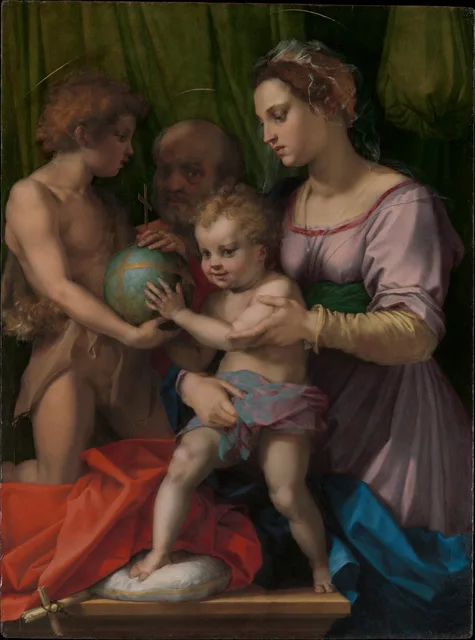 The Holy Family with the Young Saint John the BaptistAndrea del Sartoca. 1528
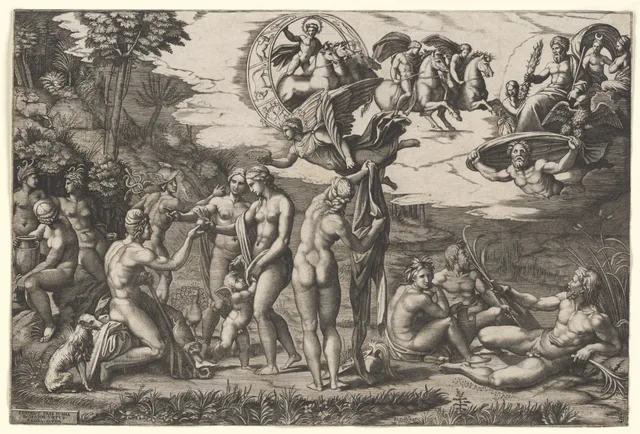 The Judgment of Paris: he is sitting at left with Venus, Juno and Pallas Athena, a winged victory above. In the upper section the Sun in his chariot preceeded by Castor and Pollux on horseback, at lower right two river gods and a naiad above whom Jupiter, an eagle, Ganymede, Diana and another goddessMarcantonio Raimondica. 1510–20
 Hermann von Wedigh III (died 1560)Hans Holbein the Younger1532
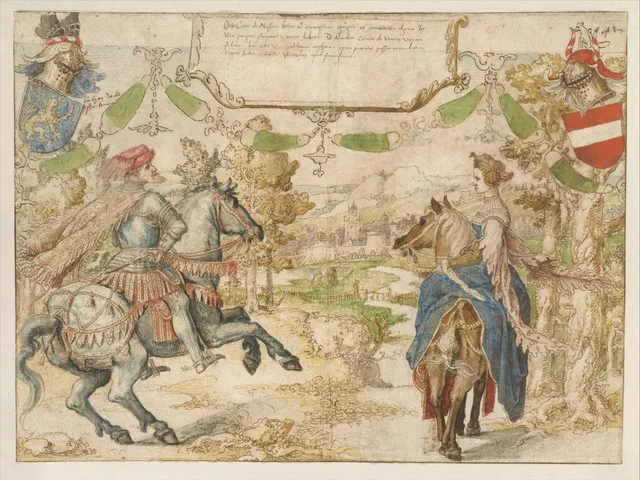 Otto, Count of Nassau and his Wife Adelheid van VianenBernard van Orley1530–35
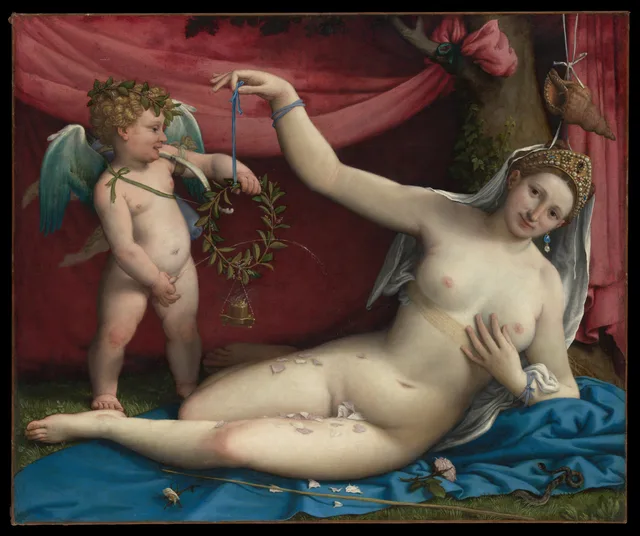 Venus and CupidLorenzo Lotto1520s
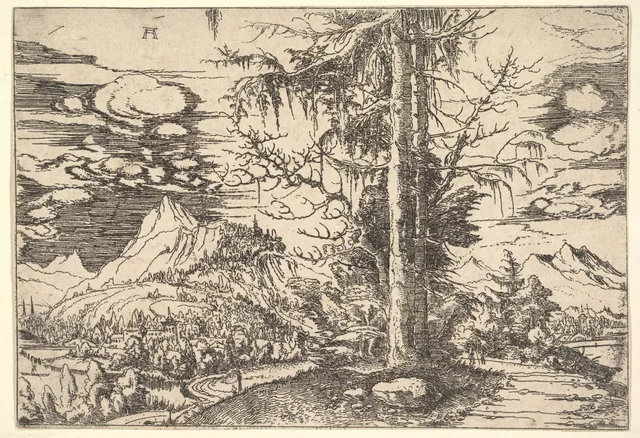 Landscape with a Double SpruceAlbrecht Altdorferca. 1521–22
Too good to keep to yourself
This painting,
for someone who comes to mind
They open it at full size
and see every brushstroke.
About this work
- Artist
- Lucas Cranach the Elder · 1472–1553
- Date
- ca. 1528
- Medium
- Oil on beech
- Size
- 101.9 × 71.1 cm
- Collection
- The Metropolitan Museum of Art
- Image
- Original long edge 3876px · shown at 2560px
- Original
- View on the museum's website ↗