 Pyeongye
Artwork · 20th century · Horace Pippin
LeoTurn on Magnifier at the lower right and move slowly across the painting.
Full screen opens it edge to edge.Tap the painting to fill the screen.
Spread two fingers to look closer.
At a glance
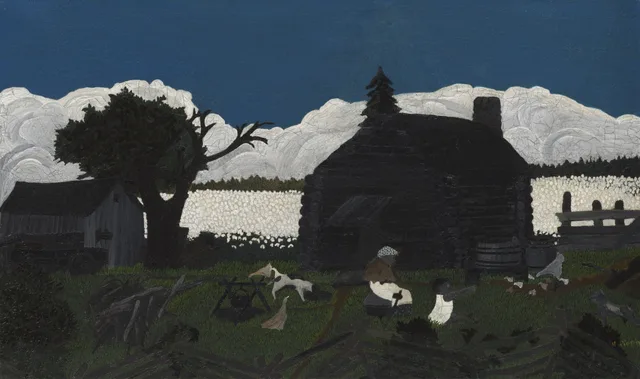
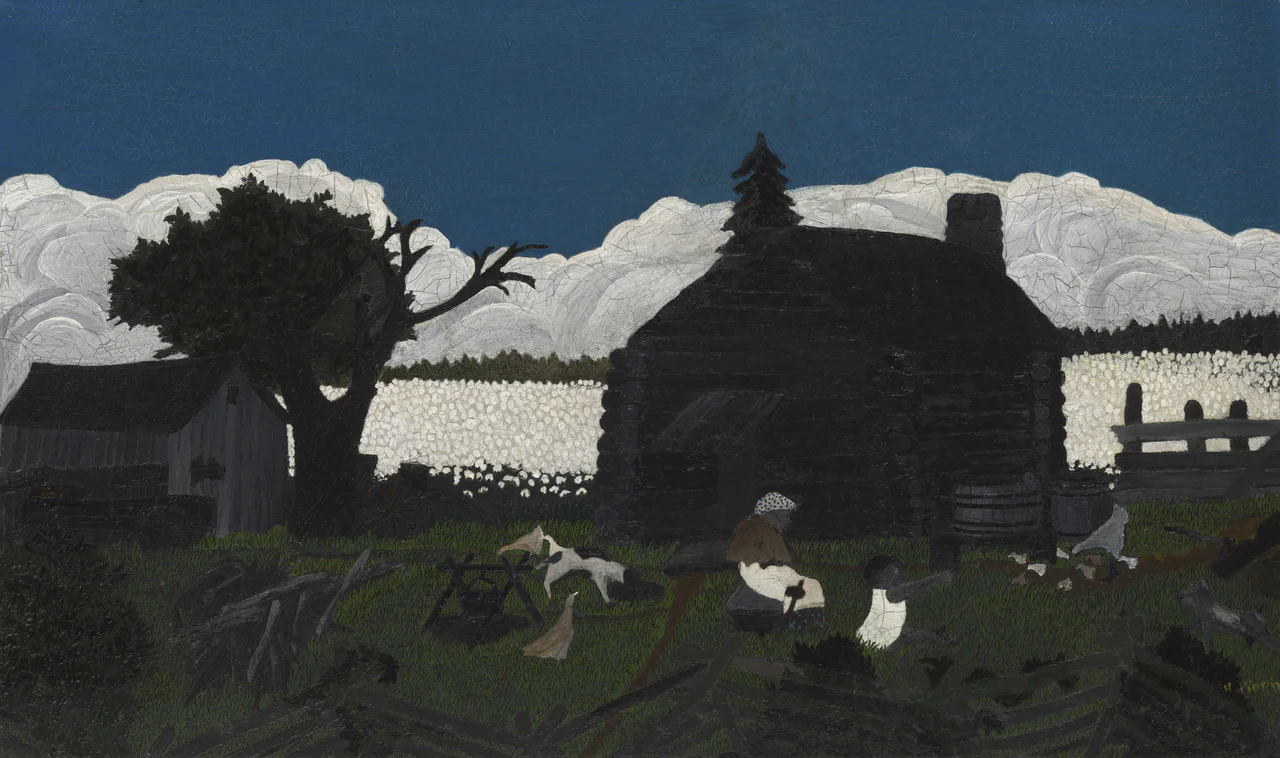
- In front of a log cabin in the American South, an older woman looks after a small child, and a white cotton field stretches out behind them.
- Horace Pippin, a self-taught American painter, made it in oil on cotton cloth around 1931–37.
- In 1937 it hung in a shoe repair shop near Philadelphia, where it caught people's attention and helped launch the painter's career.
Reading the picture
5 places to look closer
Tap a number on the painting to jump to its note, or a close-up to see that spot in the whole picture.
Zoom in on the cotton field behind the cabin. Each white boll is a separate blob of paint, so the field looks bumpy enough to touch. The museum notes that this wide field calls to mind the hard work of picking it, probably by members of the family.
Look at the two figures in front of the cabin. A woman in a blue polka-dot headscarf and a brown shawl sits in the grass. Beside her stands a small child in white. Their faces are painted so dark they almost vanish, while the white clothes glow against the deep green grass.
Zoom in on the left side of the yard. A white dog with black patches lowers its head, and two brown hens stand nearby. To the left, a black pot hangs from a frame of crossed sticks. Every blade of grass is a single upright stroke of green.
Look at the bare branches beside the big tree. Black, leafless limbs reach out like fingers against the white clouds. The clouds are covered with a web of fine cracks.
Zoom in on the right side of the yard. A wooden barrel stands against the cabin wall, a gray hen spreads her wings, and little chicks scatter around her. Beyond the fence, the cotton field goes on.
When it was painted
In 1917, Pippin was twenty-nine and a soldier. Born in Pennsylvania, he had joined a Black regiment headed for the First World War, and he spent time with his unit in South Carolina. That is where he saw cotton fields.
The next year, on the front in France, a sniper's bullet hit his right shoulder. He could no longer raise his right arm properly, and he came home to West Chester, Pennsylvania. He began making pictures to bring the arm back to life. At first he propped his right arm with his left hand and burned images into wood panels with a hot iron poker.
In the early 1930s he finished his first oil painting. He built up the paint in thick layer after layer, so each picture took a long time. In those years, Cabin in the Cotton was also the title of a popular song and a Hollywood film. The museum suggests this may have shaped the picture too.
In 1937 this painting was hanging in a shoe repair shop in West Chester. Artists, critics and dealers noticed it there. That year Pippin had his first solo show, and the following year his work was included in a show of self-taught painters at the Museum of Modern Art in New York. He died less than ten years later, in 1946.
Look again at the cotton bolls, one by one. The white paint his wounded arm dabbed on, slowly, still stands up in thick little mounds.
Questions to think about
- Look for itHow many animals can you find in the yard?
- Why?Why do you think Pippin painted the cotton and the white clothes brighter than the people's faces?
- What about you?Pippin started painting to heal an injured arm. When people are hurt in body or mind, what helps them get back on their feet today?
Too good to keep to yourself
This painting,
for someone who comes to mind
They open it at full size
and see every brushstroke.
About this work
- Artist
- Horace Pippin · 1888–1946
- Date
- c. 1931–37
- Medium
- Oil on cotton, mounted on Masonite
- Size
- 51 × 85 cm
- Culture
- United States
- Collection
- The Art Institute of Chicago
- Image
- Original long edge 8964px · shown at 2560px
- Original
- View on the museum's website ↗