 Pyeongye
Artwork · 20th century · Egon Schiele
LeoTurn on Magnifier at the lower right and move slowly across the painting.
Full screen opens it edge to edge.Tap the painting to fill the screen.
Spread two fingers to look closer.
At a glance
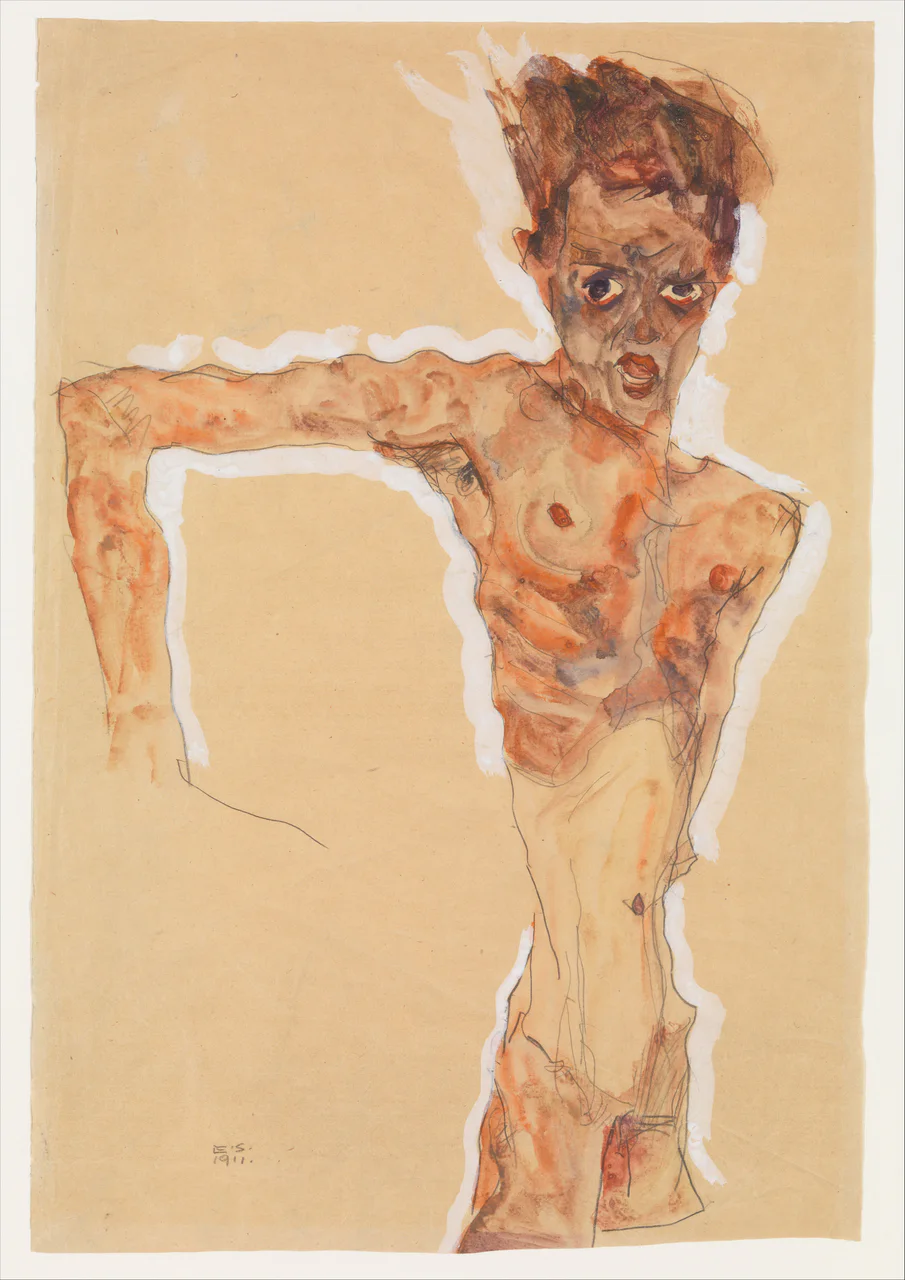
- A very thin young man, undressed, with one arm bent up at a sharp angle, glares straight at us with huge eyes.
- The Viennese artist Egon Schiele painted it in 1911, when he was about twenty-one, in watercolor, graphite, and gouache on paper.
- He did not make himself handsome. He showed the bones, the blotchy skin, and the strain, exactly as they were.
Reading the picture
5 places to look closer
Tap a number on the painting to jump to its note, or a close-up to see that spot in the whole picture.
Zoom in on the face. Red lines under the eyes make them bulge and look sunken at once. One eyebrow shoots up, and the mouth hangs half open. Wherever the paint runs and overlaps, the skin turns dark, almost bruised.
Go up to the hair. Dark brown and red clump together, and where the paint pooled and dried, it left a pattern of tiny bubbles. A single pencil line skims across the top. The hair stands straight up, unbrushed, and makes the face look even sharper.
Look along the upper edge of the outstretched arm. A thick band of white gouache follows the outline of the body. It sits just outside the pencil contour, so the body seems to rise off the tan paper and glow.
Now follow the bent arm down to where the hand should be. The red paint fades near the wrist, and after that there is only one long pencil line. Schiele never finished the hand. A fully painted body and an empty hand share the same sheet.
Check the lower left. The initials E.S. and the number 1911 are written in pencil. This is the signature and date Egon Schiele put on the work.
When it was painted
In 1911 Egon Schiele was turning twenty-one. Two years earlier he had walked out of the Vienna Academy of Fine Arts. Now he had his first solo show, at the Galerie Miethke in Vienna. Gustav Klimt, whom he had met at seventeen, and the critic Arthur Roessler both backed him early.
That spring he moved with his partner, Wally Neuzil, to Krumau, the small town his mother came from. It did not go well. The townspeople objected to an unmarried couple living together and to the local girls he asked to pose. Within a few months the two had left for Neulengbach, a village west of Vienna.
Around this time Schiele made a run of self-portraits, stripped and twisted, his own body bent into hard angles. The Metropolitan Museum reads the pose in this one as calling to mind Christ on the cross.
Neulengbach did not stay quiet for long. The next spring he was arrested and held for twenty-four days. He was convicted of leaving erotic drawings where children could see them, and in court one of his drawings was burned. In the fall of 1918 the Spanish flu reached his home. His wife, Edith, died first, and Schiele died three days later. He was twenty-eight.
This sheet later belonged to Scofield Thayer, editor of the American magazine The Dial. Between 1921 and 1923 he bought art at speed in London, Paris, Berlin, and Vienna, including many works on paper by Schiele and Klimt. After Thayer died in 1982, his bequest brought this self-portrait to the Met.
Look again at those huge eyes. Here is a young man of about twenty, about to be pushed out of one town and jailed in the next, staring straight back at himself in the mirror.
The painter
Egon Schiele
1890–1918
When painting this, the artist was about 21 years old
All paintings by Egon Schiele →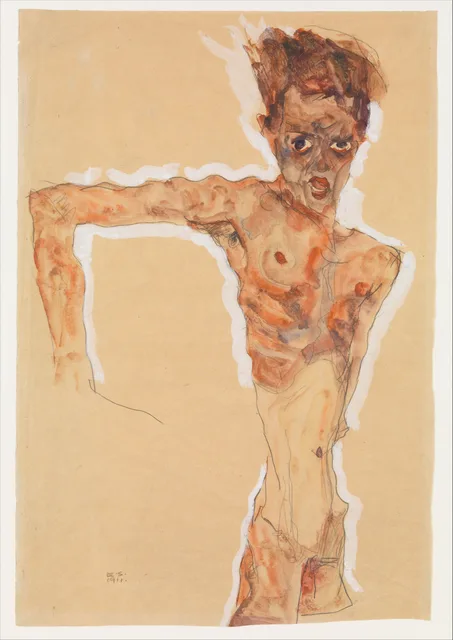
Questions to think about
- Look for itCan you find the spots where the white band around the body breaks off?
- Why?Why do you think Schiele painted himself bony and blotchy instead of tidying up his face and body?
- What about you?Many of us smooth out our faces and bodies with photo apps before we post. What kind of courage would it take to show the world an unedited version of yourself, the way Schiele did?
Same period
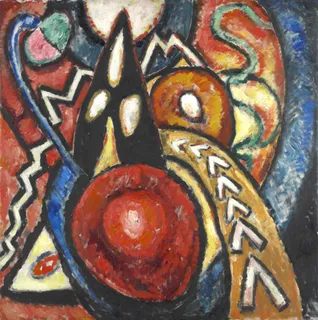
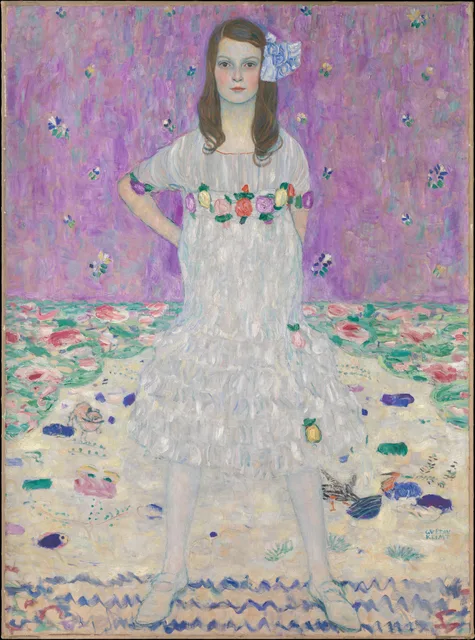
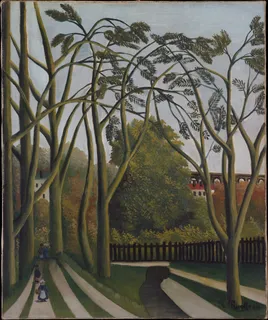
Painted around the same time,
somewhere else
Too good to keep to yourself
This painting,
for someone who comes to mind
They open it at full size
and see every brushstroke.
About this work
- Artist
- Egon Schiele · 1890–1918
- Date
- 1911
- Medium
- Watercolor, graphite, and gouache on paper
- Size
- 51.4 × 34.9 cm
- Collection
- The Metropolitan Museum of Art
- Image
- Original long edge 3868px · shown at 2560px
- Original
- View on the museum's website ↗