 Pyeongye
Artwork · 20th century · George Wesley Bellows
LeoTurn on Magnifier at the lower right and move slowly across the painting.
Full screen opens it edge to edge.Tap the painting to fill the screen.
Spread two fingers to look closer.
At a glance
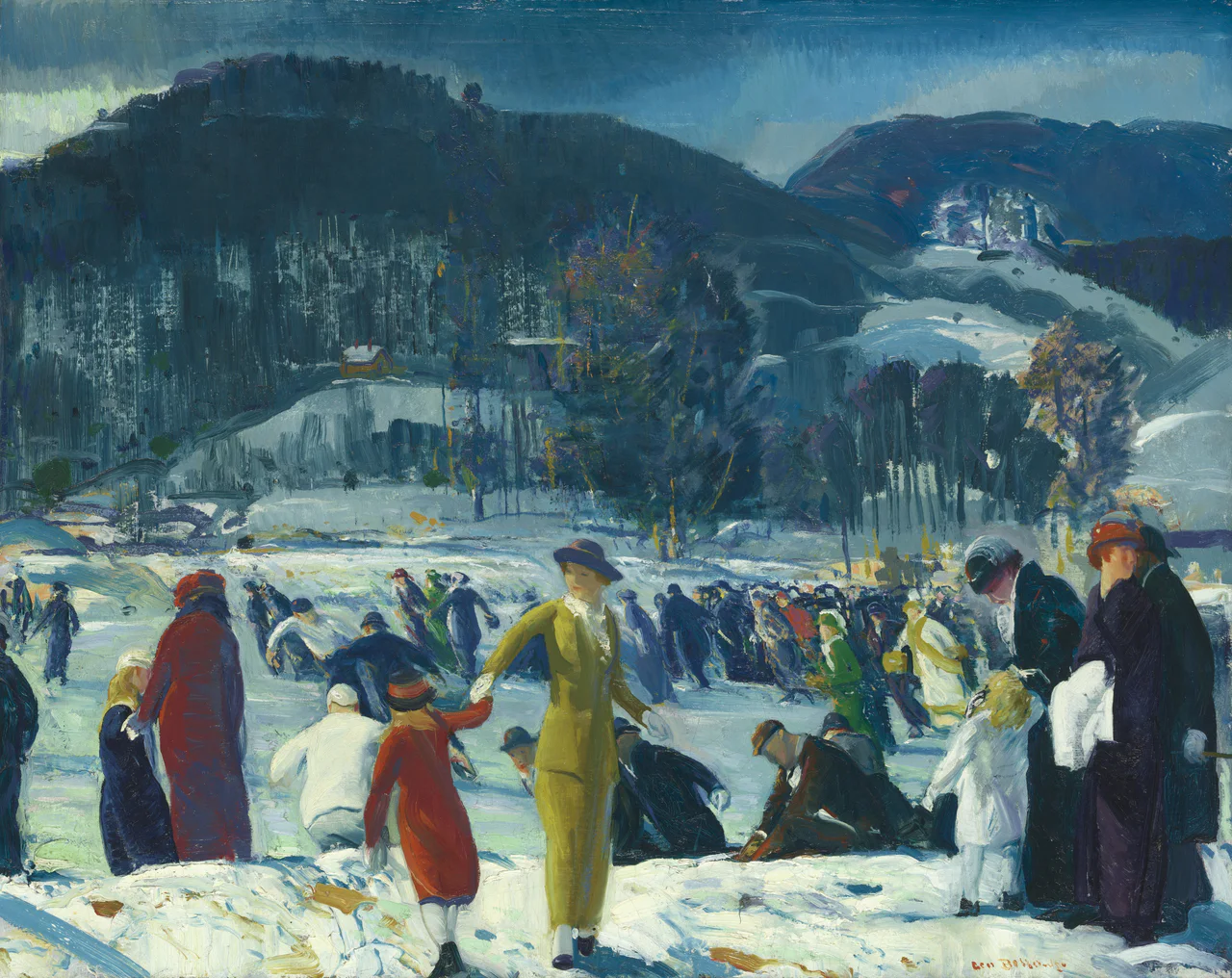
- Under snowy hills, people skate across a frozen pond, crouch on the ice, watch from the edge, and walk hand in hand with children.
- The American painter George Bellows painted it in oil on canvas in 1914.
- He laid bright reds, yellows, and greens over cold blues and used broad, slashing strokes to paint wind and speed.
Reading the picture
5 places to look closer
Tap a number on the painting to jump to its note, or a close-up to see that spot in the whole picture.
Zoom in on the woman in yellow at the center. White lace spills from her collar, and she holds the hand of a child in a red coat. The child, seen from behind, seems to tug her forward. Against the white snow and blue shadows, the yellow and red flare up like a struck match.
Move to the lower right. A man in brown kneels and bends low, his hands right down at the ice. He looks as if he is lacing a skate or fussing with a blade. His face, shaded by his cap, is just a few strokes of paint.
Look at the skaters to the left of the woman. They lean forward and swing their arms as they race past. Their outlines blur, and the brushstrokes drag sideways. That smear is what makes them look like they are really gliding.
Zoom in on the little house on the hill at the left. Two red chimneys poke up from its snowy roof. The woods behind it are made of quick strokes scraped downward. Bellows did not paint single trees. He built a whole forest out of the direction of his brush.
Check the lower right corner. The artist's signature is written in orange paint on the white snow. Even his name looks like it is sliding across the ice.
When it was painted
In January 1914, Bellows was thirty-one and living in New York. He wrote to a friend complaining about the weather. "There has been none of my favorite snow," he wrote. "I must always paint the snow at least once a year."
He did not have to wait long. On February 13, a major blizzard hit New York City. The snow he had been missing finally came, and it set him to work on Love of Winter.
Bellows grew up in Columbus, Ohio, and was a keen athlete who played baseball in college. In New York he became known for big, physical city scenes: boxing matches, construction pits, crowded streets. Here, too, he caught people in the middle of moving.
The crowd on the ice is mixed. The Art Institute of Chicago points out that the skaters and onlookers span many ages and social classes, like the varied crowds who used New York's public parks in the early twentieth century. Grown-ups and children, a fashionable woman and a kneeling man all share the same frozen pond.
The painting went to the Art Institute in the very year it was made, bought by the museum's support group, the Friends of American Art. Bellows died eleven years later, in 1925, at forty-two. Look again at the child in the red coat. After a winter of waiting, that small spot of red is the first thing the snow gives back.
The painter
George Wesley Bellows
1882–1925
When painting this, the artist was about 32 years old
All paintings by George Wesley Bellows →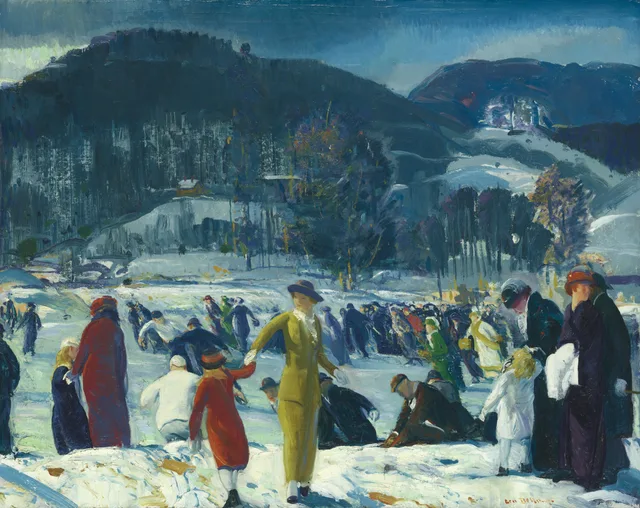
Questions to think about
- Look for itHow many skaters dressed in green can you find out on the ice?
- Why?Why do you think Bellows filled a cold winter scene with such large patches of warm yellow and red?
- What about you?In this park, people from very different walks of life share the same ice. Does your town still have enough places where anyone can spend an afternoon together without paying?
Same period
Painted around the same time,
somewhere else
Too good to keep to yourself
This painting,
for someone who comes to mind
They open it at full size
and see every brushstroke.
About this work
- Artist
- George Wesley Bellows · 1882–1925
- Date
- 1914
- Medium
- Oil on canvas
- Size
- 81.6 × 101.6 cm
- Culture
- New York
- Collection
- The Art Institute of Chicago
- Image
- Original long edge 5767px · shown at 2560px
- Original
- View on the museum's website ↗