 Pyeongye
Artwork · 20th century · Henri Rousseau
LeoTurn on Magnifier at the lower right and move slowly across the painting.
Full screen opens it edge to edge.Tap the painting to fill the screen.
Spread two fingers to look closer.
At a glance
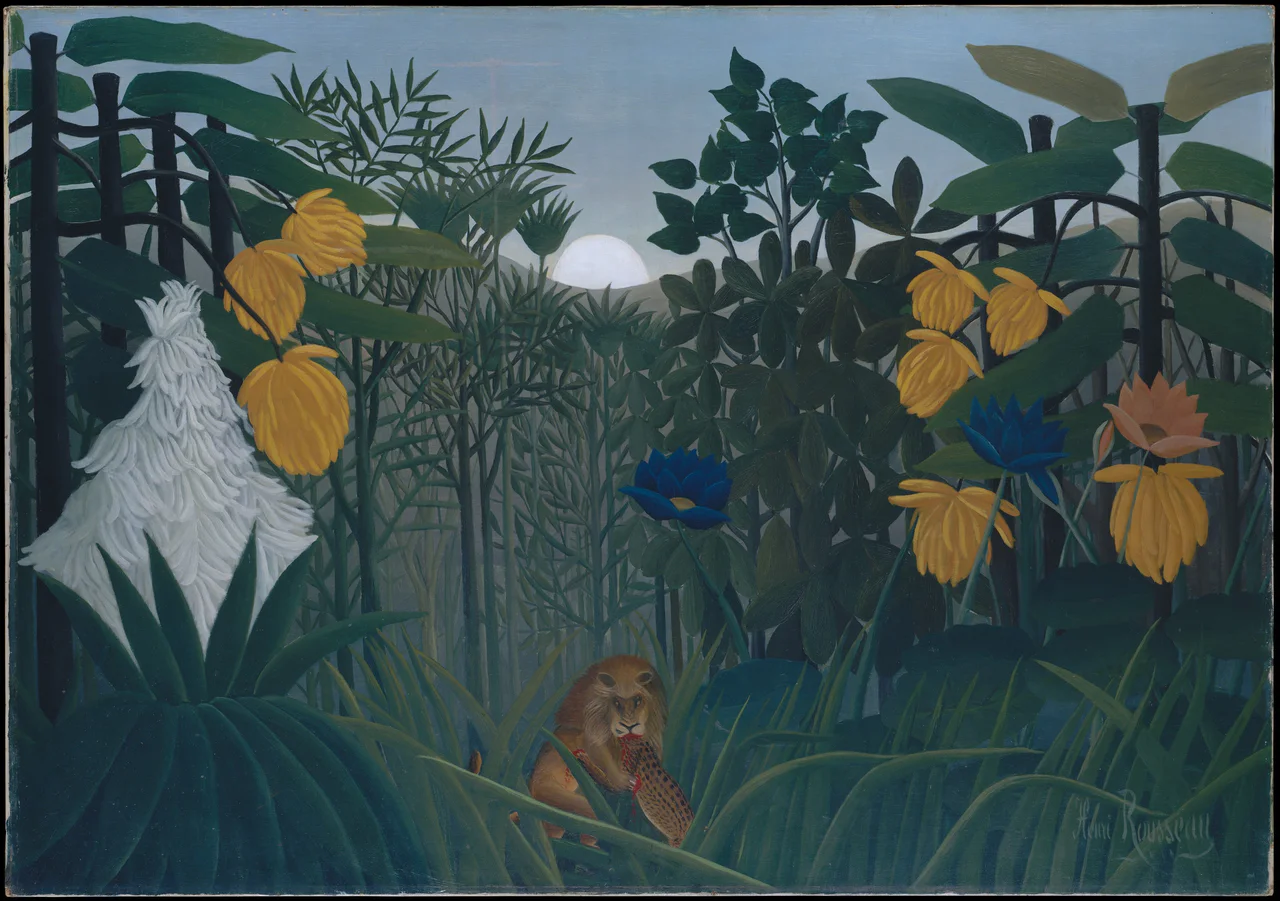
- Deep in a dense jungle, a lion crouches in the grass with a spotted animal in its jaws, under a wall of huge leaves, flowers and yellow fruit.
- Henri Rousseau, a French painter who first worked in a Paris toll office, painted it around 1907.
- It is a jungle invented in Paris by an artist who never saw one.
Reading the picture
5 places to look closer
Tap a number on the painting to jump to its note, or a close-up to see that spot in the whole picture.
Zoom into the grass at the bottom center. The lion has its teeth in the neck of a spotted animal, and red blood smears its mouth and paw. Yet its eyes are not on its meal. It stares straight out at us, with a strangely calm, blank face.
Look at the sky near the top center. A white disk sits just above the trees. From the picture alone, we cannot tell whether it is the sun or the moon. The sky around it glows a hazy, pale gray.
Zoom into the yellow clusters at upper left. Long fruits are bunched together and droop downward. Next to them, the white shrub is built from separate feathery leaves, one stroke at a time.
Find the blue flower in the middle. Its deep blue petals glow against the greens. Every leaf and petal is smooth, with almost no brushmarks and hardly any shadow. The plants stand in layers, more like paper scenery on a stage than a real forest.
Look at the grass at lower right. The signature Henri Rousseau is written there in a pale color. It blends into the blades of grass, so it takes a moment to spot.
When it was painted
Around 1907, Henri Rousseau was sixty-three. For more than twenty years he had worked for the Paris toll service, which taxed goods coming into the city, and the job earned him the nickname le Douanier, the customs officer. He retired in 1893 to paint, but money stayed tight. His second wife had died in 1903, and he lived alone.
He never went to art school. Almost every year he hung his pictures at the Salon des Indépendants, where anyone could show without passing a jury, and visitors often laughed at them. Then, at the 1905 Salon d'Automne, a big jungle scene of a hungry lion hung in the same room as works by Henri Matisse and other young painters. People began to take notice.
This canvas belongs to that run of jungle pictures. Rousseau never traveled to the tropics. He built his jungles from visits to the greenhouses and zoo at the Paris botanical garden, and from pictures in books and magazines. The Met suggests it was probably the picture he showed at the Salon d'Automne in the fall of 1907.
Late that year, Rousseau was arrested after an acquaintance drew him into a bank fraud. At his trial in 1909 he was judged a naive, trusting man and given a suspended sentence. In between, in 1908, Pablo Picasso threw a banquet in Rousseau's honor at his studio.
Rousseau died in Paris in 1910. The painting later belonged to the New York collector Adolph Lewisohn and then to his son Sam, who left it to the Met in 1951. Gauguin's Ia Orana Maria came to the museum in the same bequest.
Look down into the grass once more. In this enormous jungle, the lion is small, tucked low among the blades. Its steady stare is the heart of a wilderness dreamed up by a man who never saw the tropics.
More by the same painter
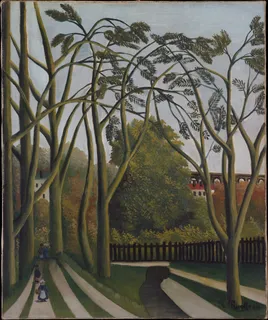
Hidden stories in this painting
Questions to think about
- Look for itHow many blue flowers can you find in the whole picture?
- Why?Why do you think Rousseau made the lion look at us instead of at its prey?
- What about you?Rousseau learned to paint on his own while holding a day job. When people today make art after work, how should we judge what they make?
Too good to keep to yourself
This painting,
for someone who comes to mind
They open it at full size
and see every brushstroke.
About this work
- Artist
- Henri Rousseau · 1844–1910
- Date
- ca. 1907
- Medium
- Oil on canvas
- Size
- 113.7 × 160 cm
- Collection
- The Metropolitan Museum of Art
- Image
- Original long edge 3811px · shown at 2560px
- Original
- View on the museum's website ↗