 Pyeongye
Artwork · 19th century · Auguste Renoir
LeoTurn on Magnifier at the lower right and move slowly across the painting.
Full screen opens it edge to edge.Tap the painting to fill the screen.
Spread two fingers to look closer.
At a glance
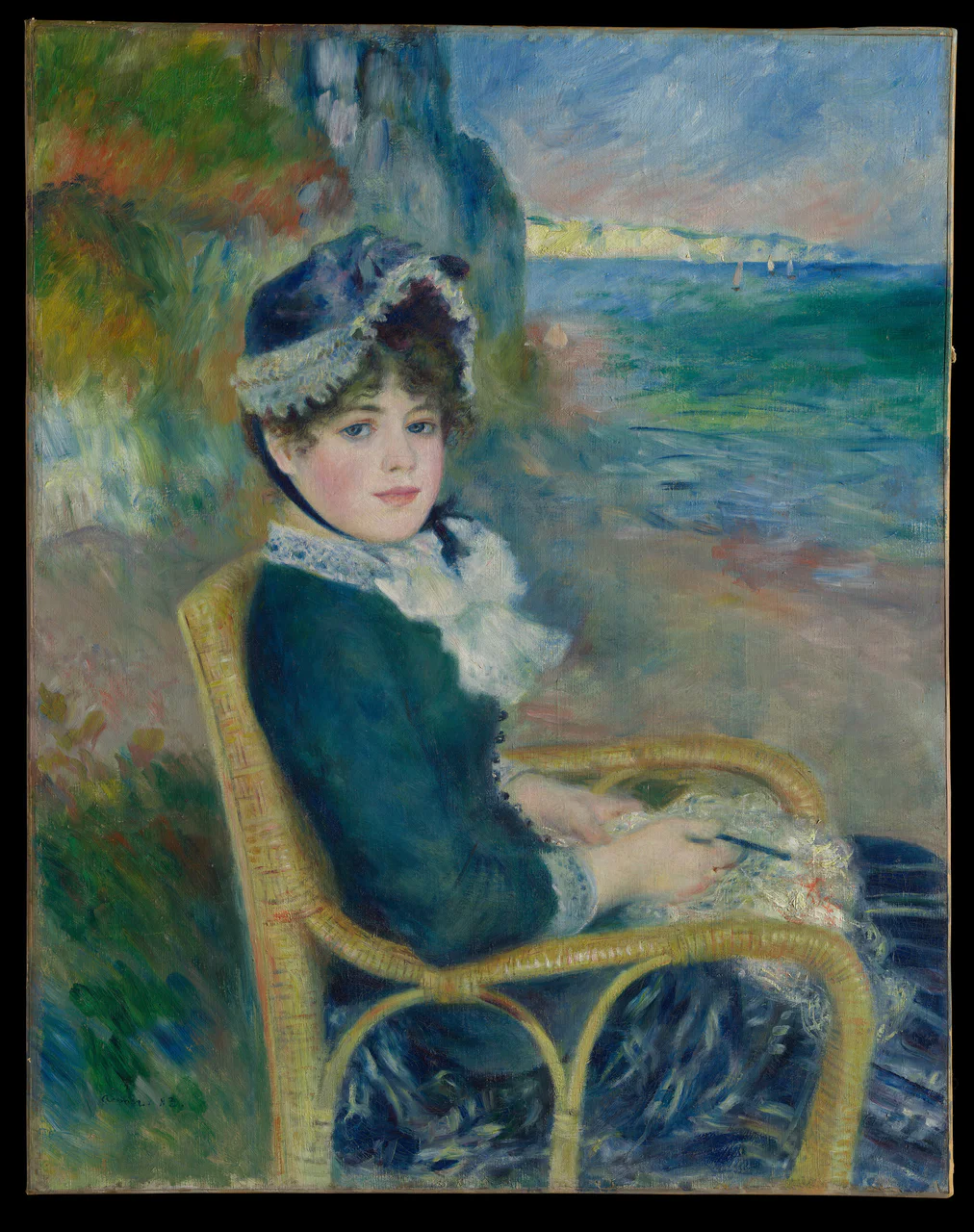
- A young woman sits in a wicker chair with the sea behind her and turns her head to look at us.
- Pierre-Auguste Renoir painted it in 1883.
- Her face is smooth and carefully finished, while the sea and hillside behind her are painted in loose, swirling strokes, so you can see two different ways of painting in one picture.
Reading the picture
5 places to look closer
Tap a number on the painting to jump to its note, or a close-up to see that spot in the whole picture.
Zoom in on her face. The blue eyes, pink cheeks, and closed pink lips are softly blended, and the brushstrokes almost disappear. Just above, the white ruffle on her hat is the opposite: thick dabs of paint dropped on quickly.
Look at the horizon at the upper right. Below pale yellow cliffs, a few white sailboats float on the blue sea. Each boat is only one or two touches of the brush. Up close they are little lumps of paint. From a distance they become sails catching the wind.
Zoom in on her hands in her lap. In one hand she holds a thin blue needle or hook, and a piece of white cloth lies across her knees. She seems to have looked up for a moment in the middle of her handwork.
Look at the arm and legs of the chair. The woven wicker is made of short strokes of yellow, orange, and red. The curving frame wraps around her body like an embrace.
Zoom in on the green grass at the lower left. The signature reads Renoir. 83. The 83 is short for 1883.
When it was painted
In 1883 Renoir was forty-two. That April the dealer Paul Durand-Ruel gave him a solo exhibition in Paris, a whole show of Renoir's work alone. The same year he finished three large paintings of couples dancing.
Around this time Aline Charigot was part of his life. She was the young woman who had posed for Luncheon of the Boating Party. The couple's first son, Pierre, was born in 1885, and they married in 1890.
Yet Renoir was wrestling with how to paint. In 1881 and 1882 he had traveled in Italy, where he saw Raphael's paintings and ancient Roman wall paintings. Years later he told the dealer Ambroise Vollard that around 1883 he felt he had taken Impressionism as far as it could go, and had come to think he did not know how to paint or draw.
That autumn he stayed on Guernsey, an island in the English Channel, and painted its rocky beaches again and again. Children on the Seashore, Guernsey, now in the Museum of Fine Arts, Boston, shows the shore of that same island.
By the Seashore later belonged to the New York collectors Henry and Louisine Havemeyer. When Louisine died, her bequest brought it to the Metropolitan Museum in 1929. Look at the picture once more. Between the carefully finished face and the restless sea, you can still see the question Renoir was asking himself that year.
The painter
Auguste Renoir
1841–1919
When painting this, the artist was about 42 years old
All paintings by Auguste Renoir →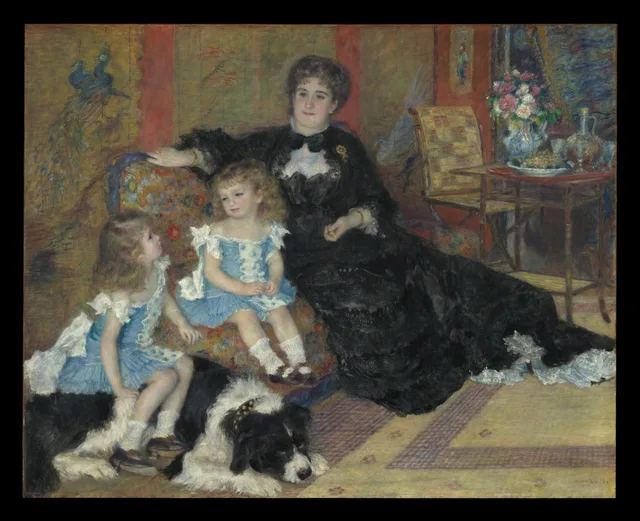
Questions to think about
- Look for itCan you find the white lace collar around her neck, and the small dark blue ribbon tied under her chin?
- Why?Why do you think Renoir smoothed out only her face and left the sea and grass so rough?
- What about you?It looks like the moment someone called her name and she turned around. If you were painted in the place where you feel most relaxed, where would you be and what would you be doing?
Same period
Painted around the same time,
somewhere else
Too good to keep to yourself
This painting,
for someone who comes to mind
They open it at full size
and see every brushstroke.
About this work
- Artist
- Auguste Renoir · 1841–1919
- Date
- 1883
- Medium
- Oil on canvas
- Size
- 92.1 × 72.4 cm
- Collection
- The Metropolitan Museum of Art
- Image
- Original long edge 4000px · shown at 2560px
- Original
- View on the museum's website ↗