 Pyeongye
Artwork · 19th century · Edgar Degas
LeoTurn on Magnifier at the lower right and move slowly across the painting.
Full screen opens it edge to edge.Tap the painting to fill the screen.
Spread two fingers to look closer.
At a glance
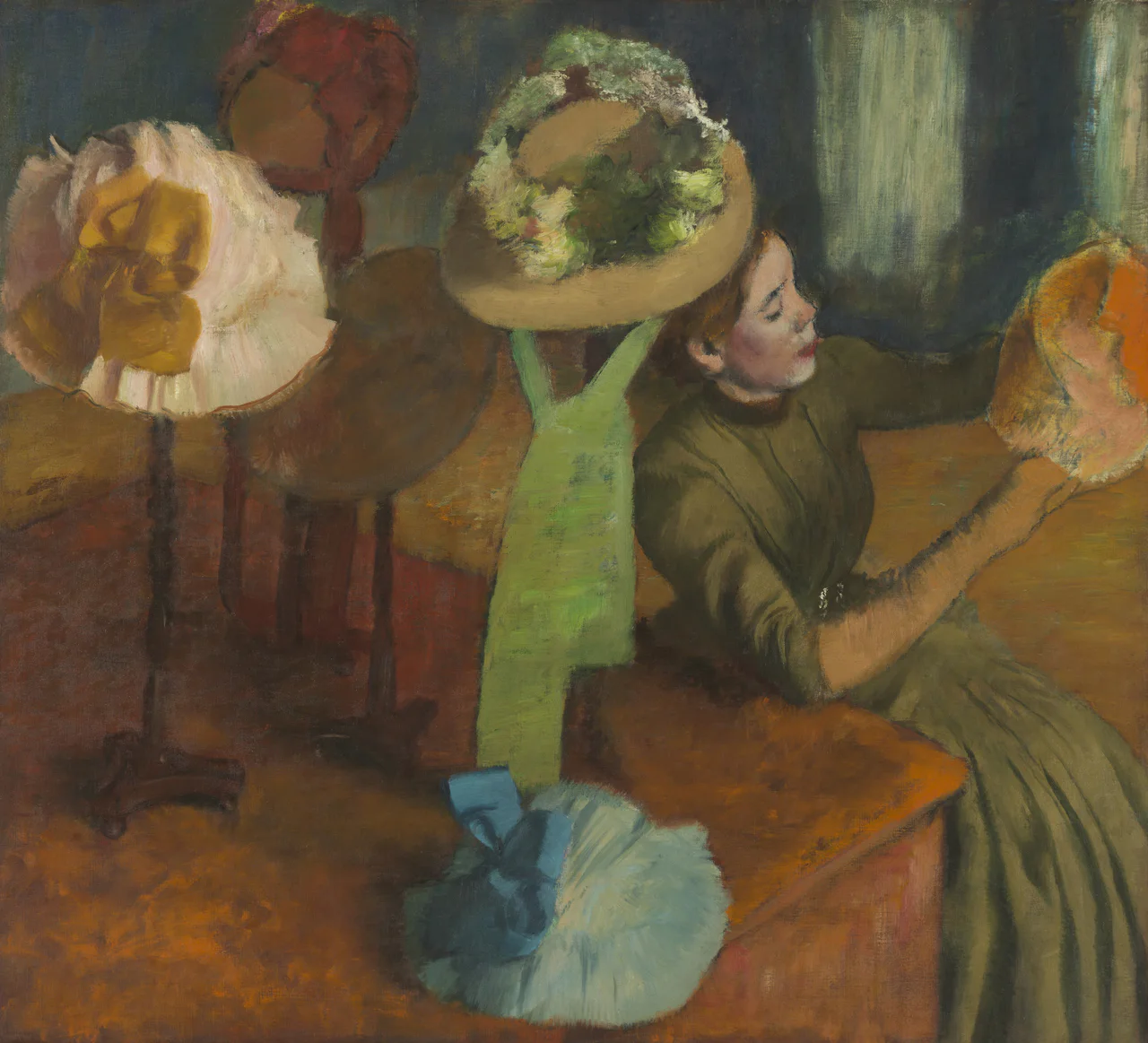
- In a Paris hat shop, a young woman in a green dress and long gloves sits studying a hat she holds in her hands.
- Edgar Degas worked on it between 1879 and 1886.
- It is the largest of his paintings of milliners, or hatmakers, and it plays a quiet trick: you cannot be sure whether she is a customer or a worker.
Reading the picture
5 places to look closer
Tap a number on the painting to jump to its note, or a close-up to see that spot in the whole picture.
Start with the straw hat at top center. Its wide brim is heaped with green leaves and cream-colored flowers, and a pale green ribbon hangs down in two long strips. The hat sits on a stand, but it lands just above the woman's head, so for a moment she seems to be wearing it.
Now look at her face. Her eyes are lowered and her lips are pushed slightly forward as she concentrates on the hat in her hands. Pink cheeks and red lips are laid in with short dabs of paint. Notice that her own head is bare.
Move right to the hands holding the hat. She wears long gloves that climb toward the elbow. A gloved hand grips the rim of an orange hat, and the hat's edge is fluffed up with quick, feathery strokes.
Drop down to the hat on the table. It is white, tied with a big sky-blue bow. Degas did not draw it carefully. A few broad sweeps of the brush are enough to suggest its soft, featherlike trim.
Finish with the hat on the stand at left. A large mustard-colored bow sits on pinkish-white trimming. Below it, the stand's thin dark pole runs all the way down past the table.
When it was painted
Degas was forty-five in 1879 and fifty-two by 1886, and this canvas stayed with him across those years. In 1879 the Impressionists held their fourth group show. In 1886 they held their eighth and last. Degas was one of the main organizers behind those exhibitions.
In the early 1880s he kept coming back to hat shops. In a pastel now at the Metropolitan Museum of Art, At the Milliner's, his friend the American painter Mary Cassatt posed as the customer trying on a hat. For this painting, he drew and pastelled the lone woman again and again, adjusting her pose and trying out different outfits.
In Paris at that time, making hats was a respected trade that called for skill and taste. Young women who did well at it could slowly move up in the world. The Art Institute of Chicago says this is exactly the uncertainty Degas painted. Her dress is good enough for a wealthy client, yet she wears no hat, which a well-off young lady of the day would have been expected to wear.
The painting came to the Art Institute through the bequest of the Chicago collector Mrs. L. L. Coburn, entering the collection in 1933. When the Fine Arts Museums of San Francisco mounted an exhibition on Degas and the Paris millinery trade in 2017, this was the picture they put on the catalogue cover.
Look once more at the space above her head. Degas let the hat on the stand slip right into place there, as if trying it on her for us. Is she a customer, or the woman who makes the hats? That one hat keeps the question open.
Hidden stories in this painting
Questions to think about
- Look for itHow many hats can you count in this shop?
- Why?Why do you think Degas placed the hat on the stand exactly above the woman's head?
- What about you?Have you ever guessed whether someone was a customer or a worker, rich or not, just from their clothes? How often do you think those guesses are right?
Same period
Painted around the same time,
somewhere else
 Alice Gerson in Prospect ParkWilliam Merritt Chase1886
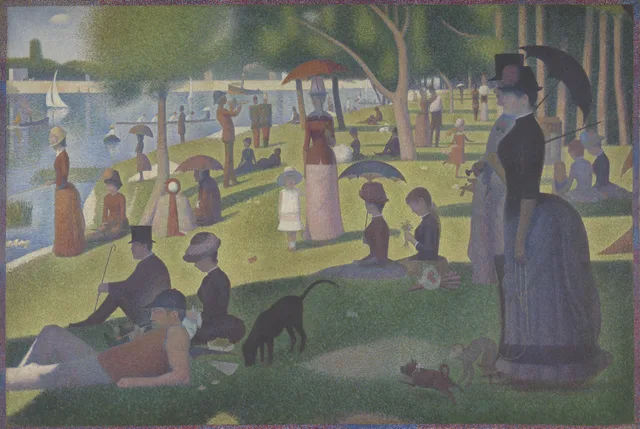 A Sunday on La Grande Jatte — 1884Georges Seurat1884–86, border added 1888–89
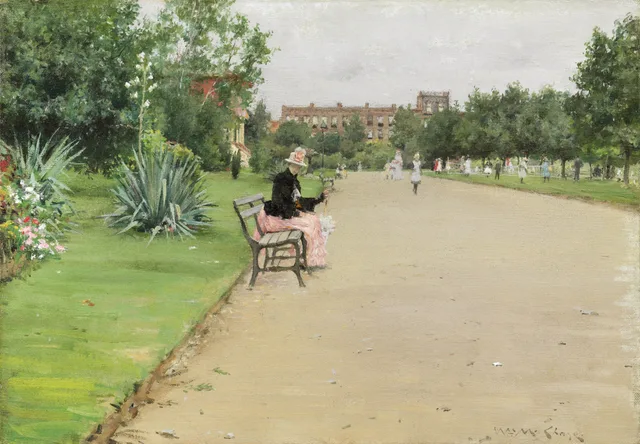 A City ParkWilliam Merritt Chasec. 1887
 The Herring NetWinslow Homer1885
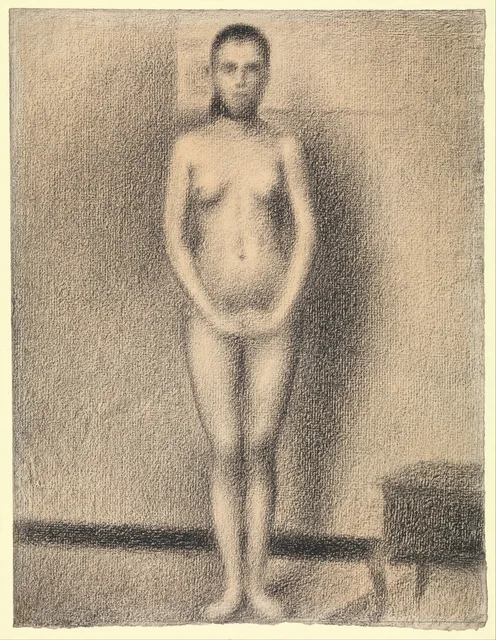 Study for "Poseuses"Georges Seurat1886–87
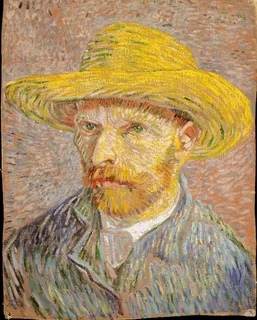 Self-Portrait with a Straw Hat (obverse: The Potato Peeler)Vincent van Gogh1887
Too good to keep to yourself
This painting,
for someone who comes to mind
They open it at full size
and see every brushstroke.
About this work
- Artist
- Edgar Degas · 1834–1917
- Date
- 1879-86
- Medium
- Oil on canvas
- Size
- 100 × 110.7 cm
- Culture
- France
- Collection
- The Art Institute of Chicago
- Image
- Original long edge 5003px · shown at 2560px
- Original
- View on the museum's website ↗