 Pyeongye
Artwork · 19th century · Théodore Rousseau
LeoTurn on Magnifier at the lower right and move slowly across the painting.
Full screen opens it edge to edge.Tap the painting to fill the screen.
Spread two fingers to look closer.
At a glance
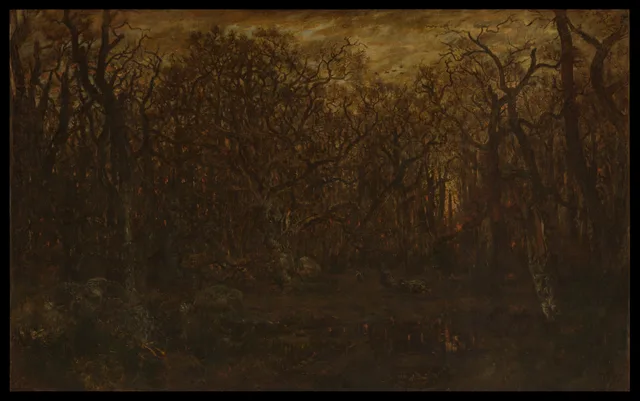
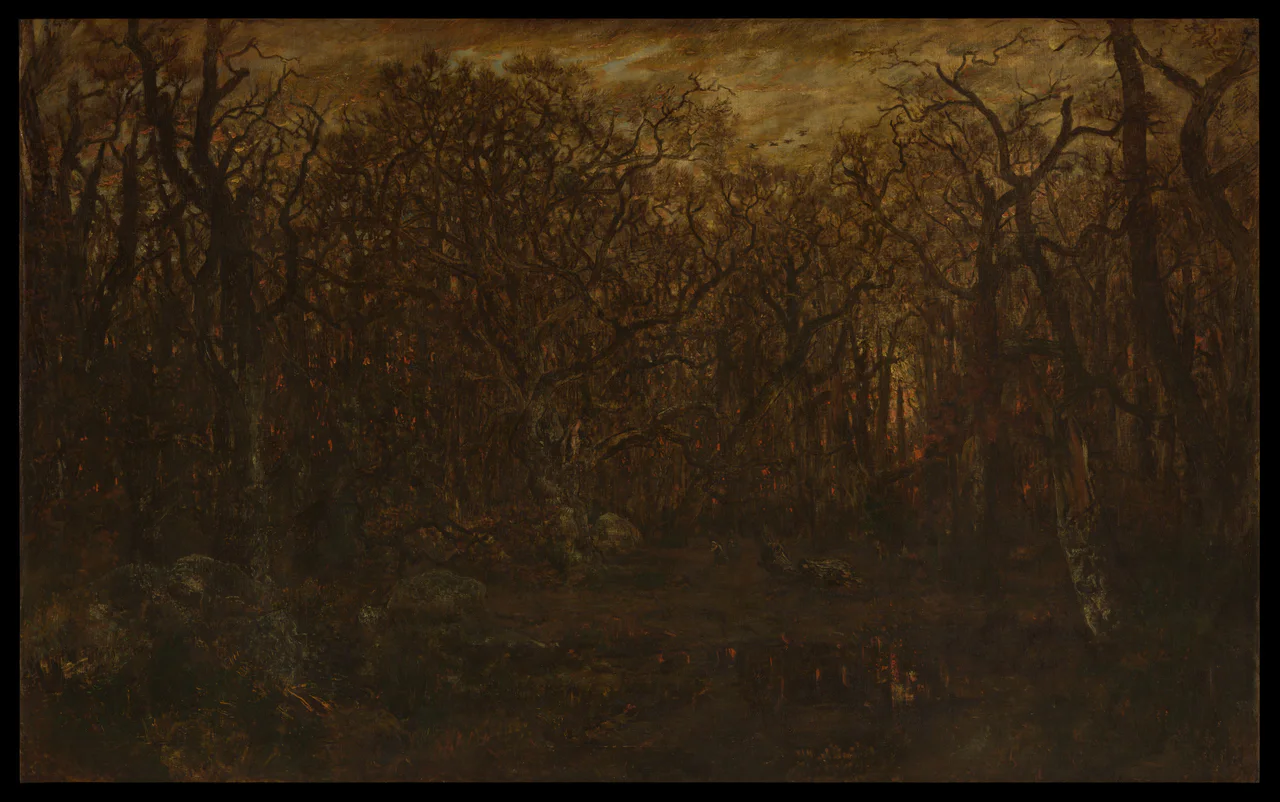
- A winter forest at sunset, its bare, twisting branches laced like a dark net against a dull gold sky.
- Painted by the French landscape painter Théodore Rousseau, who kept working on it from about 1846 until his death in 1867.
- The canvas is more than eight and a half feet wide, and its only real subject is the forest itself.
Reading the picture
4 places to look closer
Tap a number on the painting to jump to its note, or a close-up to see that spot in the whole picture.
Zoom into the sky near the top center. A handful of black birds fly in a loose line across the yellowish haze. Up close they are just quick dabs of paint, yet you can still read the spread wings. Are they heading home to roost as the light fails?
Look between the trunks on the right, just below the middle. Deep inside the woods, an orange glow leaks through. This is where the setting sun breaks through the trees. Rousseau dotted small touches of red around the trunks so the light seems to spread and flicker.
Now drop down to the clearing at the bottom center. A tiny, stooped figure is there. The person seems to wear a pale cloth over the head and to carry a load on the back. A second figure stands beside, half swallowed by the dark.
Find the pale trunk at lower right. In all that brown gloom, it is the one trunk that catches the light. Its bark is made of short, dragged strokes that leave the paint rough. Above it, thick limbs climb all the way to the sky.
When it was painted
By the mid-1840s, Théodore Rousseau was in his mid-thirties, and the official Paris Salon had been turning his paintings away again and again since the late 1830s. So he worked in the forest of Fontainebleau, south of Paris, painting its old oaks and boulders over and over. The painters who gathered in the village of Barbizon, at the forest's edge, later became known as the Barbizon school.
It was around then that he started this huge canvas. The museum dates it from about 1846 to 1867. He kept it in his hands for more than twenty years.
His fortunes changed in that time. After the revolution of 1848, the Salon jury was reformed, and his work began to be shown there again. At the Paris World's Fair of 1855, a whole group of his paintings hung together. And in 1849 the painter Jean-François Millet moved to Barbizon and became his close friend.
Millet and other artist friends urged Rousseau to finish this painting and exhibit it. He never did. In 1867 he served as president of the fine arts jury at the Paris World's Fair. That December he died at Barbizon, with Millet beside him. The canvas stayed unfinished. In 1911 the American collector P. A. B. Widener gave it to the Metropolitan Museum.
Now find the orange glow leaking between the trunks near the middle of the picture once more. The sunset Rousseau held on to for over twenty years is still hanging there.
Questions to think about
- Look for itCan you count how many birds are crossing the sky?
- Why?Why do you think Rousseau made the people in this huge picture so small and so hard to see?
- What about you?He kept returning to one painting for close to twenty years. In a world where we finish things fast and post them right away, is there anything you have stayed with that long?
Same period
Painted around the same time,
somewhere else
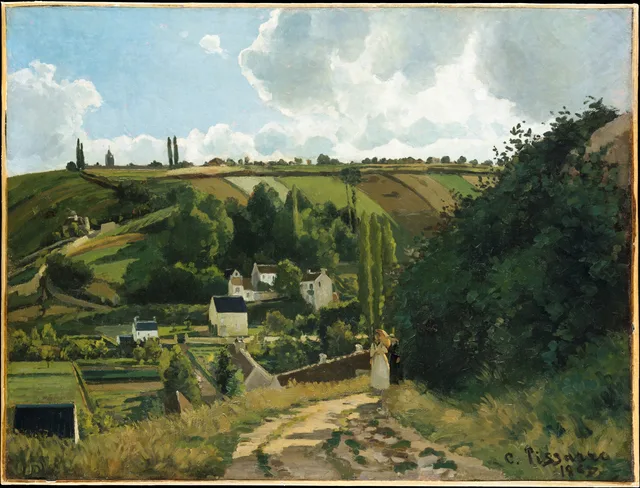 Jalais Hill, PontoiseCamille Pissarro1867
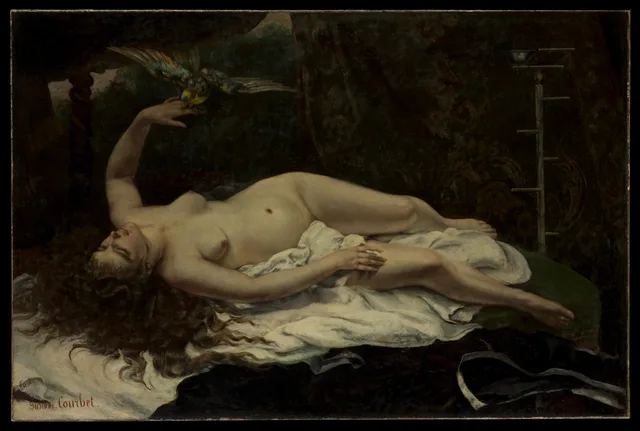 Woman with a ParrotGustave Courbet1866
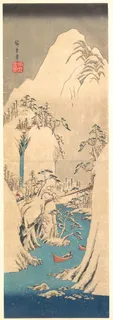 Snowy GorgeUtagawa Hiroshige1868
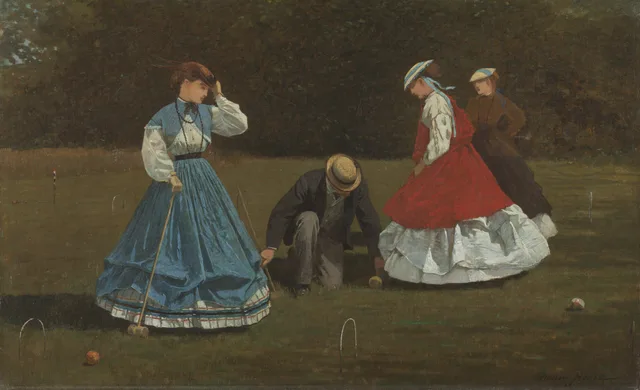 Croquet SceneWinslow Homer1866
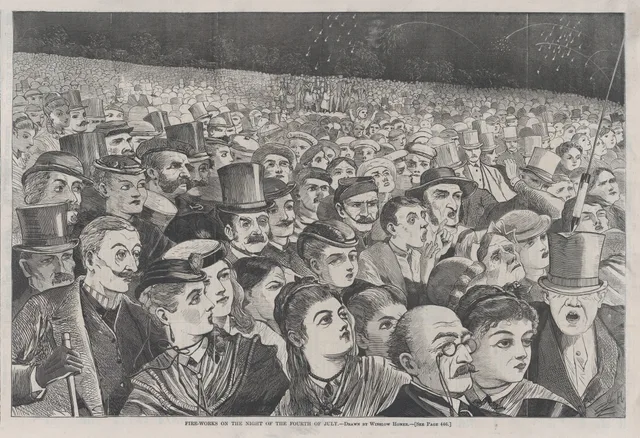 Fire-Works on the Night of the Fourth of July (from "Harper's Weekly," Vol. XII)Winslow HomerJuly 11, 1868
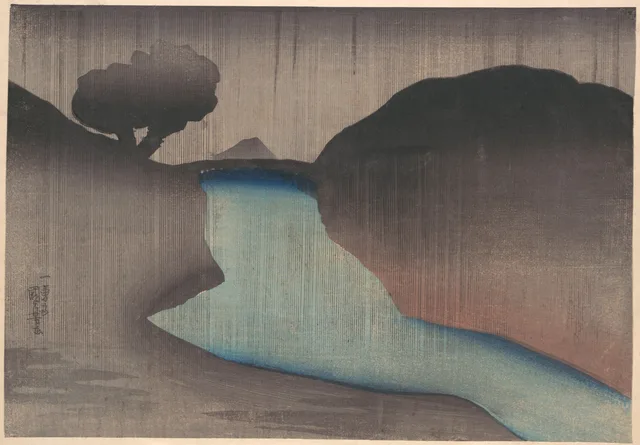 Ochanomizu in the RainUtagawa Kuniyoshimid-19th century
Too good to keep to yourself
This painting,
for someone who comes to mind
They open it at full size
and see every brushstroke.
About this work
- Artist
- Théodore Rousseau · 1812–1867
- Date
- ca. 1846–67
- Medium
- Oil on canvas
- Size
- 162.6 × 260 cm
- Collection
- The Metropolitan Museum of Art
- Image
- Original long edge 4000px · shown at 2560px
- Original
- View on the museum's website ↗