 Pyeongye
Artwork · 19th century · Utagawa Kuniyoshi
LeoTurn on Magnifier at the lower right and move slowly across the painting.
Full screen opens it edge to edge.Tap the painting to fill the screen.
Spread two fingers to look closer.
At a glance
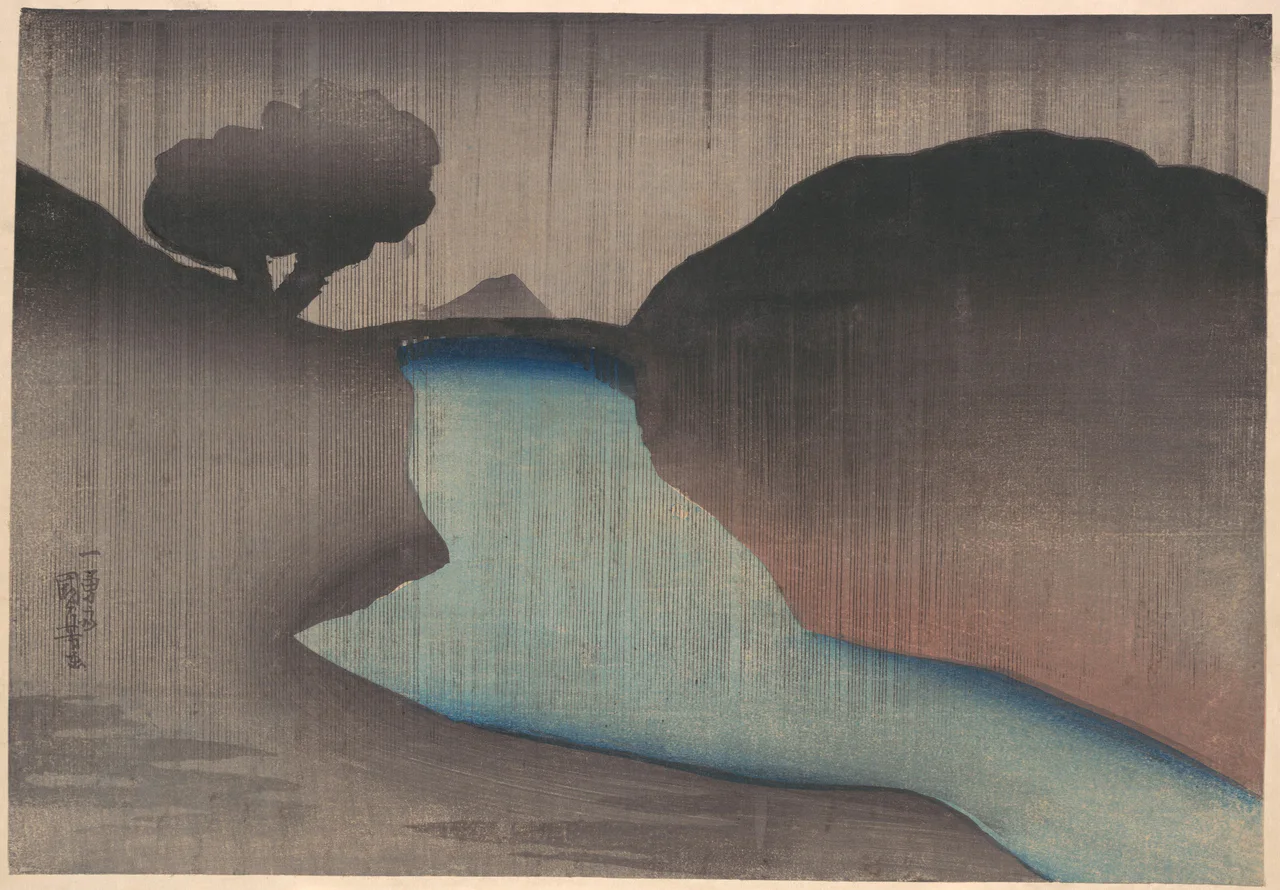
- Rain pours down on the gorge at Ochanomizu in Edo, today's Tokyo, with a blue river winding through it, in a woodblock print.
- It is by the Japanese ukiyo-e artist Utagawa Kuniyoshi, and the Metropolitan Museum of Art dates it to the mid-nineteenth century.
- There are no people, no boats, no bridges. Rain, hills, and water fill the whole sheet, which makes it an unusual landscape.
Reading the picture
5 places to look closer
Tap a number on the painting to jump to its note, or a close-up to see that spot in the whole picture.
Zoom in on the far distance in the middle, where the river begins. Between two hills, a pointed mountain rises faintly. It looks like Mount Fuji. It is printed in a single flat gray, so it seems veiled by the rain.
Look closely at any patch of sky. Fine vertical lines run densely from top to bottom. They are rain, cut as very thin lines into the woodblock. The lines do not stop at the sky. They cover the hills and the river too, across most of the picture.
Look at the big tree at the upper left. Its swelling mass of leaves is printed as a dark silhouette, like a shadow. Not one leaf or branch is drawn. Even so, the shape alone gives you the heavy weight of a tree soaked with rain.
Zoom in on the river at the lower right. Near the banks it is a deep indigo, and it fades to a pale sky blue toward the middle. Printers made this kind of gradation by inking the block unevenly, so the color seems to melt from one shade into another. Rain falls in thin lines over the water as well.
Zoom in on the writing on the hill at the left. It reads Ichiyusai Kuniyoshi ga, which means drawn by Ichiyusai Kuniyoshi. Ichiyusai was one of the artist's art names. Even the signature has rain running over it.
When it was painted
No one knows exactly what year this print was made. The Metropolitan Museum of Art dates it to the mid-nineteenth century. By then Kuniyoshi was one of the leading print designers in Edo.
Kuniyoshi was born in Edo in 1797, the son of a silk dyer. Around the age of fourteen he became a pupil of the popular artist Utagawa Toyokuni, but for years he struggled to make a name. Fame finally came around 1827, with a hugely popular series of the 108 heroes of the Chinese novel Water Margin.
He became famous for warriors, but he also brought shading and perspective learned from Western prints into his landscapes. In 1842 the shogunate's Tenpo Reforms banned prints of kabuki actors and courtesans. Kuniyoshi slipped around the ban with satirical prints that disguised their targets as animals or figures from old tales.
He loved cats. He kept them in his studio and put them into many of his prints. Kuniyoshi died in Edo in 1861. A few years later Edo was renamed Tokyo, but the name Ochanomizu still marks a neighborhood there today.
Look again at the signature on the hill at the left. An artist known for sword-swinging heroes kept only hills and water in this sheet, and he let his own name get rained on too.
Questions to think about
- Look for itCan you find any spot in the picture where the rain lines do not reach?
- Why?Why do you think Kuniyoshi left every person out of this scene?
- What about you?A street in the rain can look completely different from the same street on a sunny day. What does your neighborhood look like only when it rains?
Same period
Painted around the same time,
somewhere else
Too good to keep to yourself
This painting,
for someone who comes to mind
They open it at full size
and see every brushstroke.
About this work
- Artist
- Utagawa Kuniyoshi · 1797–1861
- Date
- mid-19th century
- Medium
- Woodblock print; ink and color on paper
- Culture
- Japan
- Collection
- The Metropolitan Museum of Art
- Image
- Original long edge 3860px · shown at 2560px
- Original
- View on the museum's website ↗