 Pyeongye
Artwork · 19th century · Winslow Homer
LeoTurn on Magnifier at the lower right and move slowly across the painting.
Full screen opens it edge to edge.Tap the painting to fill the screen.
Spread two fingers to look closer.
At a glance
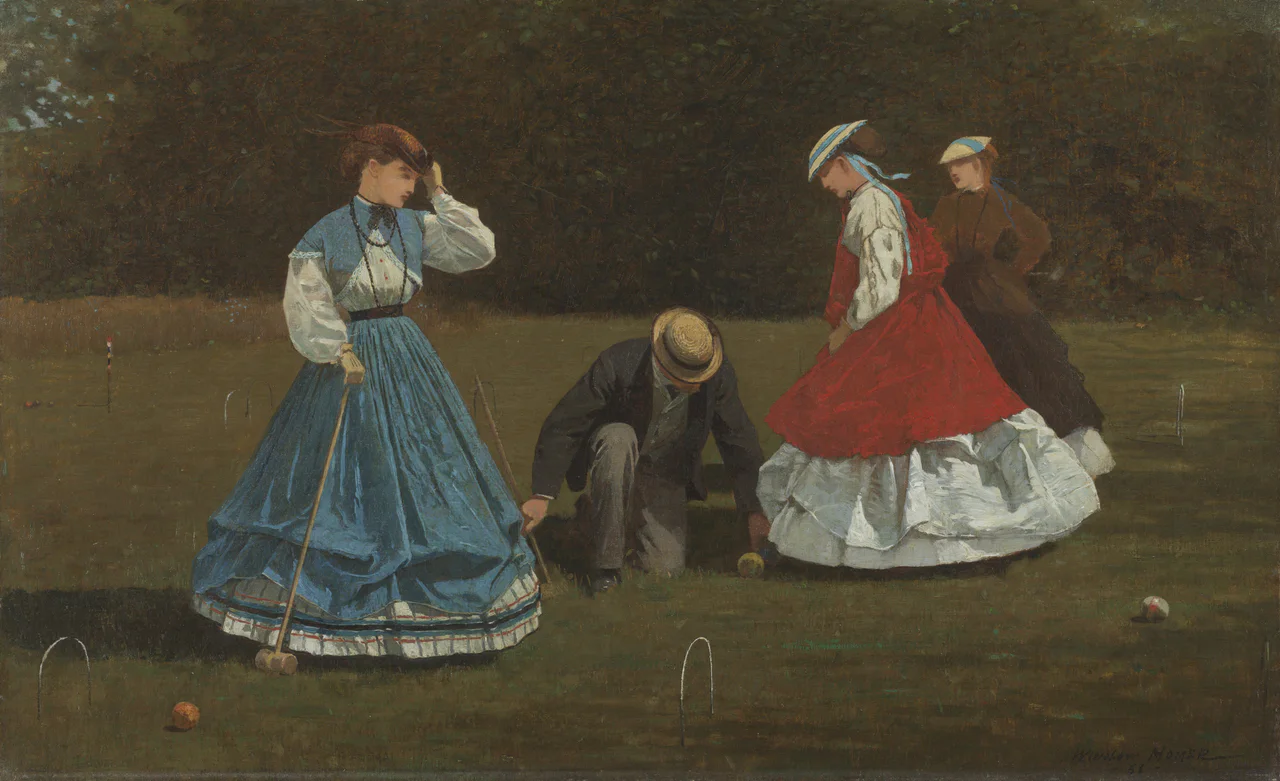
- Three women and one man play croquet on a lawn on a summer afternoon.
- The American painter Winslow Homer painted it in 1866.
- A blue skirt, a red skirt, and a white petticoat jump out against a dark wall of trees, so you can almost feel how strong the sun is.
Reading the picture
5 places to look closer
Tap a number on the painting to jump to its note, or a close-up to see that spot in the whole picture.
Zoom in on the woman in blue at the left. She lifts one hand to the brim of her hat to shade her eyes. A feather on her hat streams out behind her.
Look at the man crouching in the middle. Under his straw hat, he leans down with one hand near a yellow ball. Right next to the ball you can see the black toe of a shoe peeking out from under the red skirt. The Art Institute of Chicago reads this as the man setting the ball of the woman in red into position.
Get a close look at the red dress on the right. The top is one solid block of deep red, and below it a white petticoat spreads out in layer after layer. Homer laid thick, bright paint along each fold of the white cloth, so it seems to glitter. Behind her stands a woman in brown.
Now look at the lower left. The head of a wooden mallet rests on the grass, and a little way off sits an orange ball. A short, dark shadow clings to the bottom of the ball. A wide black shadow also spreads under the blue skirt. Those hard shadows tell you how bright the day is.
Zoom in on the lower right corner. On the dark grass you can read the signature Winslow Homer. Below it, two small digits are written.
When it was painted
In 1866 Homer was thirty years old. He had started out as an apprentice in a lithography shop in Boston. During the Civil War he worked as an illustrator, sending scenes from the front to the magazine Harper's Weekly. In the late 1860s he turned more and more to oil paintings of people out of doors in bright sunlight. That year his oil painting Prisoners from the Front hung in the exhibition of the National Academy of Design in New York. It shows captured Confederate soldiers standing before a Union officer. The picture made the young painter's name in the New York art world.
Yet the subject Homer kept coming back to in these same months was not war. It was croquet. The lawn game had only recently arrived from the British Isles, and men and women played it together, competing on the same court. Homer painted five oil paintings of croquet, and this is one of them.
Late in 1866 Homer sailed for France and spent about ten months in Paris and the French countryside. At the Paris Universal Exposition of 1867, Prisoners from the Front hung among the American pictures and won praise from critics.
This painting entered the collection of the Art Institute of Chicago in 1942. In 1984 Yale University Press even published a whole book devoted to Homer's croquet pictures.
Look again at the hand of the woman on the left. In the same year he painted soldiers and prisoners, Homer gave this much care to a single hand shading a pair of eyes from the summer sun.
The painter
Winslow Homer
1836–1910
When painting this, the artist was about 30 years old
All paintings by Winslow Homer →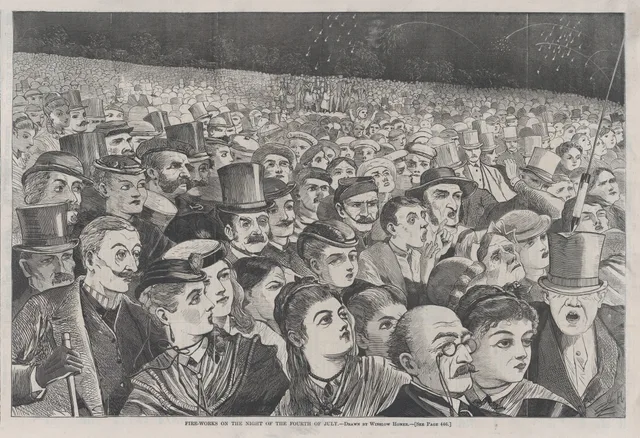
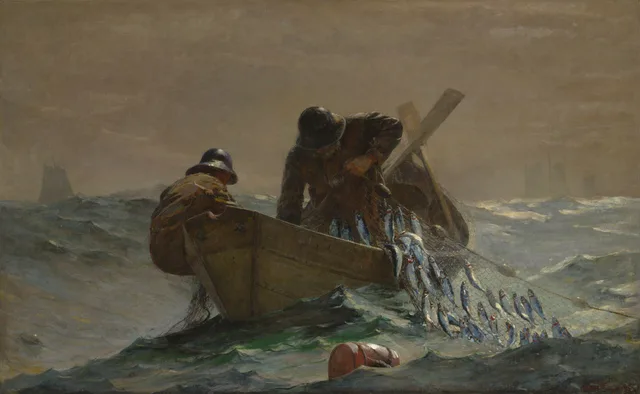
Questions to think about
- Look for itHow many white wire hoops can you find hidden around the lawn?
- Why?Why do you think Homer left out almost all of the sky and closed off the back of the scene with dark trees?
- What about you?Croquet was a game men and women played against each other on the same lawn. Which sports today are still split by gender, and do the reasons for splitting them really hold up?
Same period
Painted around the same time,
somewhere else
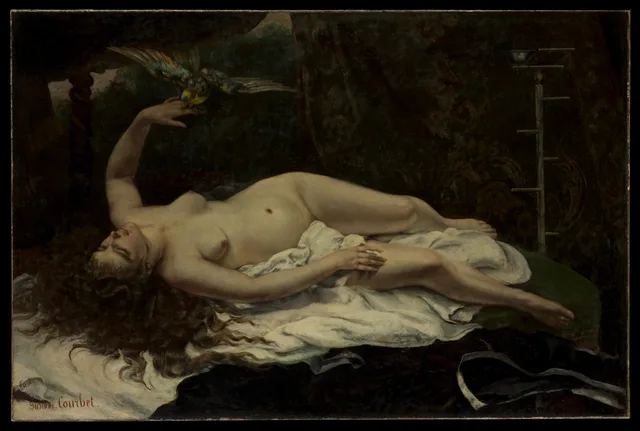 Woman with a ParrotGustave Courbet1866
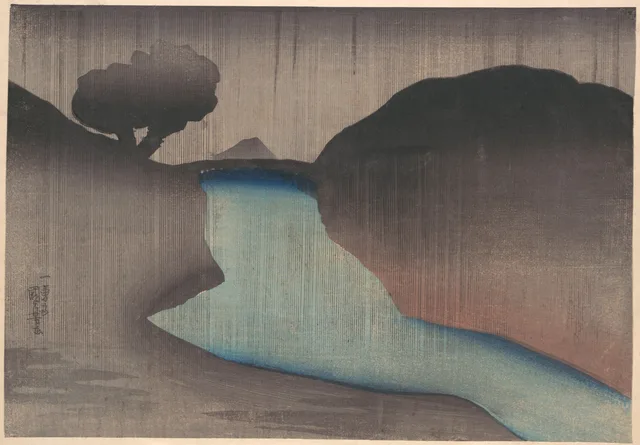 Ochanomizu in the RainUtagawa Kuniyoshimid-19th century
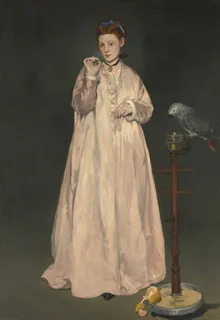 Young Lady in 1866Edouard Manet1866
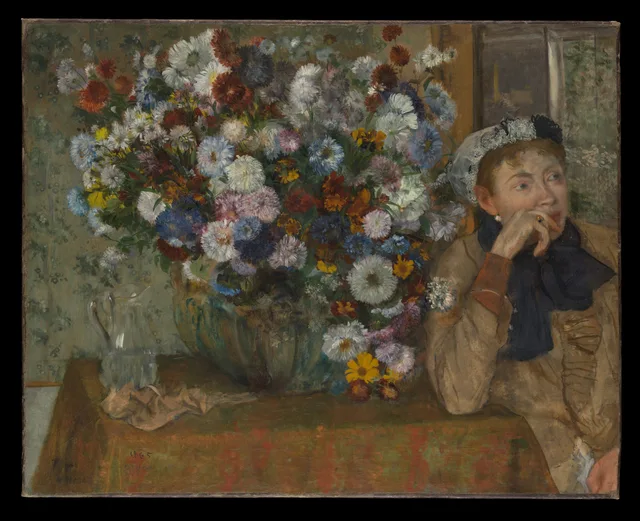 A Woman Seated beside a Vase of Flowers (Madame Paul Valpinçon?)Edgar Degas1865
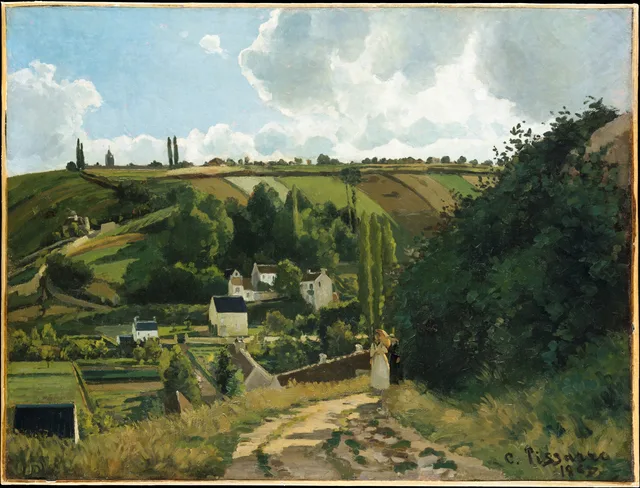 Jalais Hill, PontoiseCamille Pissarro1867
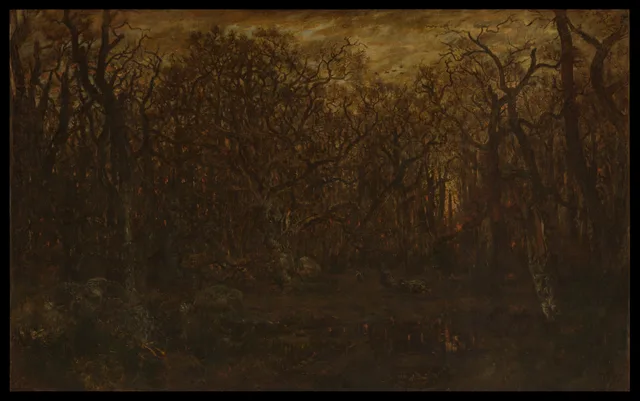 The Forest in Winter at SunsetThéodore Rousseauca. 1846–67
Too good to keep to yourself
This painting,
for someone who comes to mind
They open it at full size
and see every brushstroke.
About this work
- Artist
- Winslow Homer · 1836–1910
- Date
- 1866
- Medium
- Oil on canvas
- Size
- 40.3 × 66.2 cm
- Culture
- United States
- Collection
- The Art Institute of Chicago
- Image
- Original long edge 6246px · shown at 2560px
- Original
- View on the museum's website ↗