 Pyeongye
Artwork · 17th century · Michiel Sweerts
LeoTurn on Magnifier at the lower right and move slowly across the painting.
Full screen opens it edge to edge.Tap the painting to fill the screen.
Spread two fingers to look closer.
At a glance
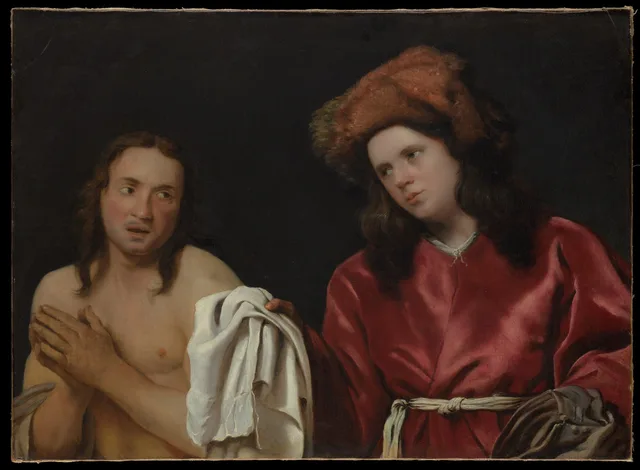
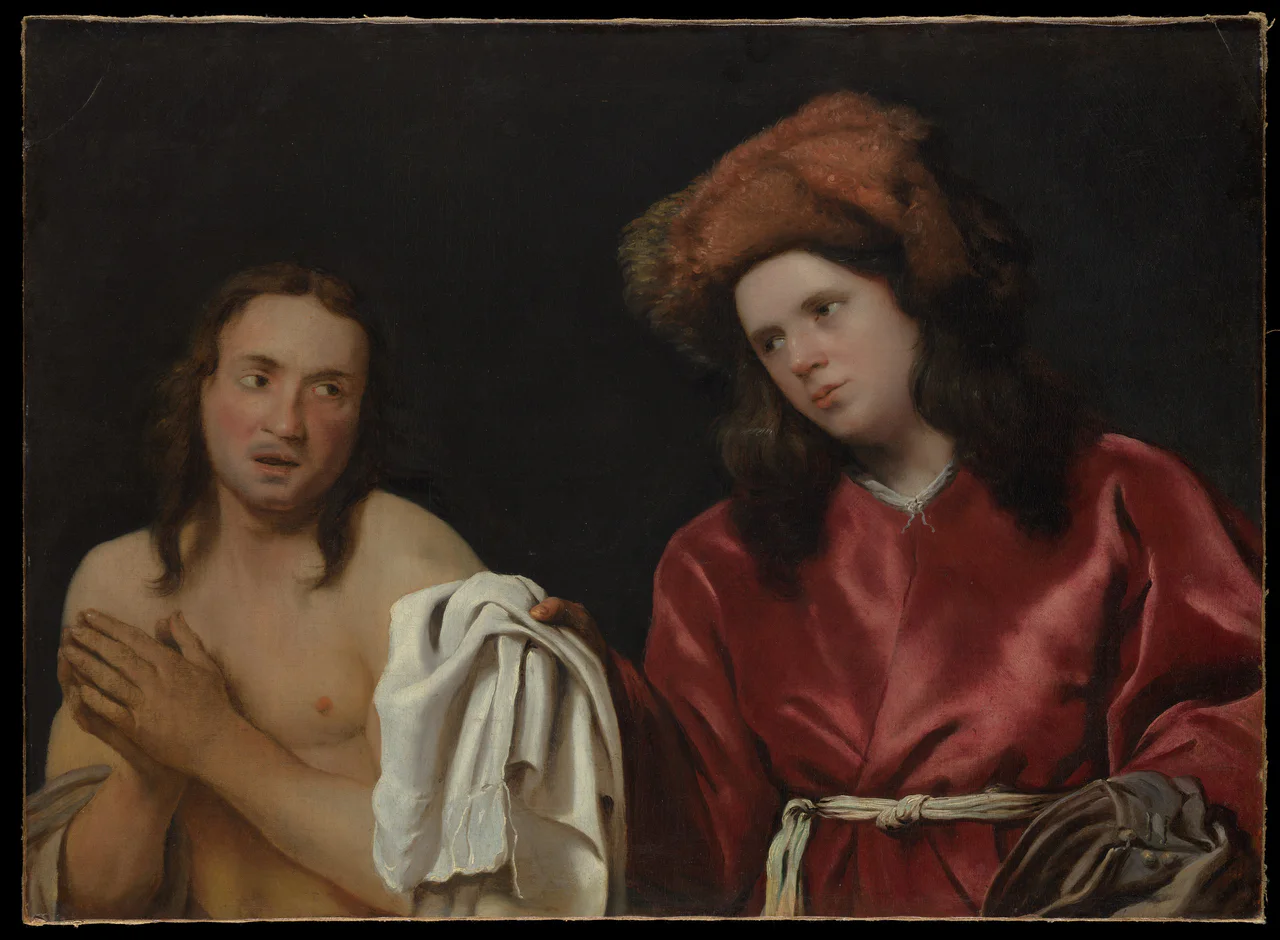
- A young man in red hands a white shirt to a man who has no shirt on.
- Michiel Sweerts, a painter from Brussels, painted it in oil on canvas around 1661.
- The background is left almost black, so all we see are two faces up close: the one who gives and the one who receives.
Reading the picture
5 places to look closer
Tap a number on the painting to jump to its note, or a close-up to see that spot in the whole picture.
Zoom in on the white shirt in the middle. The young man pinches the top of it with his fingertips. The cloth falls in folds and soft gray shadows. It is the brightest thing in the whole picture.
Look at the face of the man on the left. His lips are slightly parted, and his eyes slide sideways toward the person holding out the shirt. Is he about to say thank you, or is he still unsure?
Zoom in on his hands. He presses them together, palm to palm, against his bare chest. The backs of his hands are a deeper brown than his face, as if weathered by the sun.
Now look at the young man on the right. Under a shaggy reddish fur hat, his face is pale and smooth. He tilts his head and glances to the left out of the corner of his eye. He is giving something away, yet his expression is calm and a little distant.
Zoom in on his waist. His red robe is cinched with a pale cloth belt tied in a big knot. With just a few strokes, Sweerts painted every twist and shadow of the cloth.
When it was painted
Around 1661, Michiel Sweerts was living in Amsterdam, a painter from Brussels in his early forties. The Met believes he painted this picture there, probably for a Catholic patron. Yet his thoughts were already turning far beyond the studio. He was getting ready to join a Catholic mission bound for Asia.
He had never stayed put for long. From the mid-1640s he worked in Rome, painting laborers, beggars, and artists busy in their studios, and he was made a knight while he was there. Back in Brussels in the mid-1650s, he opened a drawing academy for young artists.
The subject comes from the Gospel of Matthew, where Jesus tells his followers that when he was naked, they clothed him. Feeding the hungry, clothing the naked, and a handful of other kindnesses were grouped as the seven works of mercy, long urged by the Catholic Church. Sweerts had already painted the seven works as a series back in Rome, and several of those canvases now belong to the Rijksmuseum in Amsterdam.
In January 1662 he sailed from Marseille with a mission led by Bishop François Pallu. On the long road east he kept clashing with his companions, and in the end he was dismissed from the group. He traveled on anyway and reached Goa, the Portuguese colony on India's west coast, where he died in 1664.
The painting came to the Metropolitan Museum in 1984. Look again at the two pairs of hands: fingertips pinching the white shirt, and palms pressed together on a bare chest. Knowing that the painter soon set out on a journey he never returned from, the shirt starts to feel like more than a piece of cloth.
Questions to think about
- Look for itCan you find the brown bundle of cloth in the lower right corner, next to the young man?
- Why?Why do you think Sweerts gave the young man a calm, almost distant face instead of a happy one?
- What about you?Today we often drop old clothes into a donation bin and walk away, so how is giving without seeing the other person's face different from handing something over face to face?
Same period
Painted around the same time,
somewhere else
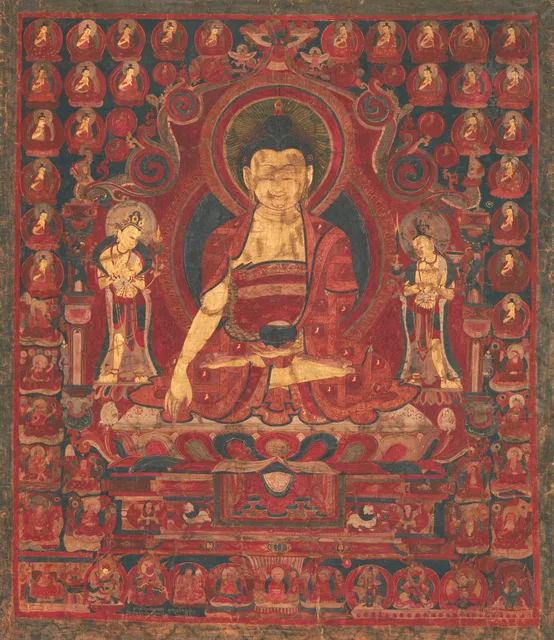 Buddha Shakyamuni as "Lord of the Munis"Unknown artist · Western Tibet, Gugemid-17th century
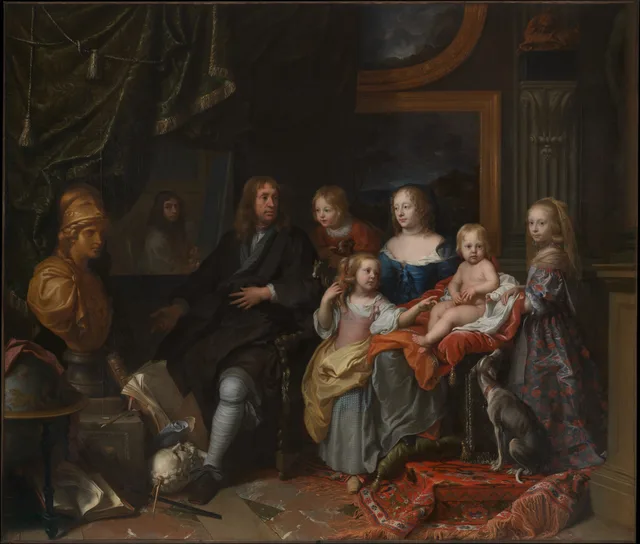 The Jabach FamilyCharles Le Brunca. 1660
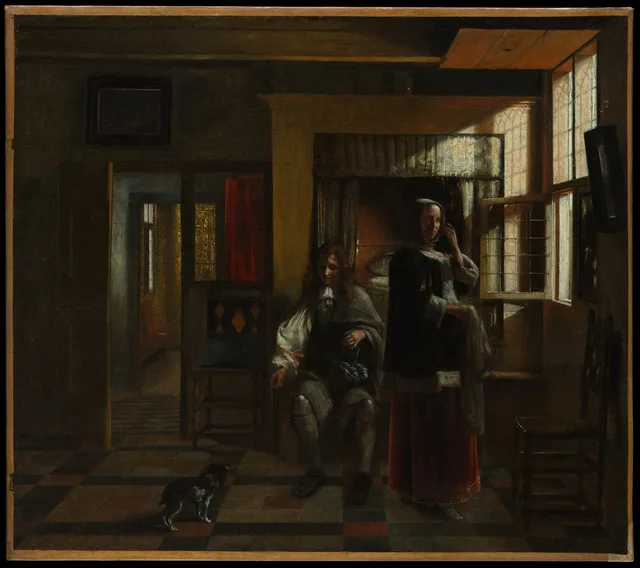 Interior with a Young CouplePieter de Hoochprobably ca. 1662–65
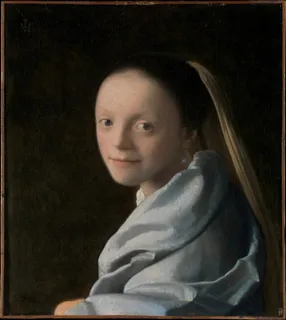 Study of a Young WomanJohannes Vermeerca. 1665–67
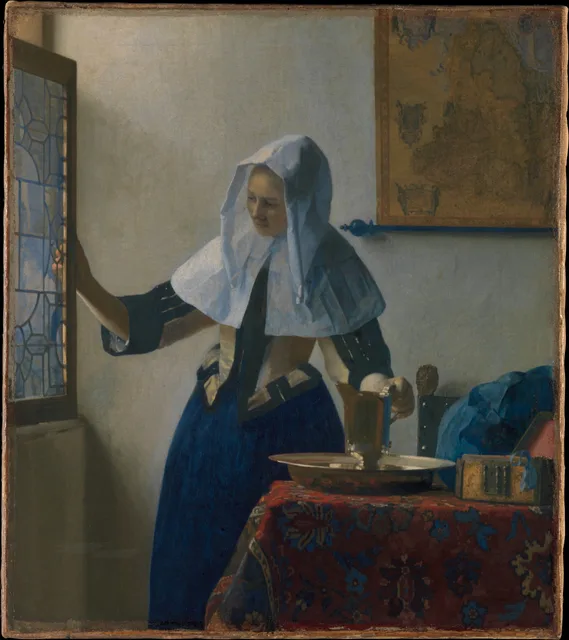 Young Woman with a Water PitcherJohannes Vermeerca. 1662
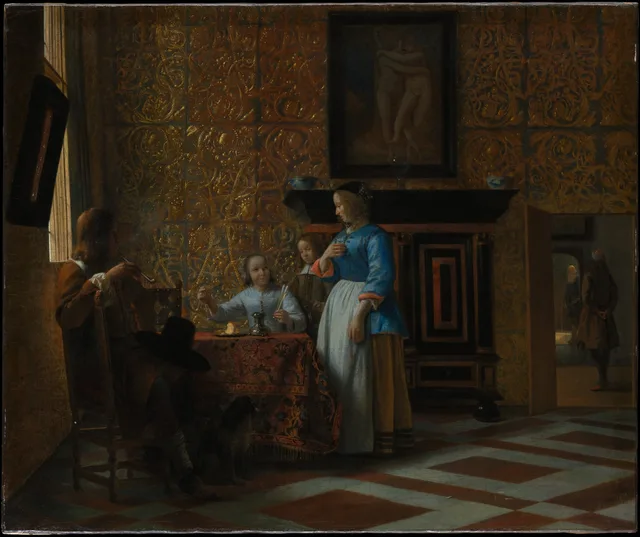 Leisure Time in an Elegant SettingPieter de Hoochca. 1663–65
Too good to keep to yourself
This painting,
for someone who comes to mind
They open it at full size
and see every brushstroke.
About this work
- Artist
- Michiel Sweerts · 1618–1664
- Date
- ca. 1661
- Medium
- Oil on canvas
- Size
- 81.9 × 114.3 cm
- Collection
- The Metropolitan Museum of Art
- Image
- Original long edge 4000px · shown at 2560px
- Original
- View on the museum's website ↗