 Pyeongye
Artwork · 17th century · Pieter de Hooch
LeoTurn on Magnifier at the lower right and move slowly across the painting.
Full screen opens it edge to edge.Tap the painting to fill the screen.
Spread two fingers to look closer.
At a glance
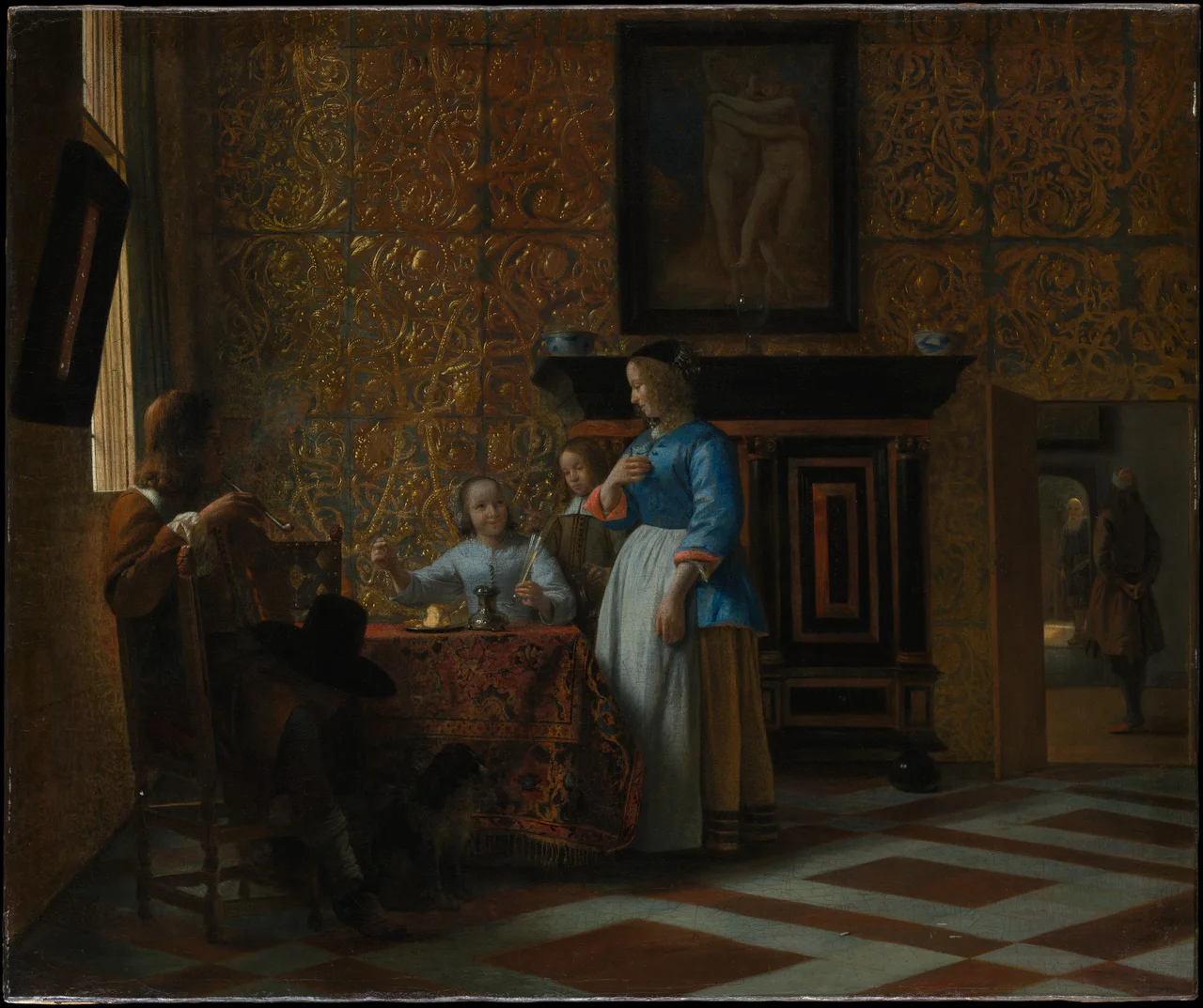
- In a large room lined with golden patterned walls, people smoke, sip wine, and chat, enjoying an idle hour.
- The Dutch painter Pieter de Hooch made it in oil on canvas around 1663 to 1665, in Amsterdam.
- Light from the window, a doorway into another room, and a marble floor make the house open up layer by layer.
Reading the picture
5 places to look closer
Tap a number on the painting to jump to its note, or a close-up to see that spot in the whole picture.
Zoom in on the man by the window at the left. He holds a long white clay pipe to his lips, steadying the stem with one hand. A thin haze of smoke drifts in front of his face. Daylight from the window catches the white lace at his cuff.
Now look at the woman seated at the table. She holds a tall, slender glass of pale wine. In front of her stand a silver candlestick with a twisted candle and a plate with a piece of bread. She smiles as if talking to someone across from her. Fine cracks from the aging paint spread across her pale blue jacket.
Zoom in on the back wall. Golden vines, flowers, and birds swirl across it in square panels, and you can see the seams where the panels meet. Wall coverings like this were made of leather stamped with patterns and given a golden finish. They were an expensive way to decorate rich homes at the time.
Look at the top of the tall cabinet. A white bowl with blue decoration sits at each end, with a small wine glass in the middle. Above them hangs a large framed painting of two figures in an embrace. It is a picture inside a picture.
Zoom in through the open door at the right. Two men stand in another room. The nearer one wears a cap and clasps his hands behind his back. Beyond him, a man with a white beard waits by a doorway. De Hooch often opened a door like this to let us see deeper into the house.
When it was painted
Around 1663, Pieter de Hooch was thirty-three. He was born in Rotterdam in 1629, the son of a bricklayer and a midwife, and the road to a painter's career was not a quick one. In his early twenties he worked as a servant in the household of a linen merchant, Justus de la Grange, and painted pictures for his employer.
In 1654 he married in Delft, and the next year he joined the city's painters' guild. In his Delft years he painted sunny courtyards and plain household scenes. At the same time, in the same town, Johannes Vermeer was painting quiet interiors too.
Around 1660 de Hooch moved his family to Amsterdam. Merchants who had grown rich on overseas trade were building grand houses along the canals there. His painted rooms grew larger and richer as well. The Met describes this scene as a family in a luxurious interior, with gilt-leather walls, Chinese porcelain, and a racy painting of naked lovers hung high on the wall, all signs of the household's wealth.
His last years were not happy ones. In 1684 he died in Amsterdam's asylum for the insane, and no one knows how he came to be there. Much later this painting belonged to Robert Lehman, and it came to the Met with his collection in 1975.
Now look at the lower right corner again. In this rich family's room, painted by a bricklayer's son, the brightest thing is not the golden wall. It is the daylight lying across the floor.
More by the same painter
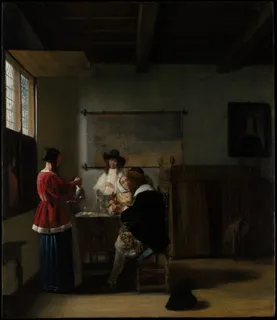
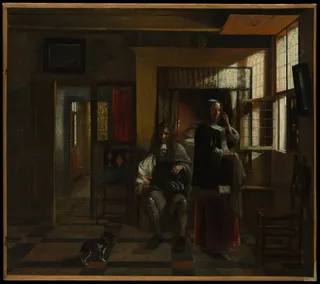
Questions to think about
- Look for itIn the bright patch of floor at the lower right, can you find the pattern of white and red tiles?
- Why?Why do you think de Hooch included two men in the next room, who seem to have nothing to do with the group at the table?
- What about you?Everyone in this room has stopped working to relax together. When you take a break, who do you most want to spend it with, and doing what?
Same period
Painted around the same time,
somewhere else
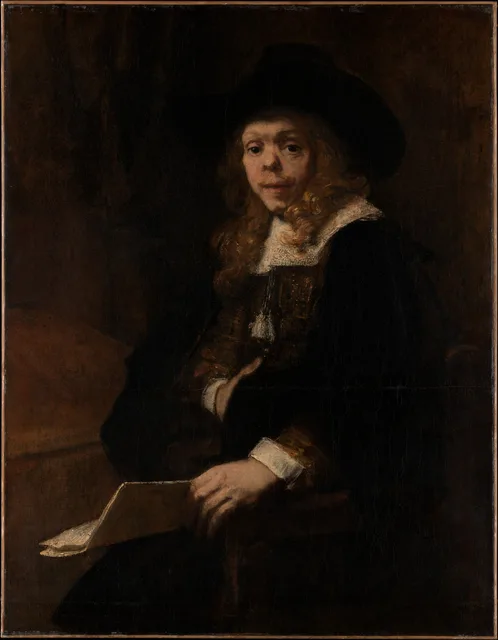 Portrait of Gerard de LairesseRembrandt1665–67
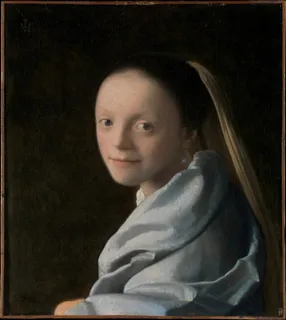 Study of a Young WomanJohannes Vermeerca. 1665–67
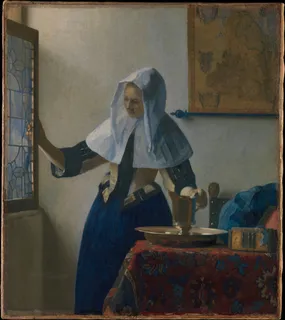 Young Woman with a Water PitcherJohannes Vermeerca. 1662
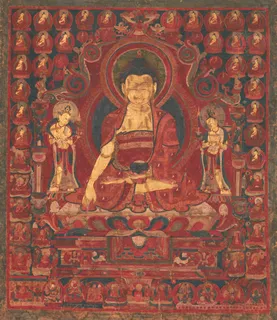 Buddha Shakyamuni as "Lord of the Munis"Unknown artist · Western Tibet, Gugemid-17th century
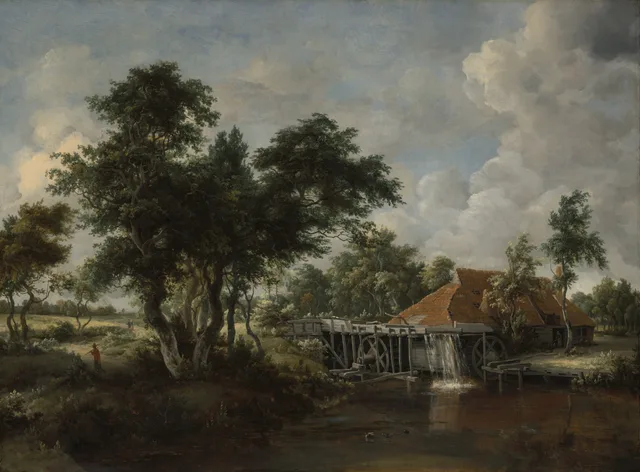 The Watermill with the Great Red RoofMeindert Hobbemac. 1665
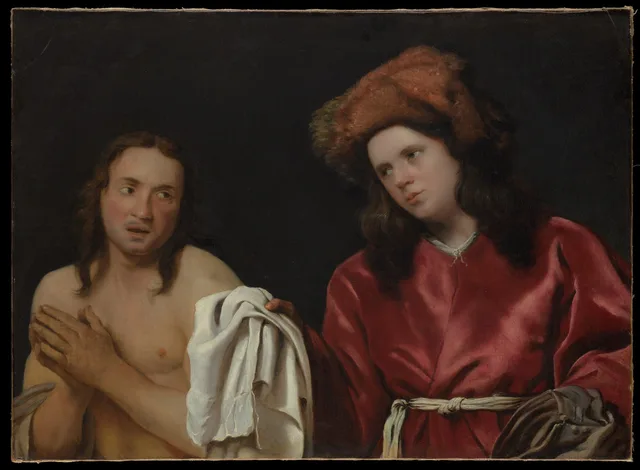 Clothing the NakedMichiel Sweertsca. 1661
Too good to keep to yourself
This painting,
for someone who comes to mind
They open it at full size
and see every brushstroke.
About this work
- Artist
- Pieter de Hooch · 1629–1684
- Date
- ca. 1663–65
- Medium
- Oil on canvas
- Size
- 58.3 × 69.4 cm
- Collection
- The Metropolitan Museum of Art
- Image
- Original long edge 3802px · shown at 2560px
- Original
- View on the museum's website ↗