 Pyeongye
Artwork · 17th century · Johannes Vermeer
LeoTurn on Magnifier at the lower right and move slowly across the painting.
Full screen opens it edge to edge.Tap the painting to fill the screen.
Spread two fingers to look closer.
At a glance
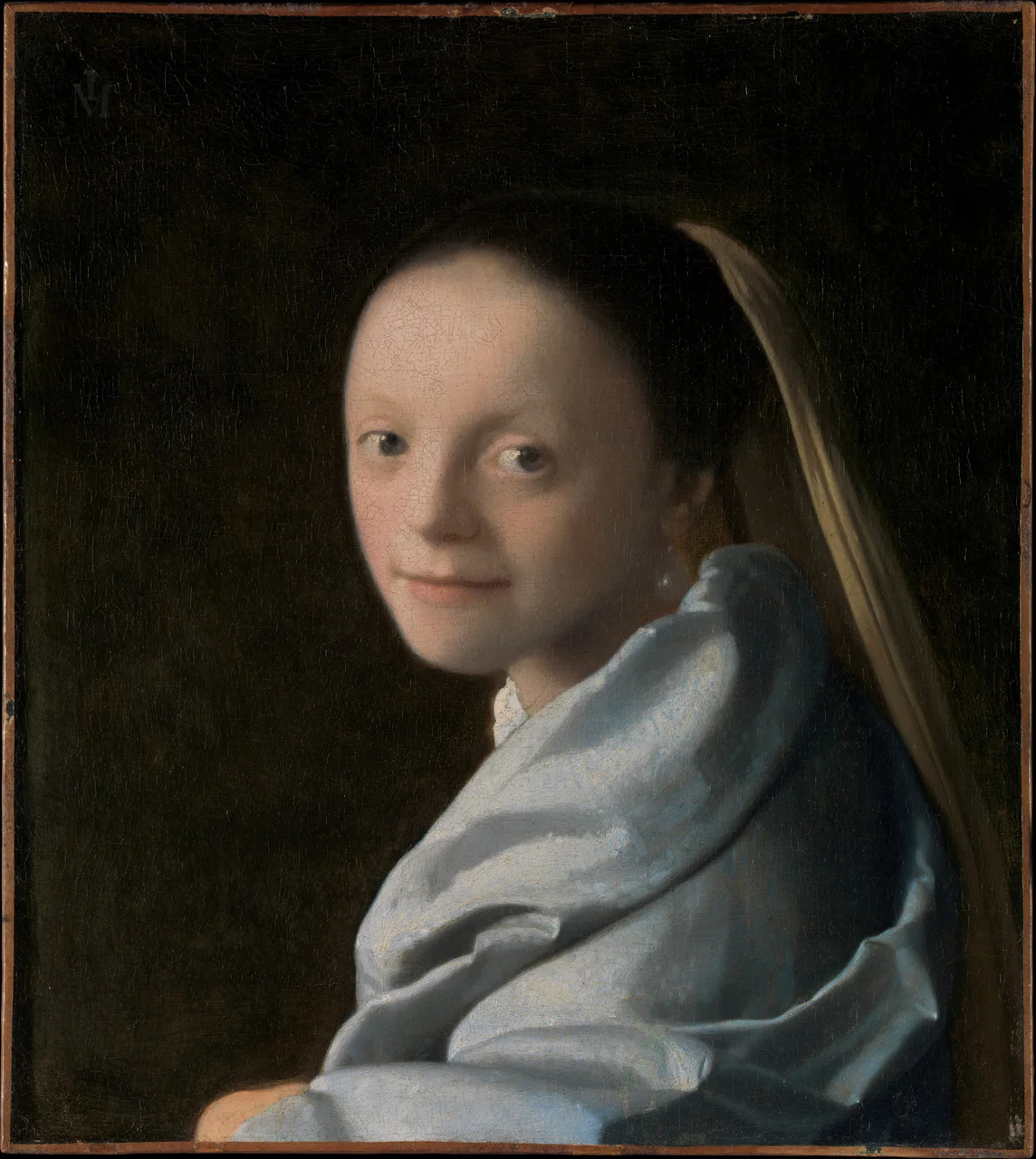
- A girl turns her head over her shoulder and looks straight at us out of a dark, empty background.
- Johannes Vermeer, a painter in the Dutch city of Delft, painted it in oil on canvas around 1665–67.
- It is a study of a face, not a portrait of a named sitter, and it is small, about 44 by 40 centimeters.
Reading the picture
5 places to look closer
Tap a number on the painting to jump to its note, or a close-up to see that spot in the whole picture.
Zoom in on her eyes and mouth. Each eye holds a single dot of white light. The corners of her mouth lift just a little, as if she is about to say something. A web of fine cracks runs across her skin, where the old paint has dried and split over the centuries.
Look just below her ear. Two tiny points of light float in the shadow. That is an earring. Vermeer did not draw its outline at all. He placed the light, and your eye builds the round bead.
Zoom in on the cloth falling behind her head. A long ocher fabric runs from the top of her head down her back. Where the light hits it, a few pale strokes are enough. Where it turns away, it melts into the dark.
Now look at the blue cloth wrapped around her shoulders. Every fold is built from thick strokes of pale gray and sky blue. Her face is painted smooth, the cloth rough, so skin and fabric feel different even from a distance.
Zoom in on the dark background at the upper left. Faint letters appear. This is Vermeer's signature. It sits so deep in the black that you only find it when you enlarge the picture.
When it was painted
In the mid-1660s Vermeer was in his mid-thirties, living in Delft in the house of his mother-in-law, Maria Thins. He had married Catharina Bolnes in 1653. The couple had fifteen children, and four of them died young. In that crowded house he worked slowly, finishing only a few paintings a year. Fewer than forty paintings are accepted as his today.
Dutch painters called a picture like this a tronie. It was not a commissioned portrait. It showed a striking face, an expression, or an unusual costume, and it was made to be sold on the open market. The Met sees this painting as a tronie, and many people pair it with Vermeer's Girl with a Pearl Earring in the Mauritshuis in The Hague, as a companion or a variation.
A few years later, Vermeer's world fell apart. In 1672 French armies invaded the Dutch Republic, the art market collapsed, and he sank into debt. He died in December 1675, at forty-three. In a later petition, his widow Catharina wrote that the weight of those debts sent him into a sudden decline, and he was dead within a day and a half.
In 1696 an auction in Amsterdam offered twenty-one of his paintings at once, and the list included tronies. Whether this picture was one of them is not certain. In 1979 Charles and Jayne Wrightsman gave it to the Metropolitan Museum in memory of the curator Theodore Rousseau Jr.
Look at her eyes once more. Each one holds a single dot of white light. This face left behind no name and no story, yet it came from the hand of a painter working slowly in a house full of children.
More by the same painter
Questions to think about
- Look for itAt the very bottom left, beside the blue cloth, can you find a bit of her bare arm?
- Why?Why do you think Vermeer left the background completely black, with nothing in it?
- What about you?Nobody recorded this girl's name, yet people have been looking at her face for more than 350 years. When a photo of a stranger spreads across the internet today, how much should we care whether that person ever agreed to it?
Same period
Painted around the same time,
somewhere else
 Buddha Shakyamuni as "Lord of the Munis"Unknown artist · Western Tibet, Gugemid-17th century
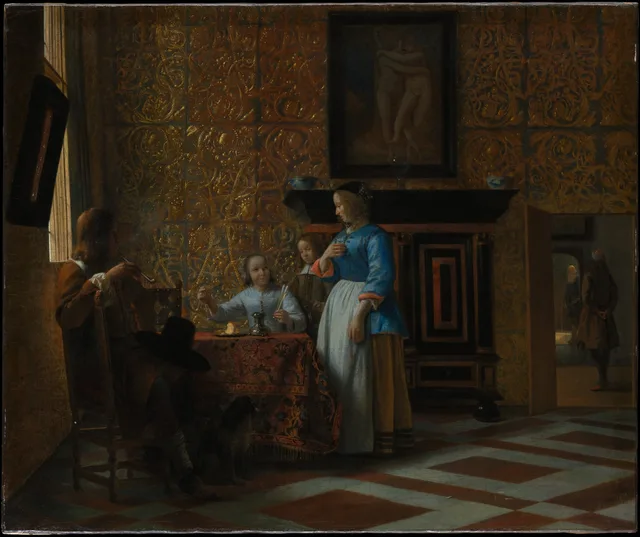 Leisure Time in an Elegant SettingPieter de Hoochca. 1663–65
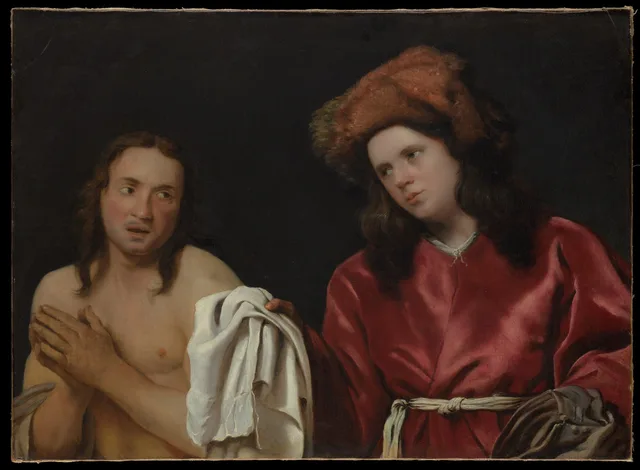 Clothing the NakedMichiel Sweertsca. 1661
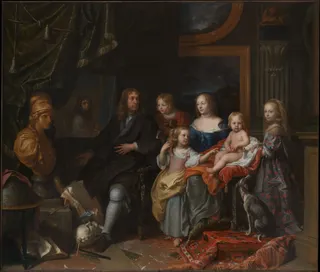 The Jabach FamilyCharles Le Brunca. 1660
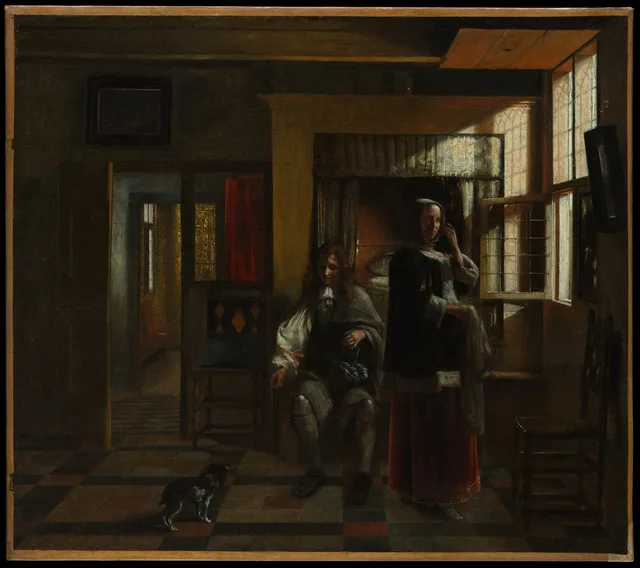 Interior with a Young CouplePieter de Hoochprobably ca. 1662–65
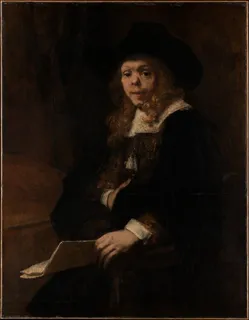 Portrait of Gerard de LairesseRembrandt1665–67
Too good to keep to yourself
This painting,
for someone who comes to mind
They open it at full size
and see every brushstroke.
About this work
- Artist
- Johannes Vermeer · 1632–1675
- Date
- ca. 1665–67
- Medium
- Oil on canvas
- Size
- 44.5 × 40 cm
- Collection
- The Metropolitan Museum of Art
- Image
- Original long edge 3866px · shown at 2560px
- Original
- View on the museum's website ↗