 Pyeongye
Artwork · 19th century · Jean Auguste Dominique Ingres
LeoTurn on Magnifier at the lower right and move slowly across the painting.
Full screen opens it edge to edge.Tap the painting to fill the screen.
Spread two fingers to look closer.
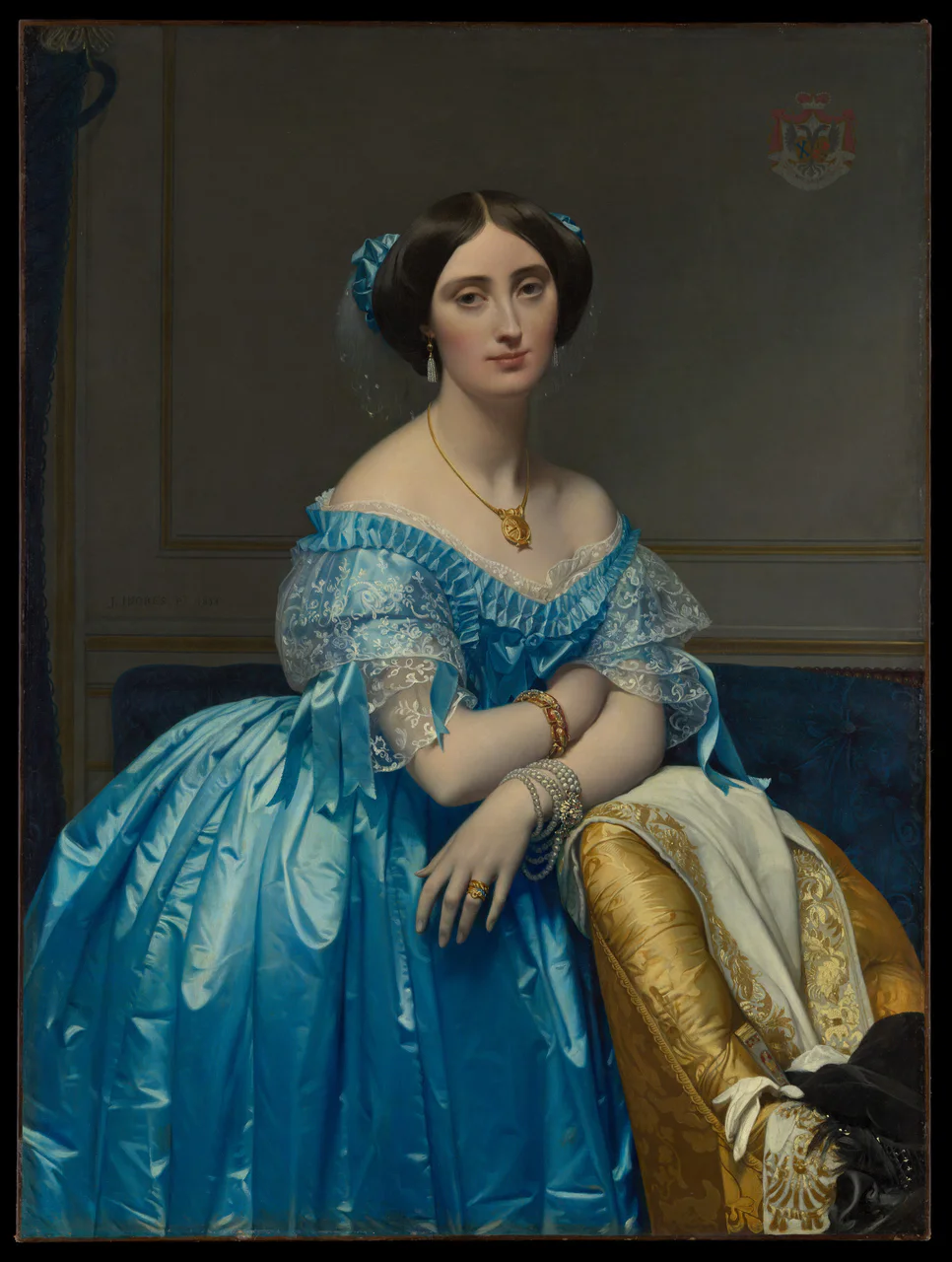
Joséphine-Éléonore-Marie-Pauline de Galard de Brassac de Béarn (1825–1860), Princesse de Broglie
Jean Auguste Dominique Ingres1851–53Oil on canvas121.3 × 90.8 cm
At a glance
- A young princess in a blue satin gown leans on a gold chair and looks at us, calm and a little distant.
- Jean Auguste Dominique Ingres painted her in 1851–53, when he was already past seventy.
- The shine of the satin, every pearl, and the gold pendant are painted so smoothly that you can barely find a brushstroke.
Reading the picture
5 places to look closer
Tap a number on the painting to jump to its note, or a close-up to see that spot in the whole picture.
Start with her face. Dark hair, parted in the middle, curves down over her ears. Her eyelids are slightly heavy and her lips hardly smile. She seems to look at us and past us at the same time.
Now look at the end of her necklace. A round gold pendant hangs from a thin chain, and it even casts a small shadow on her skin. On a jewel no bigger than a fingernail, the lit side and the shaded side are clearly separated.
Move down to her folded arms. On the arm resting on top is a gold bracelet with red inlay. Several strands of pearls wrap the wrist below, and each pearl has its own tiny highlight. The gold ring on her finger is set with a blue stone.
Zoom in on the gold chair at the lower right. A white shawl with gold patterns, a pair of white gloves, and a black cloth lie across it. It looks as if she has just come in and set them down. Here the brushwork is quicker and thicker than on the glassy gown.
Look high on the dark wall at the right. A small coat of arms is painted there. Red drapery hangs under a crown, and a double-headed eagle holds two shields. The shield on the left shows a blue X on a gold ground.
When it was painted
Around 1850 a young nobleman, Albert de Broglie, asked Ingres to paint his wife. A few years earlier Ingres had painted Albert's sister, the Comtesse d'Haussonville, and that portrait had been a great success. It now hangs in the Frick Collection in New York.
Ingres was nearly seventy and one of the grand old men of French art. He had run the French Academy in Rome and then come home to Paris. He saw himself above all as a painter of history and myth, and he often complained that portraits stole his time. Still, the aristocrats kept asking.
His own life changed a great deal in these years. His wife Madeleine died in 1849, and in 1852 he married Delphine Ramel. In 1853 he also painted a vast ceiling honoring Napoleon for the Paris city hall, which was lost when the building burned in 1871.
The portrait was finished in 1853, and you can just make out INGRES and that date halfway down the left wall. Pauline died seven years later, in 1860. Her husband went on to become a respected historian and, in the 1870s, prime minister of France.
The painting stayed with the Broglie family for more than a century. In 1958 the American banker Robert Lehman bought it, and in 1975 it came to the Metropolitan Museum with the rest of his collection.
Look again at the small coat of arms high on the right wall. The blue X on gold is the emblem of the Broglie family. The family that kept this picture for over a hundred years had its mark painted into it from the very start.
More by the same painter
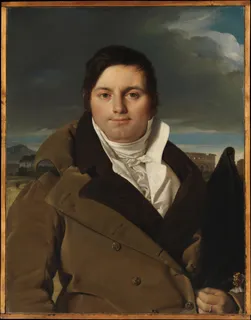
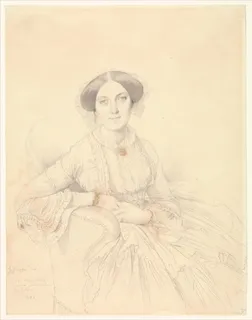
Questions to think about
- Look for itHow many gold or glittering objects can you find in this painting?
- Why?Why do you think Ingres kept the wall dark and plain, and let only the gown and jewelry shine?
- What about you?This portrait may show her smoother and calmer than she really looked. Now that anyone can retouch a photo with one tap, is it fair to share a face that has been polished beyond the real one?
Same period
Painted around the same time,
somewhere else
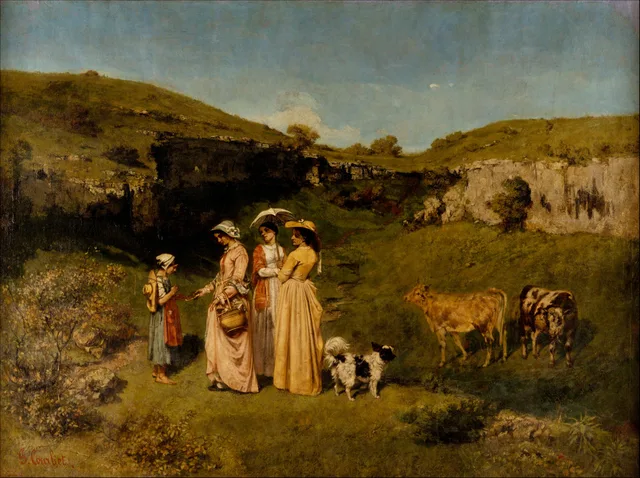 Young Ladies of the VillageGustave Courbet1851–52
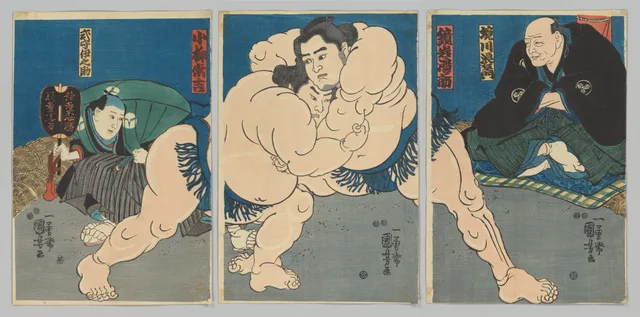 Sumo Wrestlers Kagamiiwa Hamanosuke and Koyanagi Tsunekichi, with Judge Sakaigawa Namiemon and Referee Shikimori KiichirōUtagawa Kuniyoshi1847–52 (Kōka 4–Kaei 5)
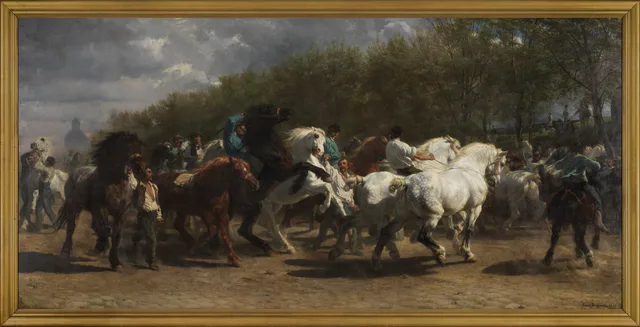 The Horse FairRosa Bonheur1852–55
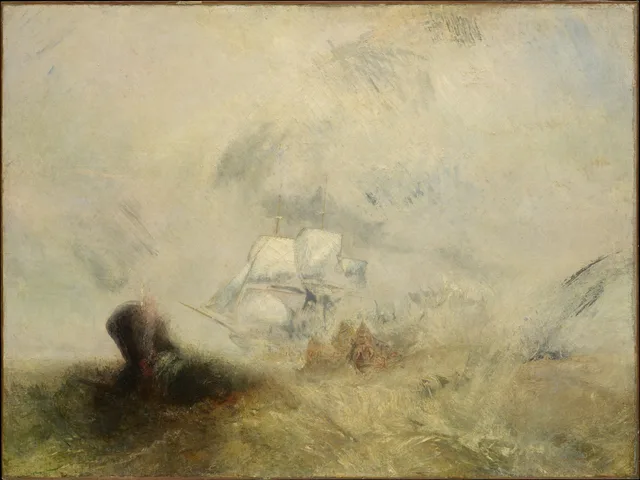 WhalersJoseph Mallord William Turnerca. 1845
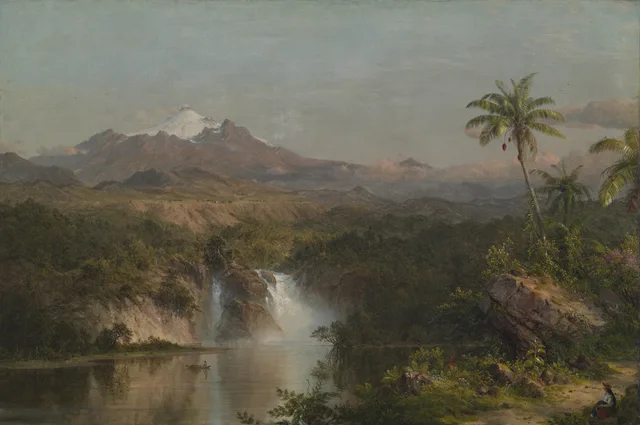 View of CotopaxiFrederic Edwin Church1857
 Mère GrégoireGustave Courbet1855, reworked 1857–59
Too good to keep to yourself
This painting,
for someone who comes to mind
They open it at full size
and see every brushstroke.
About this work
- Artist
- Jean Auguste Dominique Ingres · 1780–1867
- Date
- 1851–53
- Medium
- Oil on canvas
- Size
- 121.3 × 90.8 cm
- Collection
- The Metropolitan Museum of Art
- Image
- Original long edge 4000px · shown at 2560px
- Original
- View on the museum's website ↗