 Pyeongye
Artwork · 17th century · Johannes Vermeer
LeoTurn on Magnifier at the lower right and move slowly across the painting.
Full screen opens it edge to edge.Tap the painting to fill the screen.
Spread two fingers to look closer.
At a glance
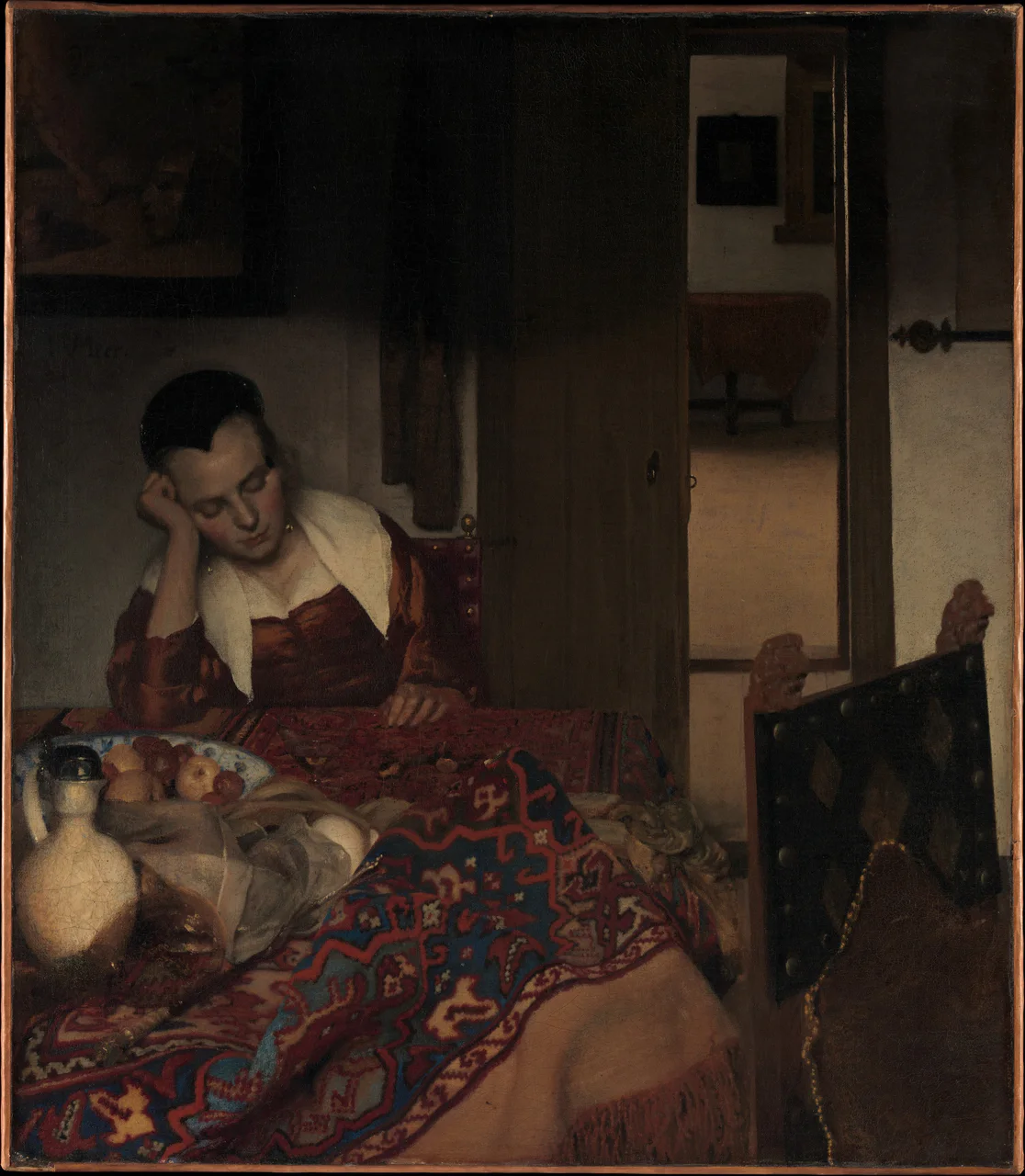
- A young woman dozes at a table with her head propped on her hand, beside a bowl of fruit and a wine jug.
- Johannes Vermeer of Delft painted it around 1656–57.
- It is one of his early domestic interiors, and X-rays have revealed a man and a dog that he painted out.
Reading the picture
5 places to look closer
Tap a number on the painting to jump to its note, or a close-up to see that spot in the whole picture.
Zoom into the woman's face. Her eyes are closed and her head rests against the back of her right hand, tipped slightly to one side. A small pearl earring catches the light. A touch of red on her cheek and lips keeps the sleeping face warm.
Look at the table in the front left. A pale jug, a blue-patterned bowl of apples and other fruit, and a crumpled white cloth are all piled together. Fine cracks spread across the jug like a net. That is the old paint itself splitting with age.
Zoom into the carpet over the table. Red, deep blue, and cream patterns are painted so thickly they look knotted from real wool. The carpet folds over the table's edge and spills toward us. Dutch households of the time often laid expensive carpets on tables rather than floors.
Look through the half-open door at the upper right. In the room beyond stand a table with a red cloth, a framed picture on the wall, and a window frame. It is empty now. At first there was a dog in this doorway and a man in the far room, until Vermeer painted over them.
Find the chair in the front right. Its dark leather back is studded with round brass nails, and carved lion-like heads rise from its top. The chair is pushed out at an angle. It looks as though someone has just got up from it.
When it was painted
Around 1656 Vermeer was twenty-four. Three years earlier he had married Catharina Bolnes, and that same year he joined the Guild of Saint Luke, the painters' guild of Delft.
At the time, a maid nodding off at her work was a popular subject among Dutch painters. Artists like Nicolaes Maes turned her into a comic scene that scolded laziness. Vermeer chose the same subject, yet nothing in his picture points a finger at her.
X-rays show where he changed his mind. In the first version, a dog stood in the doorway and a man was in the room behind. Vermeer removed both, leaving only an empty room and an open door. The story became quieter, and much harder to read.
In a 1696 auction list in Amsterdam, the painting was described as a drunken maid asleep at a table. Vermeer had died in 1675, at forty-three, leaving debts and more than ten children. The picture passed through many hands before the American collector Benjamin Altman acquired it. When he died in 1913, he left it to The Metropolitan Museum of Art.
Look again at that half-open door. With the dog and the man gone, the empty doorway leaves us wondering a little longer about what the sleeper is dreaming.
More by the same painter
Hidden stories in this painting
Questions to think about
- Look for itHow many things on the table look tipped over or out of place?
- Why?Why do you think Vermeer painted out the dog in the doorway and the man in the far room?
- What about you?Old paintings mocked a dozing maid as lazy. Today, when you see someone who works long hours nodding off for a moment, how do you feel about it?
Same period
Painted around the same time,
somewhere else
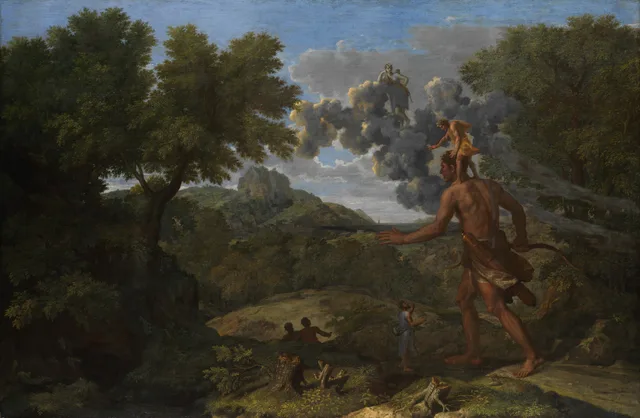 Blind Orion Searching for the Rising SunNicolas Poussin1658
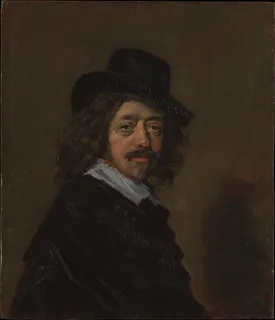 Frans Hals (1582/83–1666)Frans Halsprobably 1650s
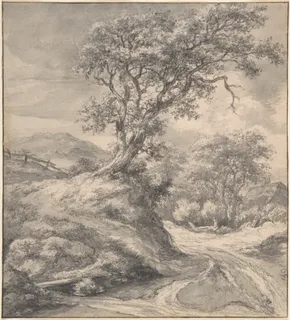 Dune Landscape with Oak TreeJacob van Ruisdael1650–55
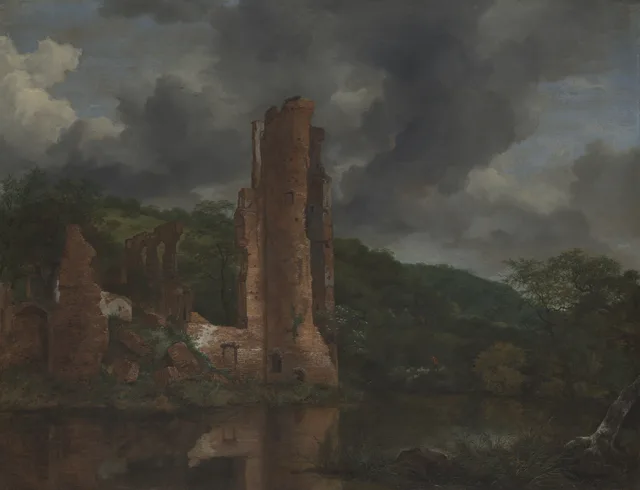 Landscape with the Ruins of the Castle of EgmondJacob van Ruisdael1650–55
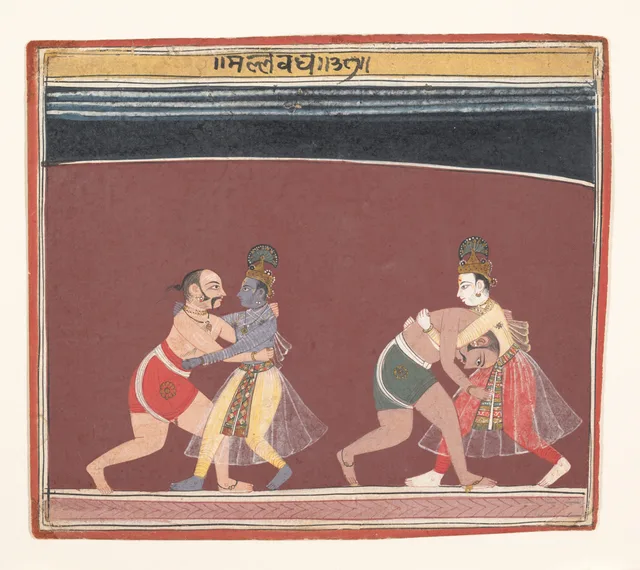 Krishna and Balarama Fight the Evil King Kamsa’s Wrestlers: Page from a Dispersed Bhagavata PuranaUnknown artist · India (Madhya Pradesh, Malwa)ca. 1650
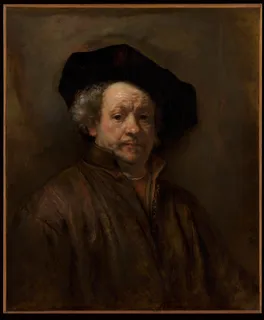 Self-PortraitRembrandt1660
Too good to keep to yourself
This painting,
for someone who comes to mind
They open it at full size
and see every brushstroke.
About this work
- Artist
- Johannes Vermeer · 1632–1675
- Date
- ca. 1656–57
- Medium
- Oil on canvas
- Size
- 87.6 × 76.5 cm
- Collection
- The Metropolitan Museum of Art
- Image
- Original long edge 3861px · shown at 2560px
- Original
- View on the museum's website ↗