Pyeongye
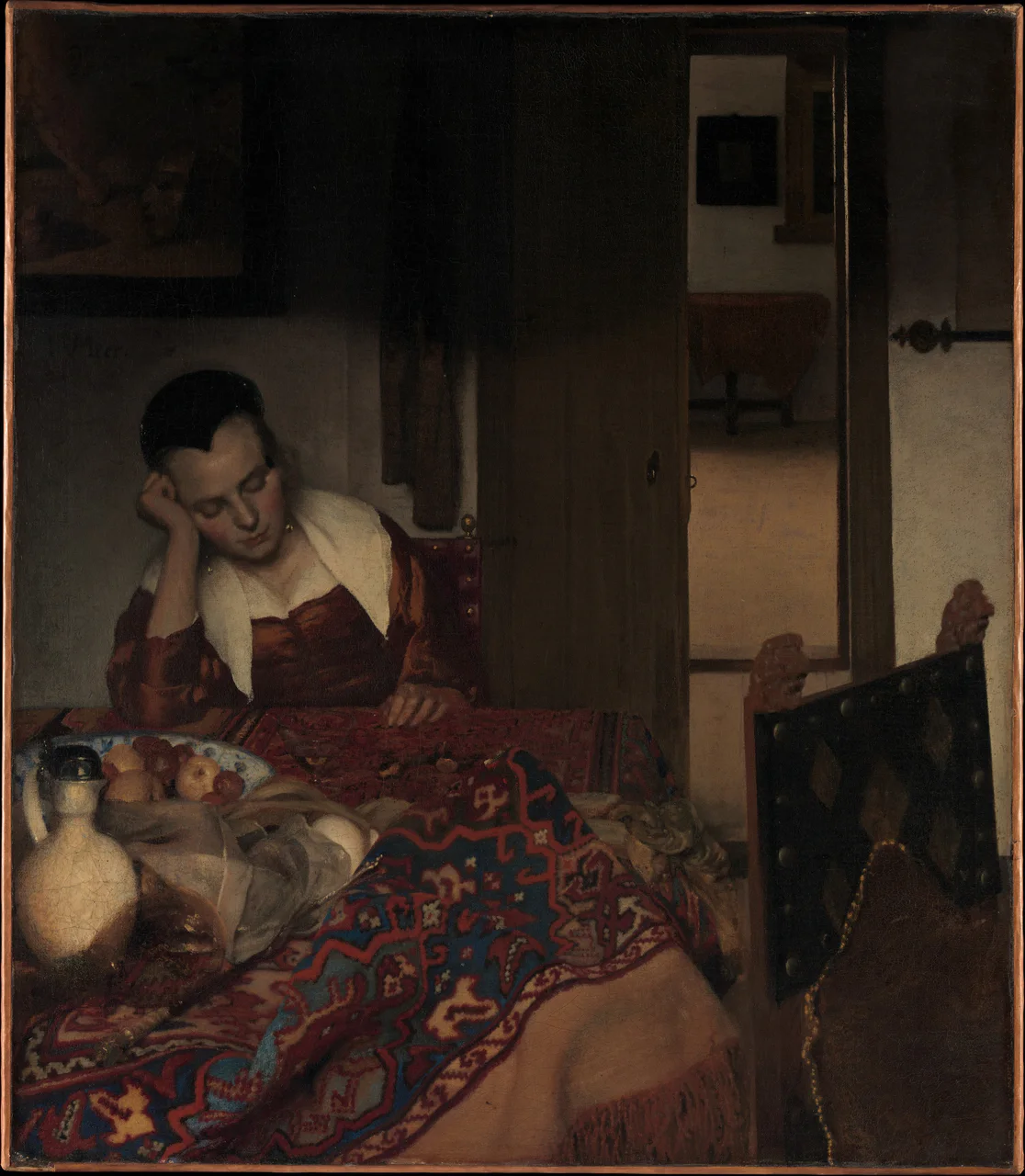
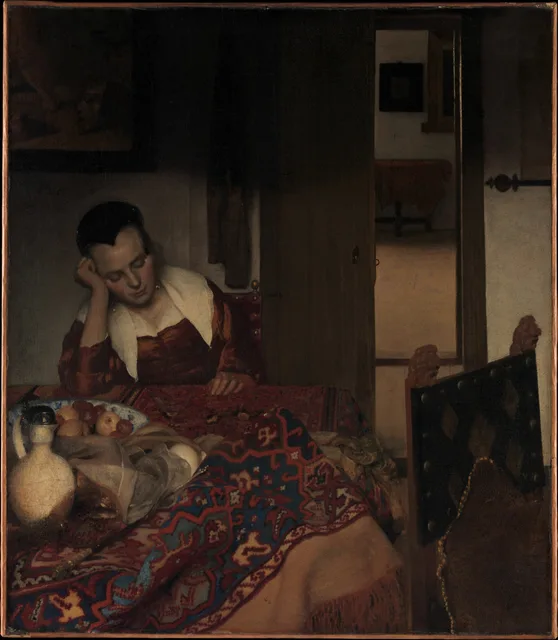
A young woman sits at a table and dozes. She props her head on her right hand, and her eyelids have almost closed. A richly patterned carpet covers the table like a cloth, and on it stand a white jug and a dish of fruit. The room is very still.
On the right, a door stands half open. Through it you can see into another room. Nobody is there. But that empty doorway holds a secret. It was not always empty.
Johannes Vermeer painted A Maid Asleep around 1656 or 1657. The canvas is about 34 1/2 by 30 inches. Fewer than forty paintings by Vermeer survive in all, and this is one of the earlier ones.
Start by looking through the open door.
On a pale floor stands a table covered with a reddish cloth. A framed picture hangs on the wall above it. On the edge of the door you can make out a small keyhole and a little ring. The front room is dim, but the back room glows with light coming from somewhere we cannot see.
When the painting was examined with X-rays and other technical methods, things that are no longer visible turned up under the paint. Vermeer had first painted a man in the back room and a dog in the doorway. Later he painted over both of them.
Now look at the spot near the threshold, where the dog used to be.
All that remains is a stretch of bare, yellowish floor and the dark line of the door frame. Stare as long as you like; there is no dog and no man. The hidden layers can only be seen with special equipment.
Think about how different the picture would be if they had stayed. Someone would have just walked in, or be about to leave. Something would be happening. Vermeer removed that event. So now we look at the empty doorway and wonder for ourselves. Did someone just pass through? Or did no one come at all?
When the painting was sold at auction in Amsterdam in 1696, the sale list described it as a drunken maid asleep at a table. Yet nothing in the picture clearly tells us she is drunk. Go back to her face.
Her head tilts gently against her hand. A small earring catches the light, and a white collar lies across her shoulders. Why she is so tired, the painting never says.
Vermeer often worked this way in his quiet rooms in Delft. He gives us the light, the objects, and a person caught in a private moment, and he leaves the story open. Here we can actually see him choosing to leave it open, by taking two figures away.