Pyeongye
Painters · 19th century
Camille Pissarro
1830–1903
Born on a Caribbean island, he spent his life painting the hills, fields and farm workers of the villages around Paris, and he showed at all eight Impressionist exhibitions.
Scenes from a life
The life of Camille Pissarro,
scene by scene
- 1852Caracas
It is 1852 on St. Thomas, a Danish island in the Caribbean. Camille, twenty-two, walks away from his father's store and boards a ship. His companion is the Danish painter Fritz Melbye. His parents did not want him to become an artist, but the two young men sailed for Venezuela anyway.
He stayed about two years in Caracas and La Guaira, sketching streets, people, mountains and the coast. When he came back to the island, his parents finally let him go to Paris to study painting.
- 1860Paris
In Paris, Pissarro worked at the Académie Suisse, a studio where anyone could pay to draw from a model. There he met a younger painter named Claude Monet.
In 1860 a young woman named Julie Vellay came to work in his parents' Paris household as a kitchen maid. Pissarro soon fell in love with her. His mother disapproved. Their first son, Lucien, was born in 1863, but the wedding would wait for years.
- 1868Paris
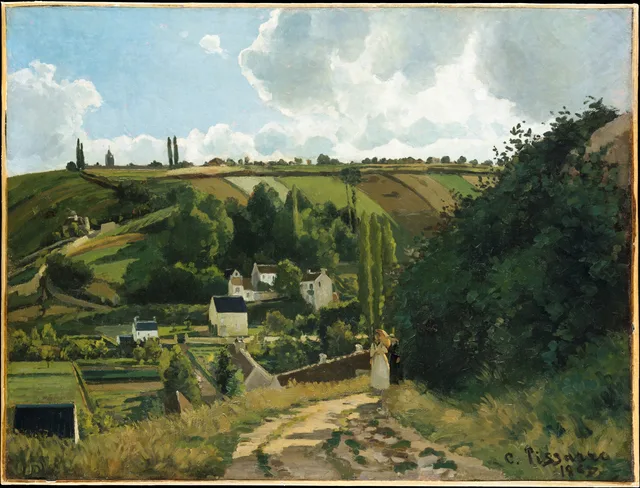
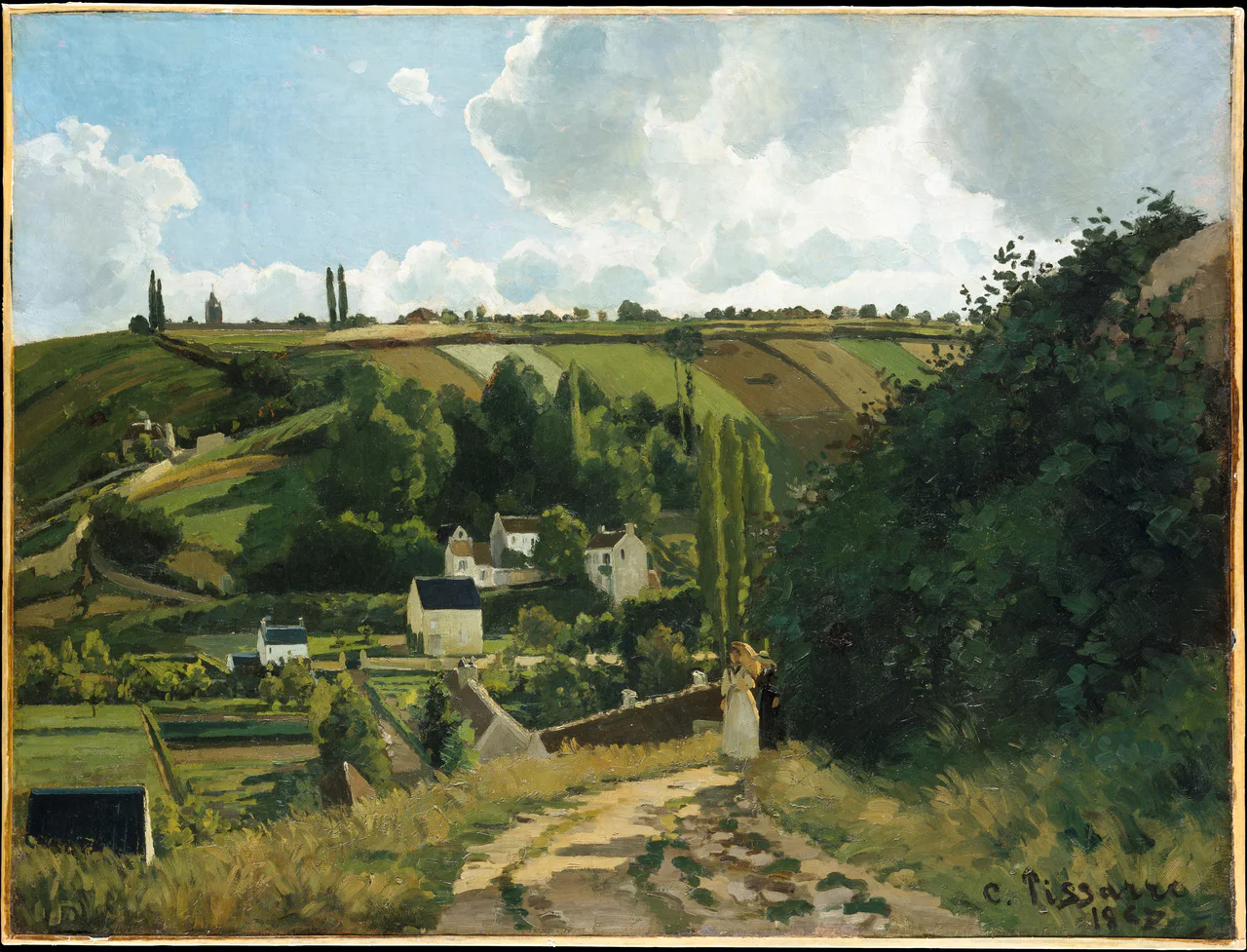
In the spring of 1868, a view of a hillside at Pontoise hangs at the Paris Salon. The landscape painter Charles-François Daubigny, a member of that year's jury, had argued for accepting Pissarro's work. The novelist Émile Zola reviewed the show and praised the painting warmly.
Look at Jalais Hill, Pontoise. Two figures, one in white and one in black, stand side by side on the dirt road at right. Behind them, white houses sit on the slope, and the fields above run in bands of green and brown.
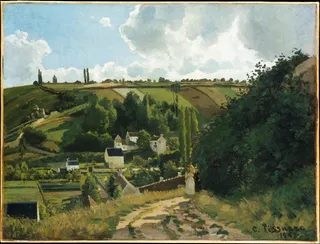 Painted around this timeJalais Hill, Pontoise
- 1871London
When war broke out between France and Prussia in 1870, the family fled to Norwood, south of London. There Pissarro met Paul Durand-Ruel, a Paris art dealer who had also escaped the war, and Durand-Ruel bought his paintings. On June 14, 1871, Camille and Julie were finally married in nearby Croydon.
Back in France that year, they found their house at Louveciennes ransacked. Prussian soldiers had used it as quarters, and many of the paintings he had left behind were destroyed. Years of work were gone.
- 1874Paris
In April 1874, an exhibition opens in the former studio of the photographer Nadar on the Boulevard des Capucines. The artists had organized it themselves, with no Salon jury. Pissarro drew up the group's rules, modeling them on the charter of a bakers' union in Pontoise.
Critics mocked the painters and called them Impressionists. The group held eight exhibitions through 1886, and Pissarro showed work in every one of them.
- 1881Pontoise
In the summer of 1881, visitors arrive at Pissarro's home in Pontoise. His old friend Paul Cézanne came to paint beside him, and Paul Gauguin, still working at the stock exchange, spent his vacation there. Now past fifty, Pissarro was a teacher figure for younger artists.
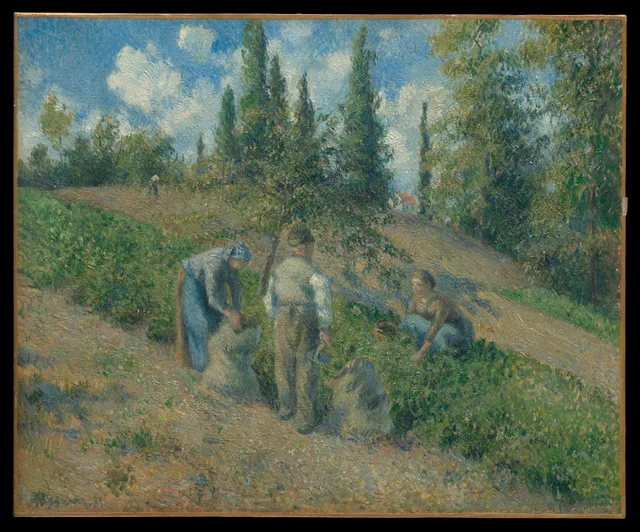
In The Harvest, Pontoise, three farm workers step forward on a sunny slope. At left, a woman in a blue apron bends to grip a sack. A man in a white shirt stands with his back to us. At right, a young woman crouches and reaches toward the ground.
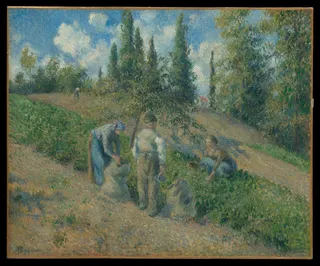 Painted around this timeThe Harvest, Pontoise (La Récolte, Pontoise)
- 1892Éragny-sur-Epte
Since 1884 the family had rented a house in the village of Éragny, near Normandy. In 1892 the owner put it up for sale. While Pissarro was away in London, Julie went to Monet and asked to borrow 15,000 francs. Monet lent the money, and the family bought the house.
Its garden, orchard and the meadow in front became the views Pissarro painted again and again for the rest of his life.
- 1903Paris
In his last years Pissarro suffered from a chronic eye infection. Told to avoid wind and dust, he moved his easel from the fields to the window. From hotel rooms in Paris, Rouen and Le Havre he painted series of bridges, streets and harbors.
He died in Paris on November 13, 1903, at seventy-three. His sunny hillside and his harvesters now hang at the Metropolitan Museum of Art in New York.
People around them
- Julie VellayShe worked in his parents' household and became his wife at Croydon in 1871.
- Fritz MelbyeThe Danish painter who sailed with him to Venezuela in 1852.
- Paul CézanneA friend who often painted beside him at Pontoise and later listed himself in an exhibition catalogue as Pissarro's pupil.
- Claude MonetA fellow painter from the Académie Suisse who lent the money for the Éragny house.
- Paul Durand-RuelThe dealer he met in London, who bought his work.
- Lucien PissarroHis eldest son, born in 1863, who also became an artist.
Works