Pyeongye
Painters · 19th century
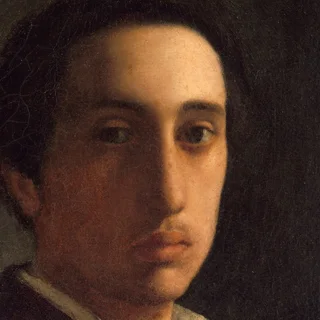
Edgar Degas
1834–1917
A Parisian painter who looked where others rarely did, into rehearsal rooms, hat shops, and bathrooms, and caught people at the moment they were absorbed in something.
Scenes from a life
The life of Edgar Degas,
scene by scene
- 1856Italy
Born in 1834 into a Paris banking family, the eldest son dropped his law studies to paint. At twenty-two he set off for Italy and spent about three years moving between Naples, Rome, and Florence, copying the old masters. His grandfather had founded the family bank in Naples. In Florence lived his aunt Laura and her family, and the large group portrait he began of them, The Bellelli Family, grew out of this trip.
- 1865Paris
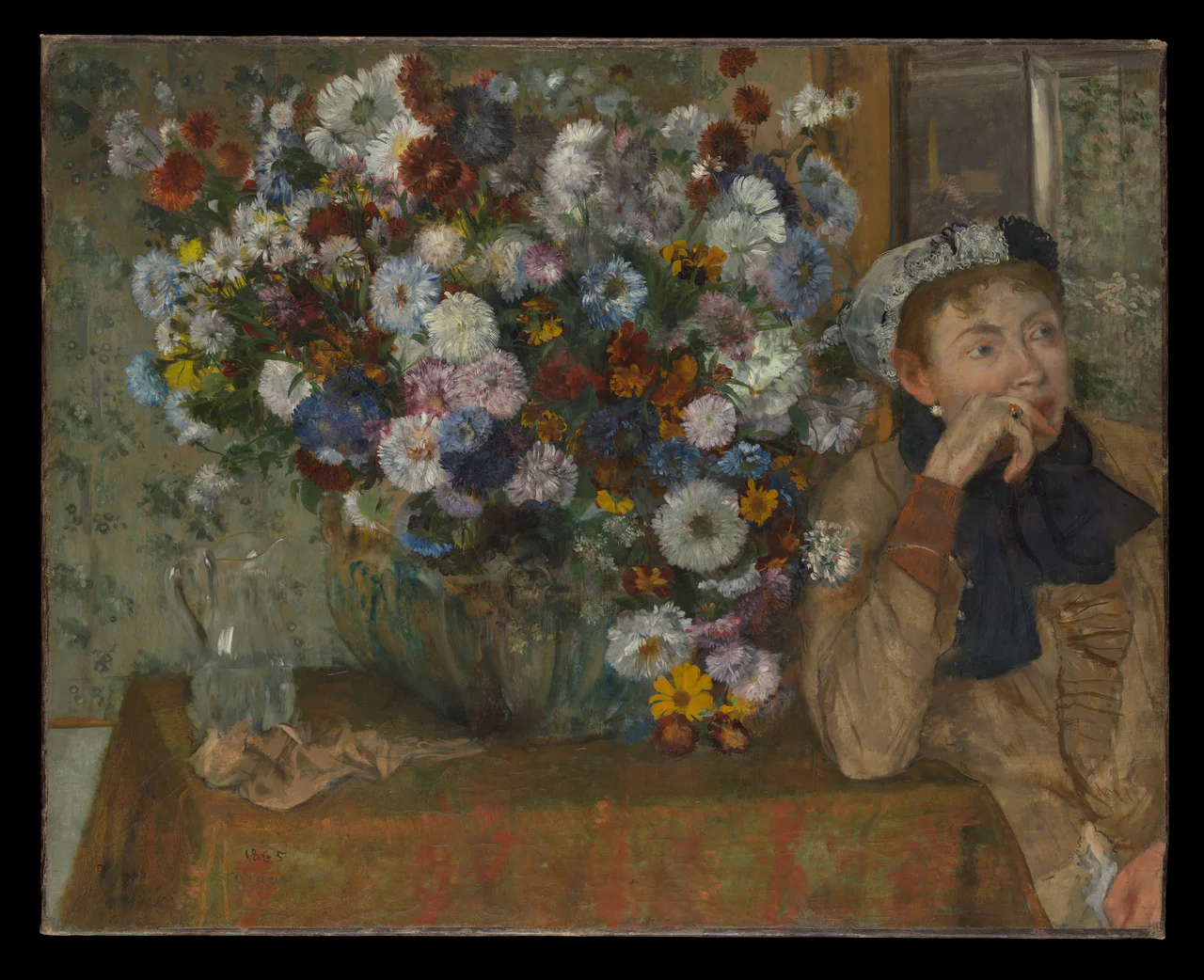
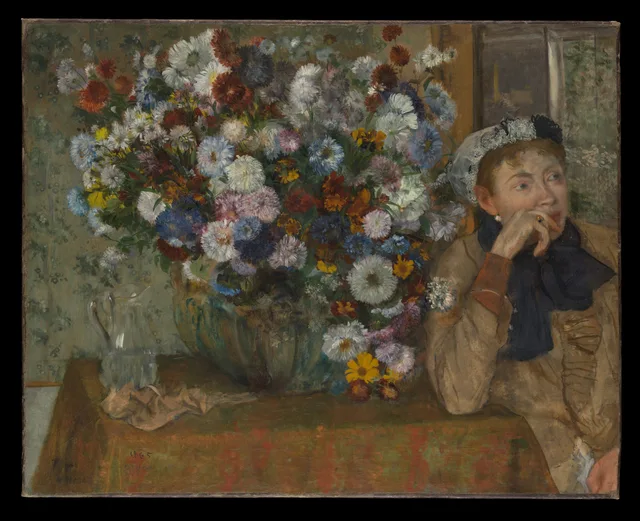
A huge bouquet takes over the middle of the canvas. White chrysanthemums, dark red blooms, and bursts of yellow crowd together, while the only person is pushed to the far right edge. She rests her hand against her mouth and looks off at something we cannot see. Check the tablecloth in the lower left: the year 1865 is painted right into it. The museum thinks the sitter may be the wife of Paul Valpinçon, Degas's school friend, but it keeps a question mark in the title.
 Painted around this timeA Woman Seated beside a Vase of Flowers (Madame Paul Valpinçon?)
- 1872New Orleans
Degas's mother came from New Orleans. In the fall of 1872 he crossed the Atlantic to visit two of his brothers, who worked in the cotton trade there. He stayed about five months, painting his mother's relatives and a crowded cotton office full of men at work. It was his only trip to America.
- 1874Paris
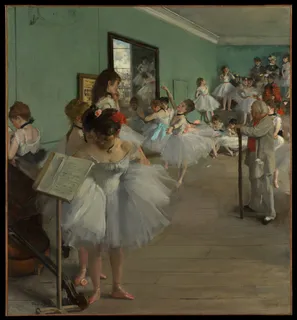
In the spring of 1874, a group of artists working outside the official Salon put on their own show in a photographer's former studio. It would later be called the first Impressionist exhibition, and Degas was one of its organizers. Look at the old man with the cane on the right of The Dance Class, painted the same year. In front of this teacher in a red scarf, one girl lifts her arm to show a step. Meanwhile the girl up front bends her head to fuss with her skirt, and the one behind her rests a hand at her chin and looks off to the side. This is not a performance. It is the waiting that fills a rehearsal room.
 Painted around this timeThe Dance Class
- 1875Naples
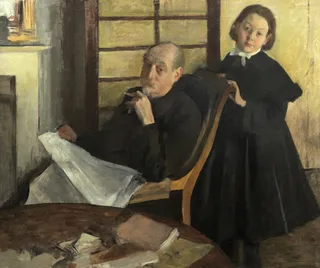
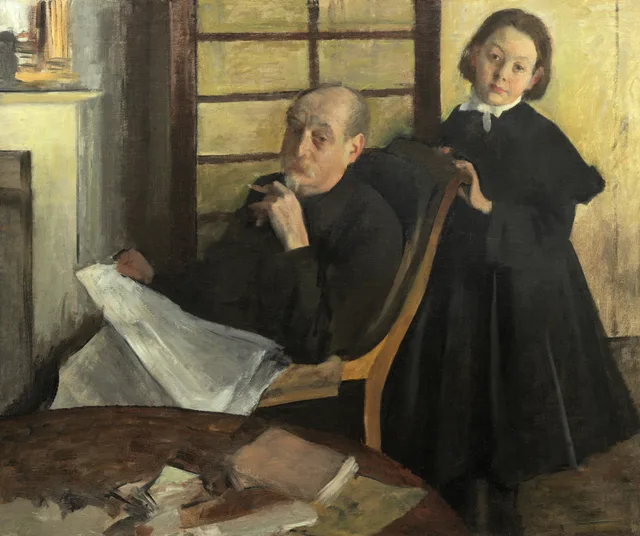
Degas's father died in Naples in 1874. The next year the painter spent about four months there and painted his uncle Henri with his cousin Lucie. Lucie had lost both parents and had just been placed in her uncle's care. Both wear black mourning clothes, and the back of a chair splits the canvas between them. Henri sits lost in thought, a newspaper in his hand. Lucie leans on the chair and looks straight at us. The nephew painting them had just lost a father too.
 Painted around this timeHenri Degas and His Niece Lucie Degas (The Artist's Uncle and Cousin)
- 1881Paris
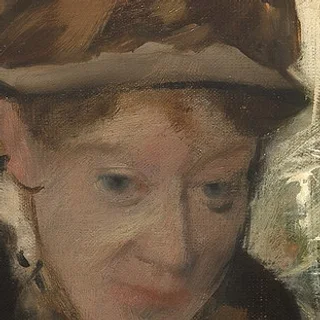
At the sixth Impressionist exhibition, Degas showed a wax sculpture of a fourteen-year-old dancer. He dressed her in a real fabric skirt and gave her real hair, and viewers were startled. Around these years he also kept returning to hat shops. In The Millinery Shop, a woman in a green dress studies an orange hat in her gloved hands. But notice the hat with the green ribbon on the stand beside her. It sits so that it seems to be perched on her own head. Is she a customer or a shop worker? Degas lets us wonder.
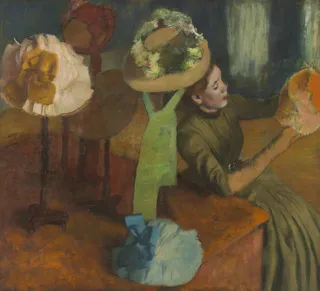 Painted around this timeThe Millinery Shop
- 1886Paris
At the eighth and last Impressionist exhibition, Degas hung a group of pastels showing women bathing, drying themselves, and having their hair combed. Woman Having Her Hair Combed comes from these years. The woman tips her head back with her eyes closed while a maid in pink takes hold of her hair. Look at the yellow armchair: its texture is built from crisscrossing strokes of pastel. As his eyesight weakened, Degas relied more and more on pastel and sculpture instead of oil paint.
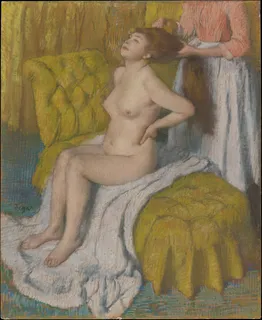 Painted around this timeWoman Having Her Hair Combed
- 1917Paris
Degas died in Paris in September 1917, at eighty-three. In his last years he could barely see and had stopped working. He never married, and he was a keen collector of other artists' work, including Ingres and Delacroix. After his death, the wax figures he had kept almost entirely to himself were found in his studio and later cast in bronze.
People around them
- Édouard Maneta close friend and a rival, each very aware of the other's work.
- Mary Cassattthe American painter Degas invited to join the Impressionist exhibitions, and a colleague who followed his work for years, as he followed hers.
- Paul Valpinçona school friend whose family Degas painted more than once.
- Henri Degashis uncle in Naples, painted in 1875 with his niece Lucie.
- René de Gasa younger brother who worked in the cotton business in New Orleans.
Works
Paintings by
Edgar Degas on Pyeongye
 A Woman Seated beside a Vase of Flowers (Madame Paul Valpinçon?)1865The Dance Class1874
 Henri Degas and His Niece Lucie Degas (The Artist's Uncle and Cousin)1875–76The Millinery Shop1879-86
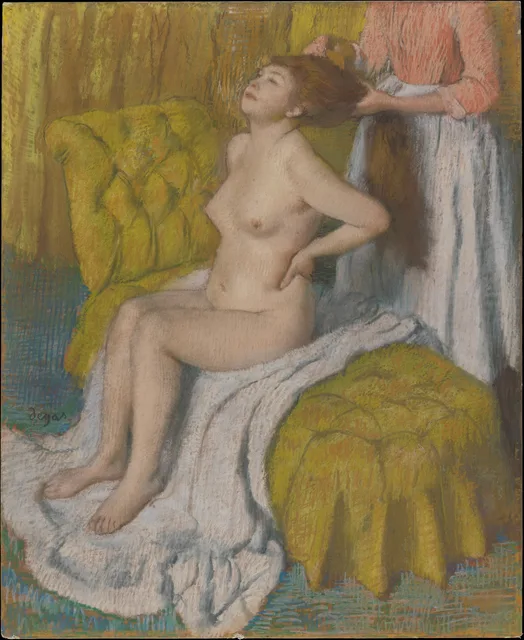 Woman Having Her Hair Combedca. 1886–88
Hidden stories in Edgar Degas's paintings
Contemporaries