Pyeongye

Painters · 19th century
James McNeill Whistler
1834–1903
Born in Massachusetts, trained in Paris and famous in London, Whistler asked people to look at paintings the way they listen to music, and he took a critic to court to defend that idea.
Scenes from a life
The life of James McNeill Whistler,
scene by scene
- 1845St. Petersburg
An eleven-year-old American boy starts drawing classes at the Imperial Academy of Fine Arts in the Russian capital. His father, George Washington Whistler, was a railway engineer. Tsar Nicholas I had hired him to build the line between St. Petersburg and Moscow, and the family had followed him there.
The academy was a short walk from the Whistlers' home. Then, in 1849, his father died of cholera. His mother, Anna, took the children back to the United States.
- 1854West Point and Washington
In the summer of 1854 the cadet James Whistler is dismissed from the U.S. Military Academy at West Point, his father's old school. He had failed chemistry and piled up too many demerits. The one class he shone in was drawing.
That November he found a job in the drawing office of the U.S. Coast Survey in Washington. Jefferson Davis, then Secretary of War, met him and recommended him for the post. The pay was a dollar and a half a day, and he learned to etch by engraving maps onto copper plates. He turned up for work so irregularly that he was gone within a few months. In 1855 he sailed for Paris to study art.
- 1863Paris
On 15 May 1863 a strange exhibition opens in Paris. It is made up entirely of pictures the official Salon jury turned down, and it comes to be called the Salon des Refusés. One of the paintings people crowd around shows a young woman in a white dress standing on a fur rug. It is Whistler's The White Girl.
The model was Joanna Hiffernan, his companion. The London Royal Academy had rejected the picture the year before, and now the Paris Salon had rejected it too.
- 1871Chelsea, London
In 1871 a model fails to show up at Whistler's studio near the Thames in Chelsea. So he asks his mother, Anna, who was living with him, to pose instead. She tried to stand for him, but it was too tiring. He sat her in a chair and painted her in profile.
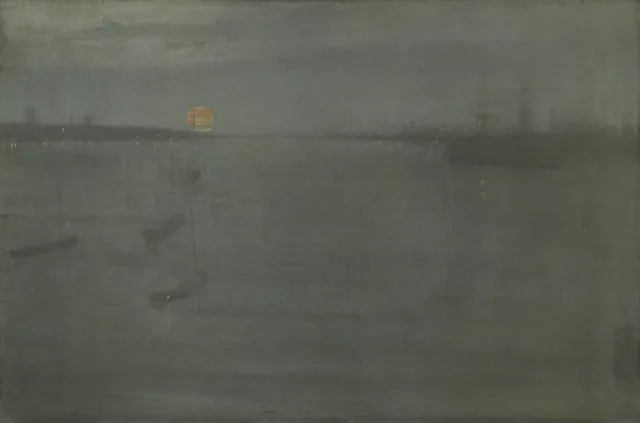
That picture, Arrangement in Grey and Black, now known as Whistler's Mother, went on show at the Royal Academy the next year. Around the same time he began calling his paintings of rivers and harbors at night Nocturnes. In Nocturne: Blue and Gold—Southampton Water, almost everything melts into grey dark. What is left is an orange moon and a few yellow lights along the horizon.
 Painted around this timeNocturne: Blue and Gold—Southampton Water
- 1876London
In 1876 Whistler is hard at work in the London dining room of Frederick Leyland, a Liverpool shipowner. The room had been designed to show Leyland's Chinese blue-and-white porcelain. While the owner was away, Whistler kept going, covering walls and ceiling with blue-green and gold peacock patterns. Leyland was annoyed that the work had grown so much without his say.
Whistler asked for 2,000 guineas. Leyland paid half, and in pounds, not the guineas that gentlemen and artists expected. Early in 1877 Whistler answered on the wall itself, painting two peacocks squaring off, with coins scattered at the feet of one. The room became known as the Peacock Room.
- 1878London
In November 1878 a painter takes a critic to court. The year before, John Ruskin had written that one of Whistler's Nocturnes was like flinging a pot of paint in the public's face. Whistler sued for libel. In the witness box, Ruskin's lawyer asked whether he really wanted two hundred guineas for two days' work.
The jury found for Whistler, but awarded him a single farthing, the smallest coin there was. Legal costs, on top of debts from his newly built house, ruined him. In May 1879 he was declared bankrupt. He lost the White House in Chelsea, and his belongings went to auction.
- 1879Venice
With nothing left, Whistler gets a lifeline from the Fine Art Society, a London dealer. They send him to Venice to make twelve etchings in three months. He arrived in September 1879.
Three months became fourteen. Instead of the famous palace views, he etched narrow canals, dark doorways and people in the back streets. When he returned to London in November 1880 he had about fifty Venetian plates. Twelve of them went on show at the Fine Art Society that December.
- 1894Paris
In 1894 a Chicago lawyer, Arthur Jerome Eddy, climbs to Whistler's studio on the rue Notre-Dame-des-Champs in Paris. Eddy had seen Whistler's work at the 1893 World's Fair in Chicago, and he crossed the ocean for one reason: to sit for his portrait. The two stayed friends for the rest of Whistler's life.
By then the tide had turned. In 1891 the French state bought the portrait of his mother for 4,000 francs. His wife Beatrice, whom he married in 1888, died of cancer in 1896. Whistler died in Chelsea on 17 July 1903 and was buried beside her at Chiswick. In Eddy's portrait, only the face, the white collar and the hand holding a hat glow out of the brown dark.
 Painted around this timeArrangement in Flesh Color and Brown: Portrait of Arthur Jerome Eddy
In their own words
No. I ask it for the knowledge I have gained in the work of a lifetime.
His answer at the Ruskin trial in 1878, when Ruskin's lawyer asked if two days' labor was what he was charging two hundred guineas for.
People around them
- Anna McNeill Whistlerhis mother, who lived with him in London and sat for his best-known portrait.
- Joanna Hiffernanhis companion and model in the 1860s, the woman in The White Girl.
- Frederick Leylanda Liverpool shipowner and patron who fell out with him over the bill for the Peacock Room.
- John Ruskinthe critic who mocked a Nocturne and whom Whistler sued for libel.
- Beatrice Whistlerhis wife from 1888, herself an artist.
- Arthur Jerome Eddythe Chicago lawyer and collector who sat for him and later wrote a book of recollections about him.
Works
Paintings by
James McNeill Whistler on Pyeongye
 Nocturne: Blue and Gold—Southampton Water1872Arrangement in Flesh Color and Brown: Portrait of Arthur Jerome Eddy1894
Hidden stories in James McNeill Whistler's paintings