Pyeongye

Painters · 19th century
Dante Gabriel Rossetti
1828–1882
The London-born son of an Italian exile, a founder of the Pre-Raphaelite Brotherhood who painted like a poet and wrote poems like a painter.
Scenes from a life
The life of Dante Gabriel Rossetti,
scene by scene
- 1848London
In the spring of 1848, a teenager writes to the painter Ford Madox Brown. He wants to become his pupil. Brown takes him on, and the two stay friends for life. The young man is Dante Gabriel Rossetti, son of Gabriele Rossetti, an Italian political exile who taught Italian at King's College London.
That autumn, Rossetti, William Holman Hunt and John Everett Millais form a group of seven. They call it the Pre-Raphaelite Brotherhood. They want art to go back to the clear, honest look of painting before Raphael. His younger brother, William Michael, is one of the seven.
- 1849London
In the spring of 1849, Rossetti's first major oil goes on show at an exhibition near Hyde Park Corner. It is The Girlhood of Mary Virgin. Tucked into the picture are three letters, PRB, the secret initials of the Brotherhood.
The model for the young Mary is his sister Christina. She would become a well-known poet. In the Rossetti family, brothers and sisters kept turning up in one another's pictures and poems.
- 1850London
Around 1850, Walter Deverell, a friend of the Brotherhood, spots a young woman working in a milliner's shop. He asks her to sit for him. Her name is Elizabeth Siddal. With her red hair, she soon appears in picture after picture by the group.
Rossetti draws her again and again, and teaches her to paint. Siddal becomes an artist and poet in her own right. That same year the Brotherhood launches a magazine, The Germ. It folds after four issues.
- 1860Hastings
On May 23, 1860, Rossetti and Siddal marry at St Clement's Church in the seaside town of Hastings. Nearly ten years have passed since they met. Siddal has been in poor health for a long time and is very ill before the wedding.
They honeymoon in Paris. The next year Siddal gives birth to a daughter, but the baby is stillborn.
- 1862London
In February 1862, Siddal dies from an overdose of laudanum, an opium medicine. They have been married less than two years. Before the burial, Rossetti lays a notebook of his own poems in her coffin. She is buried in Highgate Cemetery in London.
That autumn he moves to 16 Cheyne Walk in Chelsea, beside the Thames. He spends most of the rest of his life in that house.
- 1869Highgate
One night in October 1869, a grave is opened at Highgate Cemetery. Rossetti's friend Charles Augustus Howell handles the job at his request. Rossetti himself stays away. The notebook, seven years in the coffin, is lifted out and disinfected by a doctor.
The poems appear the following year in Rossetti's Poems of 1870. Verses he had buried with his wife became a published book.
- 1871Kelmscott
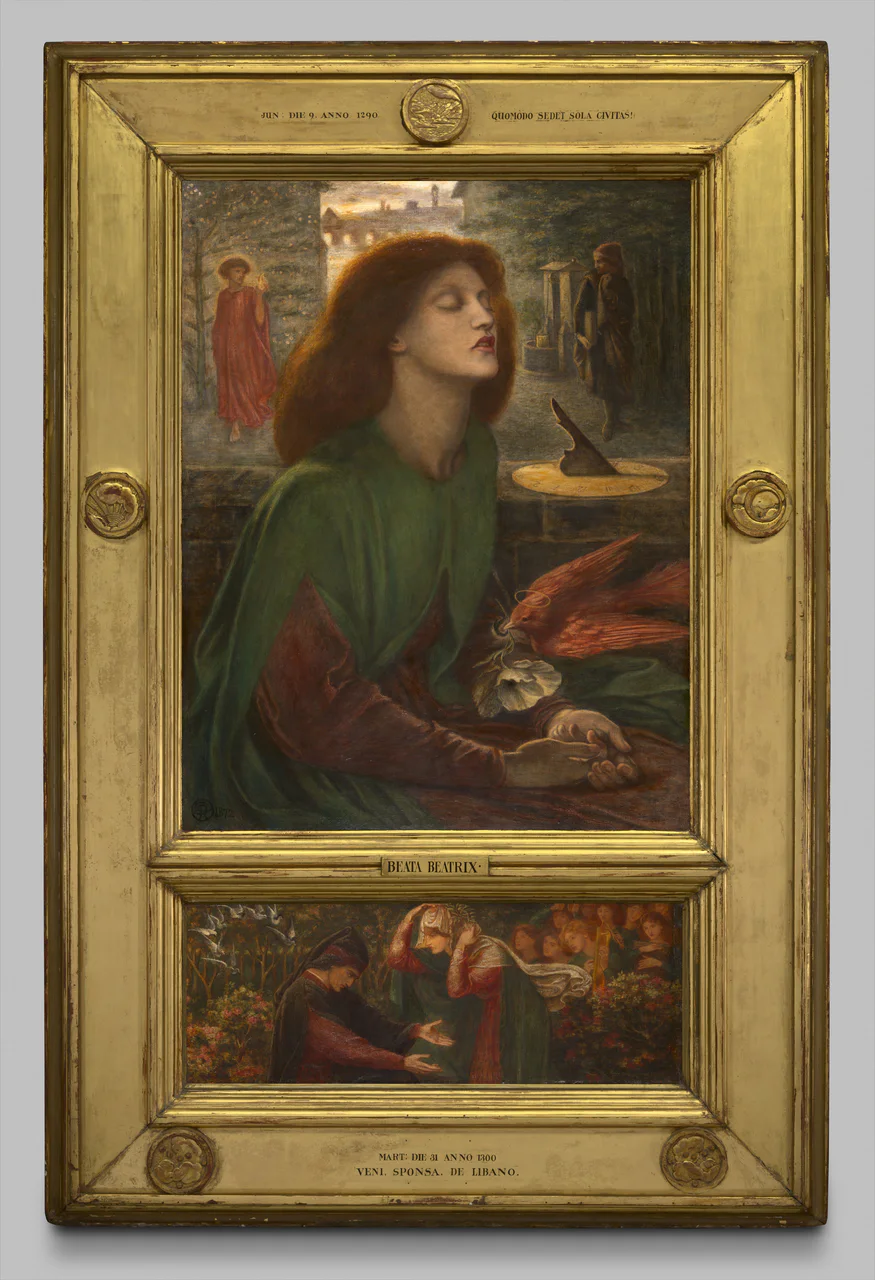
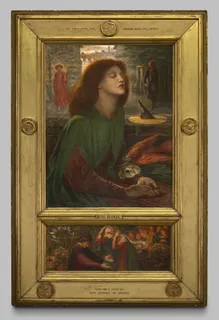
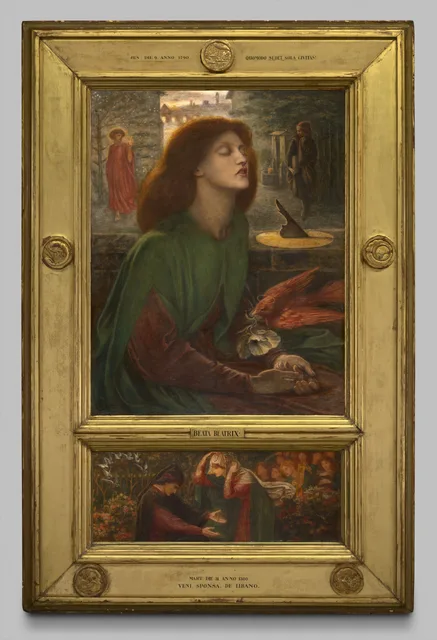
In the summer of 1871, Rossetti and his friend William Morris take a joint lease on Kelmscott Manor, an old house in the Oxfordshire countryside. There he draws and paints Morris's wife, Jane, again and again. That year his patron William Graham asks him for a second Beata Beatrix. Rossetti refuses at first, then gives in.
In October, the critic Robert Buchanan attacks Rossetti's poetry in an article called The Fleshly School of Poetry, signed with the false name Thomas Maitland. Rossetti takes it very hard. The following summer he suffers a severe breakdown.
 Painted around this timeBeata Beatrix
- 1882Birchington
On April 9, 1882, Rossetti dies at fifty-three in Birchington-on-Sea, a seaside village in Kent. He had come there to rest his failing health. He is buried not in the family grave at Highgate but in the village churchyard.
The second Beata Beatrix he painted for Graham was sold at auction in London in 1886. It later crossed the Atlantic, entered the Art Institute of Chicago in 1925, and hangs on this site today.
People around them
- Elizabeth Siddalhis wife from 1860 and his model, an artist and poet in her own right.
- Christina Rossettihis sister, a poet, who posed as the young Mary in his first major oil.
- William Michael Rossettihis brother, a member of the Brotherhood, who later edited his letters and writings.
- Ford Madox Brownthe painter he wrote to in 1848 asking to be a pupil, and a lifelong friend.
- William Holman Hunta fellow founder of the Pre-Raphaelite Brotherhood in 1848.
- William Grahama patron and collector who asked him to paint a second Beata Beatrix.
Works
Paintings by
Dante Gabriel Rossetti on Pyeongye
More paintings by this artist will be added.