Pyeongye
Painters · 19th century
Gustave Moreau
1826–1898
Moreau spent almost his whole life in one Paris house, painting myths and Bible stories crowded with jewel-like detail, and then left the house itself to France as a museum.
Scenes from a life
The life of Gustave Moreau,
scene by scene
- 1852Paris
In 1852 his parents buy a house at 14 rue de La Rochefoucauld in Paris. His father, Louis Moreau, was an architect. The top floor became their son's studio. That same year Gustave, twenty-six, showed his first painting at the Salon, a Pietà.
The years before had been bumpy. He had entered the École des Beaux-Arts, failed the Prix de Rome in 1848 and again in 1849, and walked away from the school in 1849. Once he moved into this house, he rarely lived anywhere else.
- 1858Rome
In 1856 the painter Théodore Chassériau, an older friend Moreau looked up to, died at thirty-seven. The next autumn Moreau left for Italy. He stayed nearly two years, copying the old masters.
In 1858, at the Villa Medici in Rome, he sat beside a young Edgar Degas, eight years his junior, and the two drew the same male model. Moreau wrote 1858 on his sheet at the time. Degas dated his own drawing 1857 many years later, so Moreau's date is the one to trust. That summer the two friends were together in Florence as well.
- 1864Paris
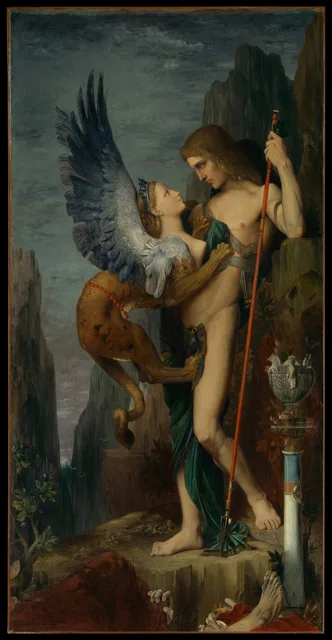
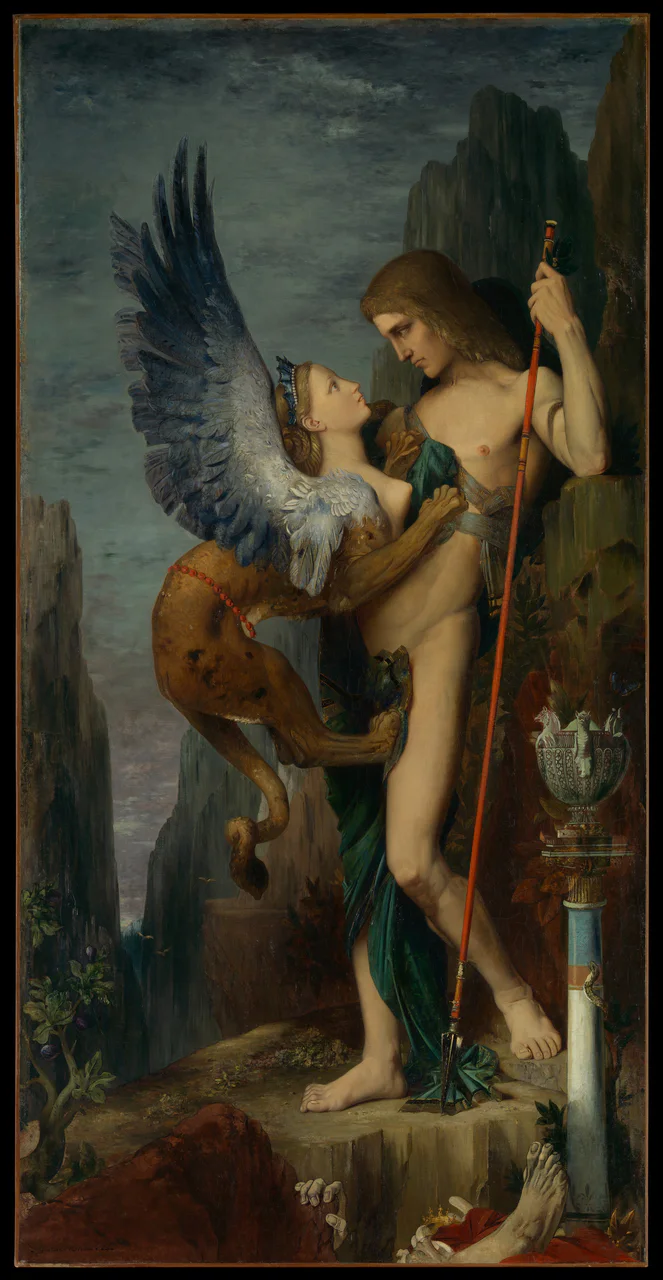
At thirty-eight, still almost unknown, Moreau sends a canvas more than two meters tall to the Salon: Oedipus and the Sphinx. It won a medal. Prince Napoléon, cousin of Emperor Napoleon III, bought it right away.
Stand in front of it. A Sphinx with blue-gray feathered wings clings to the young man's chest and stares up into his eyes. At the very bottom, a hand and a foot poke out between the rocks, beside a small fallen gold crown. The next year Moreau showed Young Man and Death, inscribed to the memory of Chassériau.
 Painted around this timeOedipus and the Sphinx
- 1869Paris
At the Salon that year Moreau showed Prometheus and Jupiter and Europa. Prometheus won a medal, but the critics in the press were harsh.
Moreau stopped sending work to the Salon. For seven years he sold to a small circle of collectors who believed in him, and kept working alone in his top-floor studio.
- 1876Paris
After seven years away, Moreau comes back to the Salon. He brought Hercules and the Lernaean Hydra, an oil of Salome dancing, and a watercolor called The Apparition.
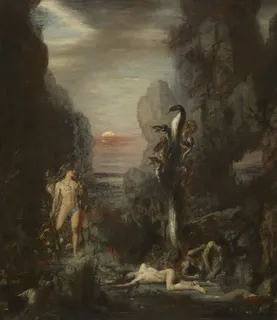
For the Hercules he made study after study of every detail, and even went to the Paris zoo to sketch live snakes. On the left, Hercules stands calmly with his club and bow. On the right, a cluster of snake heads rises up, and the bodies of earlier victims lie on the ground. Between the cliffs, a red sun is going down. In 1884 the novelist Joris-Karl Huysmans gave the hero of his novel Against Nature a long, dazzled passage about Moreau's Salome pictures.
 Painted around this timeHercules and the Lernaean Hydra
- 1890Paris
In 1884 Moreau lost his mother, who had lived with him all his life. In old age she had grown so deaf that he wrote her notes explaining each of his paintings.
On 28 March 1890 his longtime companion, Alexandrine Dureux, died. The two never married. In her memory he painted Orpheus at the Tomb of Eurydice, the mythical musician grieving the wife he lost.
- 1892Paris
Moreau becomes a professor at the École des Beaux-Arts. He took over the studio of his friend Élie Delaunay, who had died the year before. The young man who once left the school after failing the Prix de Rome came back as a teacher.
His students included Henri Matisse, Georges Rouault and Albert Marquet. He did not ask them to paint like him. When Rouault failed the Prix de Rome twice, Moreau advised him to leave the school.
- 1898Paris
Moreau died in Paris on 18 April 1898, aged seventy-two. In his will he left the house on rue de La Rochefoucauld, with thousands of his works inside, to the French state, to become a museum.
It opened in 1903 as the Musée Gustave Moreau, and its first curator was Rouault. Some pictures had already left the house. Oedipus and the Sphinx came to the Metropolitan Museum of Art in New York in 1920. Hercules and the Lernaean Hydra hangs in the Art Institute of Chicago.
People around them
- Théodore Chassériauthe older painter Moreau admired, whose early death he honored with Young Man and Death.
- Edgar Degasa younger painter who drew beside Moreau in Italy in 1858.
- Pauline Moreauhis mother, for whom he wrote notes about his paintings when she could no longer hear.
- Alexandrine Dureuxhis longtime companion, remembered in his Orpheus painting after her death in 1890.
- Georges Rouaulthis student, who became the first curator of the museum Moreau left behind.
- Henri Matissea student in Moreau's studio at the École des Beaux-Arts.
Works