 Pyeongye
Artwork · 19th century · Dante Gabriel Rossetti
LeoTurn on Magnifier at the lower right and move slowly across the painting.
Full screen opens it edge to edge.Tap the painting to fill the screen.
Spread two fingers to look closer.
At a glance
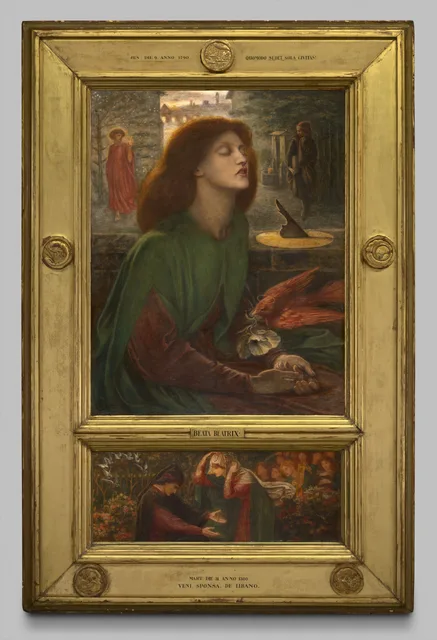
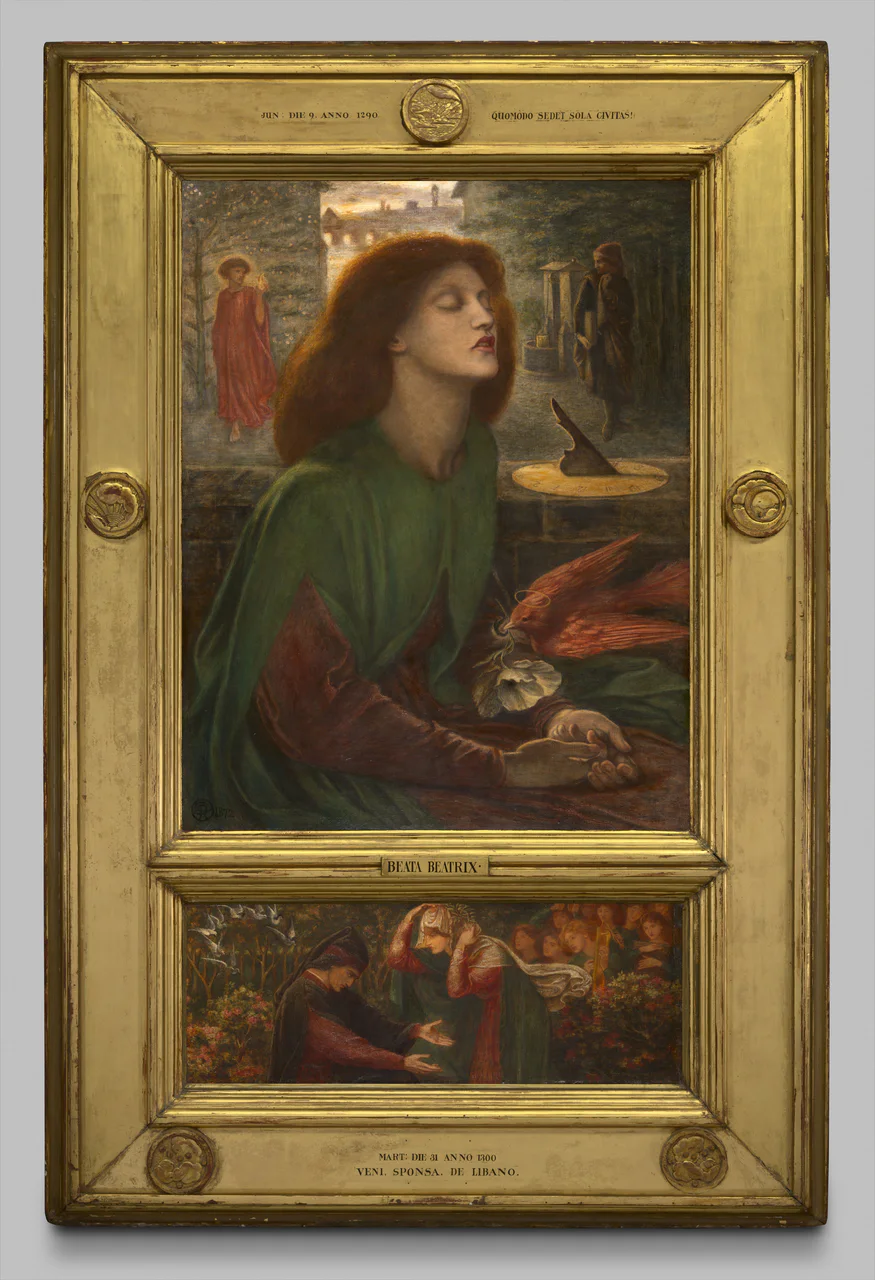
- A red-haired woman with closed eyes and lifted chin: Beatrice, the woman the poet Dante loved.
- Painted by the English painter and poet Dante Gabriel Rossetti in 1871–72.
- Rossetti blended Beatrice with his late wife, Elizabeth Siddal, and designed the frame himself.
Reading the picture
5 places to look closer
Tap a number on the painting to jump to its note, or a close-up to see that spot in the whole picture.
Zoom in on her face. Her eyelids are lowered and her red lips are slightly parted. She might seem asleep, but Rossetti insisted this was not a picture of death. He painted a trance, a moment when the body stays here while the spirit is somewhere else.
On the right, a red bird with a thin gold halo flies in. In its beak is a white poppy, drifting down toward the open hands in her lap. Rossetti's pet name for Siddal was the Dove. The poppy points to laudanum, the opium medicine that killed her.
Behind her on the right, a sundial sits on a ledge. You can read numbers like 12, 11 and 10 on its round face, with the tall blade casting its shadow across it. According to the museum, the shadow falls on nine. Dante was nine years old when he first met Beatrice.
The figure in red at the upper left is Love, painted as a person. In one raised hand, Love holds a small flame. Across on the right stands Dante in dark clothes. He doubles as the painter himself, who shared the poet's name.
Now drop down to the small panel below the main picture. Dante bends forward with his hands held out, and Beatrice, veiled, comes to meet him. A crowd of faces gathers behind her, and white birds fly at the upper left. This is their reunion in paradise.
When it was painted
In 1871 Rossetti, then forty-three, got a request from his patron William Graham. Would he paint Beata Beatrix a second time? Graham was a member of Parliament for Glasgow and a devoted collector of Rossetti's work. Rossetti said no at first. The face in this picture was too private a memory.
That memory went back nine years. In February 1862 his wife, Elizabeth Siddal, died of an overdose of laudanum, less than two years after they married. In his grief, Rossetti laid a notebook of his own poems in her coffin and buried it with her in Highgate Cemetery in London.
Seven years later, in 1869, he changed his mind. Through a friend, he had the grave opened and the manuscript taken out. The poems came out in 1870 as a book. Then in the fall of 1871 the critic Robert Buchanan, writing under a false name, attacked Rossetti's poetry as fleshly. Rossetti took the attack very hard.
In the summer of 1872, while this second version was under way, Rossetti suffered a severe breakdown. Even so, the picture was finished, and a new panel at the bottom showed Dante and Beatrice reunited in paradise. The museum suggests this happy ending may mean he was beginning to come to terms with his grief.
Rossetti died in 1882. After Graham's death the painting came up at auction in London in 1886. It later belonged to Charles L. Hutchinson, president of the Art Institute of Chicago, and came to the museum through his bequest in 1925.
Look again at the sundial's shadow, falling on nine. Beside it, the red bird glides in with its white poppy. The painter who once had to open a grave chose to paint, along the bottom of this picture, a way for the two lovers to meet again.
Questions to think about
- Look for itHow many numbers and dates can you find on the painting and its frame?
- Why?Why do you think Rossetti added a scene of the lovers meeting again in heaven to this second version?
- What about you?Keeping someone's memory alive in pictures, writing or photos can comfort us, but can it also become a weight that is hard to put down?
Too good to keep to yourself
This painting,
for someone who comes to mind
They open it at full size
and see every brushstroke.
About this work
- Artist
- Dante Gabriel Rossetti · 1828–1882
- Date
- 1871–72
- Medium
- Oil on canvas
- Size
- 87.5 × 69.3 cm
- Culture
- England
- Collection
- The Art Institute of Chicago
- Image
- Original long edge 7319px · shown at 2560px
- Original
- View on the museum's website ↗