Pyeongye
Painters · 19th century
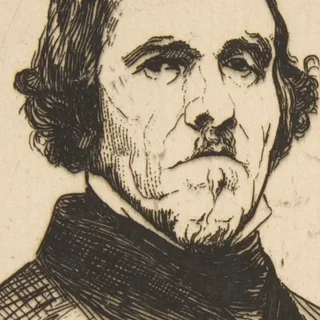
Eugène Delacroix
1798–1863
A Paris painter who poured novels, poems, street revolution, and the light of Morocco into bold color and loose brushwork, and kept a diary almost to the end.
Scenes from a life
The life of Eugène Delacroix,
scene by scene
- 1822Paris
In the spring of 1822, a large canvas by a 24-year-old unknown goes up at the Paris Salon. The poet Dante and his guide Virgil cross a river in hell while drowning souls claw at their boat. A few years earlier, the young painter had posed as a model for his older friend Théodore Géricault, who was painting The Raft of the Medusa.
Antoine-Jean Gros, famous for his Napoleonic battle scenes, praised the picture and compared it to Rubens. The state acquired it that year, and it hangs in the Louvre today. It was a strong start.
- 1824Paris
In June 1824, Delacroix goes to see some landscapes by the English painter John Constable, including The Hay Wain. In his journal he writes that this Constable is doing him a lot of good. The Hay Wain was soon to hang in that year's Salon.
Delacroix had his own big canvas for the same show, a scene of the massacre on the Greek island of Chios. Just before the Salon opened, he went back into it with fine strokes, glazes, and fresh highlights. At that Salon, King Charles X awarded The Hay Wain a gold medal.
- 1825London
In the summer of 1825, Delacroix crosses the Channel to London. In the theaters there he sees Shakespeare, and a stage version of Goethe's Faust. Back in Paris, he began a set of lithographs of Faust. When Goethe saw them, he said that in some scenes the artist had gone beyond what he himself had imagined.
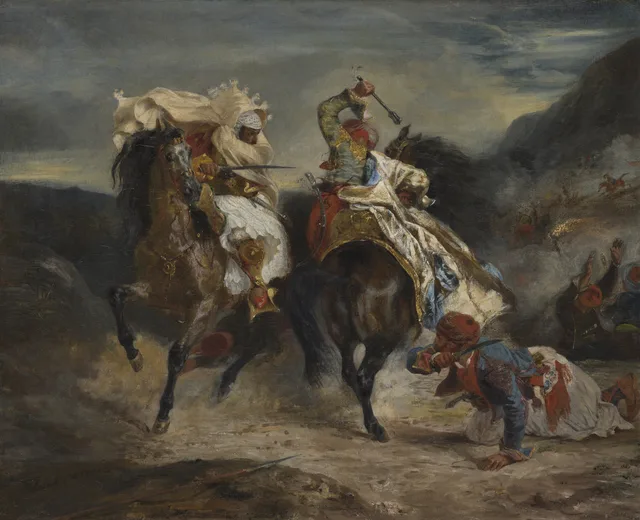
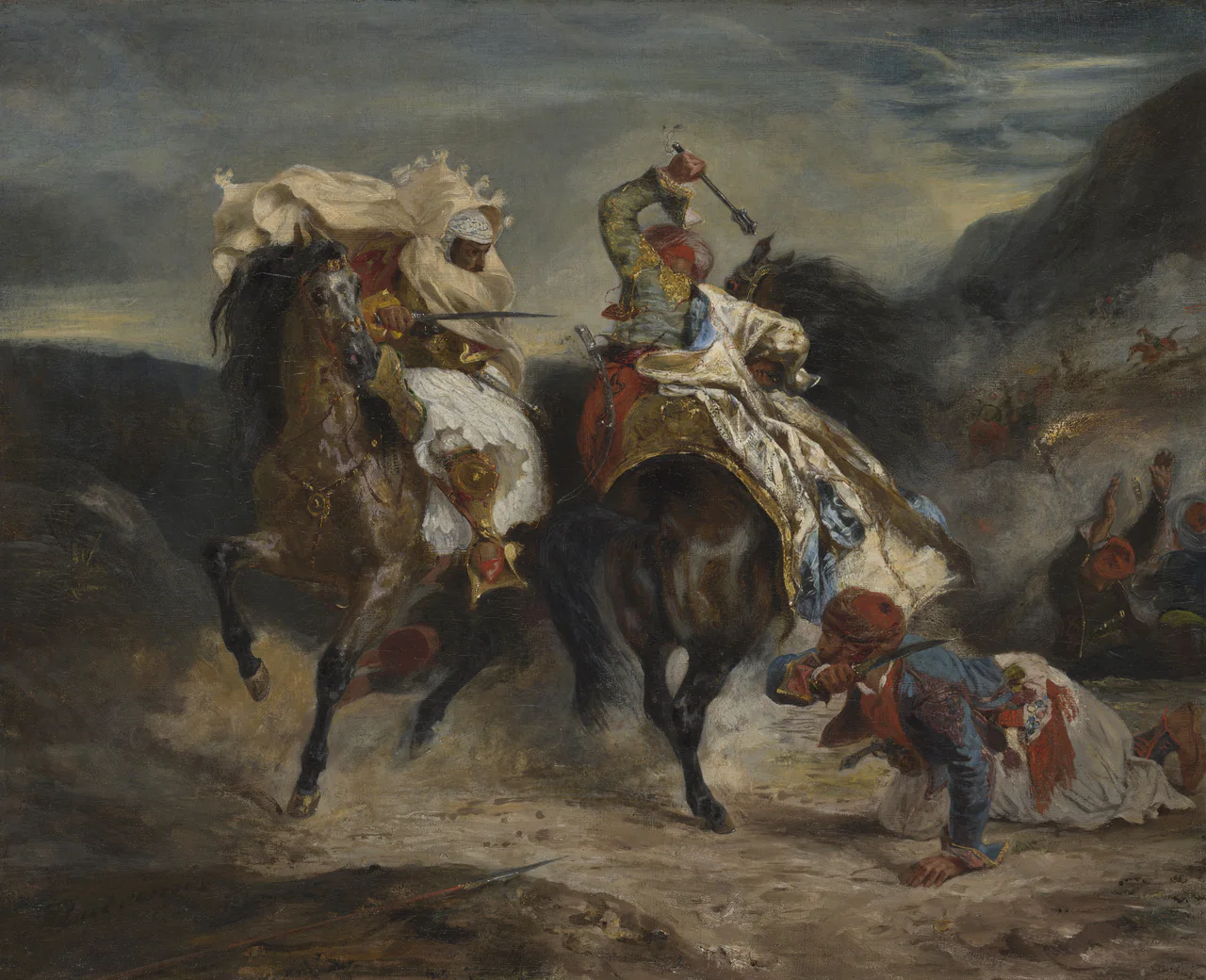
The English poet Lord Byron had died in 1824 after joining the Greek war of independence. In 1826 Delacroix painted a duel from one of Byron's poems. Two riders crash together, one with a curved sword, the other swinging a mace, while a man below falls to his hands in the dust.
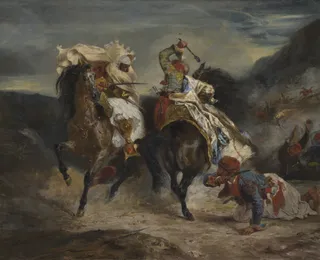 Painted around this timeThe Combat of the Giaour and Hassan
- 1830Paris
In July 1830, barricades go up in the streets of Paris. After three days of fighting, King Charles X is forced out. That October, Delacroix writes to his older brother Charles, a general, that he has started a modern subject: a barricade.
The result was Liberty Leading the People. It hung at the Salon the next year and was bought by the new government. But it did not stay on view for long before it was taken down and put away.
- 1832Tangier
In January 1832, Delacroix steps ashore in Tangier, Morocco, with a French diplomatic mission led by the Count de Mornay. The mission's interpreter is Abraham Ben-Chimol, a Jewish man who works for the French consulate. Ben-Chimol takes the painter into his own home and introduces him to his wife and daughters.
On February 21, Delacroix attended a Jewish wedding in Tangier and described it in great detail in his journal. In Saada, the Wife of Abraham Ben-Chimol, and Préciada, One of Their Daughters, the daughter sits in bridal dress, with a tall headpiece and strings of red beads. Her mother, in a yellow shawl, leans over her from behind.
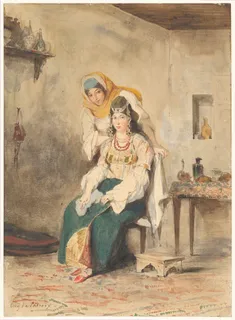 Painted around this timeSaada, the Wife of Abraham Ben-Chimol, and Préciada, One of Their Daughters
- 1838Paris
In 1838, Delacroix paints his friend Frédéric Chopin and the novelist George Sand on one canvas. Chopin sits at the piano, and Sand listens beside him. In later years Delacroix stayed with the couple at Sand's country house at Nohant.
The painting was never finished and stayed in his studio. After his death, someone cut it in two and sold the pieces separately. Today Chopin's face is in the Louvre, and Sand is in a museum in Denmark.
- 1846Paris
At the Salon of 1846 hangs The Abduction of Rebecca. It shows a scene from Walter Scott's novel Ivanhoe, with Rebecca carried off as a castle burns. The 25-year-old poet Charles Baudelaire gave Delacroix an entire chapter of his Salon review that year.
Delacroix was also spending years on the ceiling paintings of the library in the French parliament building. In January 1847 he picked up his long-abandoned journal again. He kept writing in it nearly until his death.
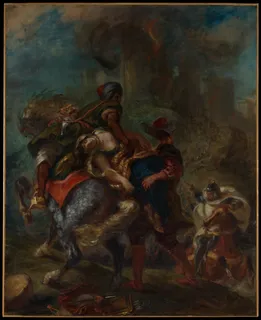 Painted around this timeThe Abduction of Rebecca
- 1863Paris
On August 13, 1863, Delacroix dies in his apartment on the rue de Furstenberg in Paris. With him is Jenny Le Guillou, his housekeeper of many years. In January 1857, on his seventh try, he had finally been elected to the Academy of Fine Arts.
He had moved to this apartment that December to be close to the church of Saint-Sulpice, where he was finishing his wall paintings. Jacob still wrestles the angel on that chapel wall today. His apartment and studio are now the Musée Delacroix.
In their own words
J'ai entrepris un sujet moderne, une barricade, et si je n'ai pas vaincu pour la patrie, au moins peindrai-je pour elle.
I have taken up a modern subject, a barricade. If I have not won victories for my country, at least I will paint for her. (letter to his brother, October 1830)
People around them
- Théodore Géricaultan older painter friend, for whose Raft of the Medusa the young Delacroix posed.
- Charles-Henri Delacroixhis older brother, a general, who received the letter about the barricade painting.
- Abraham Ben-Chimolthe interpreter at the French consulate in Tangier who brought him into his family's home.
- Frédéric Chopina close friend, whom he painted at the piano.
- Charles Baudelairethe poet who wrote at length about him in the Salon of 1846.
- Jenny Le Guillouhis longtime housekeeper, who was with him when he died.
Works