Pyeongye

Painters · 19th century
Jean Auguste Dominique Ingres
1780–1867
A French painter who believed his calling was grand history painting, yet is remembered above all for portraits made with a sharp pencil and a glassy, smooth brush.
Scenes from a life
The life of Jean Auguste Dominique Ingres,
scene by scene
- 1790sToulouse
A boy of thirteen or fourteen sits in the orchestra pit of the Capitole theater in Toulouse, playing second violin. Ingres held that seat from about thirteen to sixteen.
He was born in Montauban in 1780. His father painted, carved, and played music, and he taught his son both drawing and the violin. Ingres kept playing all his life. That is why the French phrase "violon d'Ingres" came to mean a beloved hobby on the side.
- 1806Paris
At twenty-six, Ingres had been waiting five years to leave. A pupil of Jacques-Louis David, he won the Prix de Rome in 1801, the top state prize for young painters, which came with a stay in Rome. But the government was short of money, and the travel funds only came through in 1806.
That year he got engaged to Julie Forestier. In the fall he left for Rome alone, just as critics at the Paris Salon were mocking his portrait of Napoleon on the imperial throne as strange and old-fashioned. From Rome he wrote to Julie on October 19, 1806. About nine months later he broke off the engagement, unwilling to come back to Paris.
- 1813Rome
Now thirty-three, Ingres marries in Rome. His bride, Madeleine Chapelle, came from a small town in France. Friends had put them in touch, and their courtship ran entirely by letter. He proposed before he had ever seen her, and she accepted.
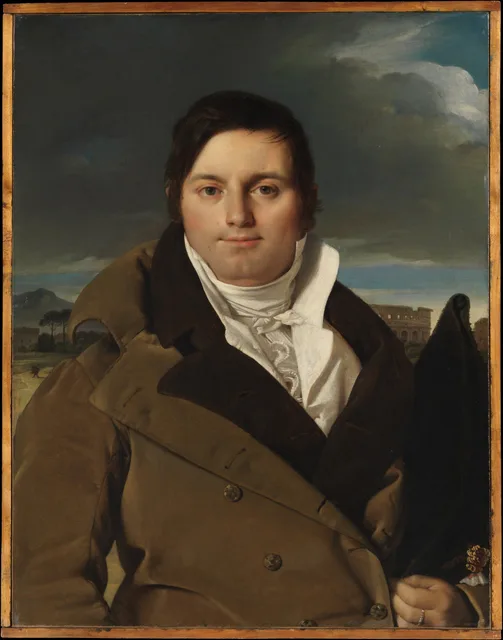
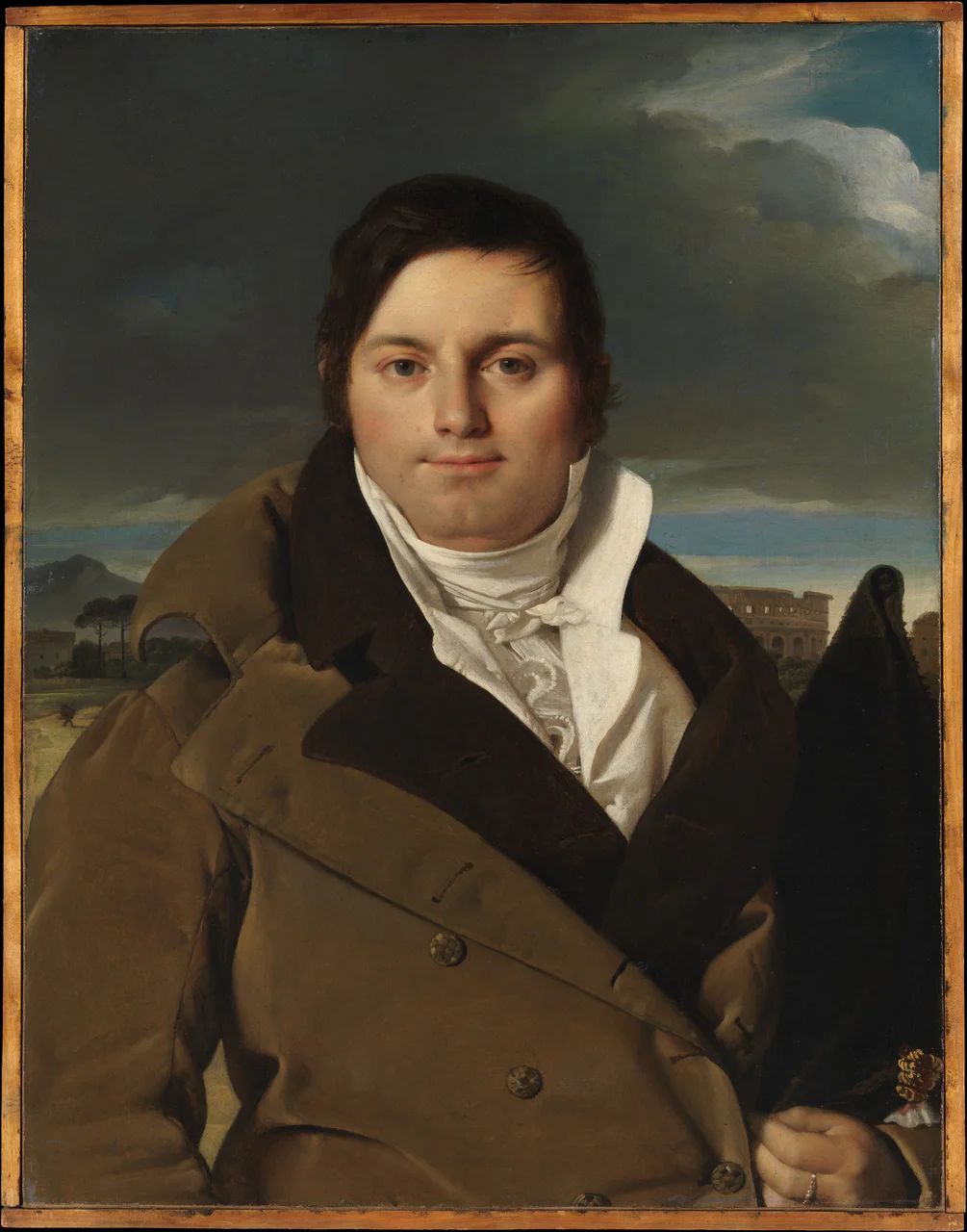
Rome was then ruled by Napoleon's France, and the city was full of French officials. Ingres paid his bills by painting them. One was Joseph-Antoine Moltedo, a Corsican who ran the Rome post office. Behind him you can see the Colosseum.
 Painted around this timeJoseph-Antoine Moltedo (born 1775)
- 1824Paris
After eighteen years in Italy, Ingres comes home to Paris at forty-four. At that year's Salon he shows The Vow of Louis XIII, painted for the cathedral of his hometown, Montauban. It is a hit.
Hanging in the same Salon was The Massacre at Chios by the young Eugène Delacroix. From then on, people set the two men against each other: Ingres for line, Delacroix for color. In January 1825 Ingres received the Legion of Honor, and that same year he was elected to the Academy of Fine Arts.
- 1834Paris
The Martyrdom of Saint Symphorian, a huge canvas Ingres had labored over for years, goes up at the Salon. He meant it as his statement piece. The critics tore into it.
Stung, Ingres swore he would never show at the Salon again. He took the post of director of the French Academy in Rome and left Paris once more. It was the same school where he had lived as a young prize winner. He ran it until 1841.
- 1852Paris
In the summer of 1849, Madeleine, his wife of thirty-six years, died. Ingres was crushed. Three years later, at seventy-one, he married again. His new wife, Delphine Ramel, was the niece of his old friend and patron Charles Marcotte.
The marriage brought a crowd of new relatives, and Ingres gave several of them pencil portraits. Madame Félix Gallois, drawn that year, shows Delphine's cousin.
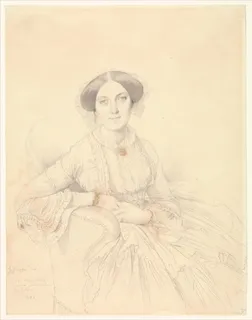 Painted around this timeMadame Félix Gallois
- 1853Paris
The young nobleman Albert de Broglie asked Ingres to paint his wife, Pauline. A few years earlier Ingres had painted Albert's sister, the Comtesse d'Haussonville, and that portrait had been widely admired.
Ingres often grumbled that portraits ate up his time, but he finished this one in 1853. That same year he painted a vast ceiling for the Paris city hall in honor of Napoleon. It was lost when the building burned in 1871.
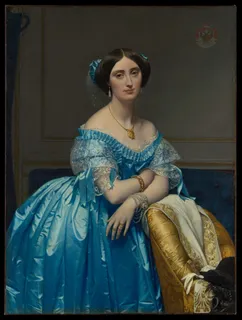 Painted around this timeJoséphine-Éléonore-Marie-Pauline de Galard de Brassac de Béarn (1825–1860), Princesse de Broglie
- 1867Paris
On January 14, 1867, Ingres dies of pneumonia at his home on the Quai Voltaire in Paris. He was eighty-six.
Thousands of his drawings, a group of paintings, and his personal things went to his hometown of Montauban. Among them was his worn old violin. You can still see it today at the Musée Ingres Bourdelle there. The portraits he gave to relatives and patrons have traveled further, some all the way to New York.
People around them
- Jacques-Louis Davidthe teacher in whose Paris studio Ingres trained as a young man.
- Julie Forestierhis fiancée in 1806, until he broke it off from Rome.
- Madeleine Chapellehis first wife, married in Rome in 1813, who stayed at his side until her death in 1849.
- Delphine Ramelhis second wife, married in 1852, niece of Charles Marcotte.
- Eugène Delacroixthe painter set up as his rival from the Salon of 1824 on.
Works