Pyeongye
Painters · 19th century
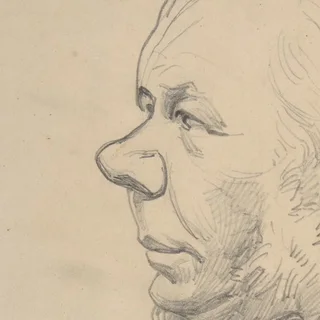
Honoré Daumier
1808–1879
A Paris printmaker who went to prison for mocking a king, then spent his life drawing and painting the ordinary people who crowded the city's courts, streets and third-class railway cars.
Scenes from a life
The life of Honoré Daumier,
scene by scene
- 1816Paris
In the autumn of 1816, eight-year-old Honoré arrives in Paris from Marseille. His father, a glazier who wrote verse, had gone ahead to make his name as a poet, and the family followed. The fame never came, and money stayed tight.
By about twelve, the boy was running errands for a bailiff at the law courts. Later he worked for a bookseller. Around 1822 a friend of his father, the artist Alexandre Lenoir, began to teach him. Lawyers and judges would one day be regular characters in his prints.
- 1832Paris
In February 1832 the young Daumier stands trial over a single print. It is called Gargantua. He had drawn King Louis-Philippe as a bloated giant on a throne, with baskets of money squeezed from the poor carried up a ramp straight into his mouth.
The charges were stirring up hatred of the government and insulting the king. The sentence was six months. He went into Sainte-Pélagie prison at the end of August. After about ten weeks he was moved to Dr. Pinel's private clinic to serve out his time, and he was released in February 1833. Charles Philipon, who published his drawings, had also been jailed at Sainte-Pélagie for insulting the king.
- 1834Paris
In April 1834, soldiers putting down an uprising enter a building on the Rue Transnonain and kill people inside. Daumier drew one room afterward. A man in a nightshirt lies dead on the floor beside his bed, a small child crushed beneath him.
When the print went up in the window of a print shop in the Galerie Véro-Dodat, the police came. They seized every copy they could find, and took the lithographic stone as well. The next year new laws banned political caricature. Daumier turned from the king to the everyday people of Paris.
- 1846Paris
At thirty-eight, Daumier marries Alexandrine Dassy, a young seamstress. Their home and his studio were on the Quai d'Anjou, on the Île Saint-Louis in the middle of the Seine. He lived and worked there from 1841 to 1863.
People strolling the quays and bathing in the Seine found their way into his lithographs.
- 1848Paris
In February 1848 a revolution drives out the king, and France becomes a republic again. The new government held a competition for an image of the Republic, and Daumier entered. His small oil sketch shows a strong seated woman holding a flag, nursing two children while a third reads at her feet.
In early April the finalists' sketches went on view at the École des Beaux-Arts, and his was among them. He never painted the full-size picture. The sketch now hangs in the Musée d'Orsay in Paris.
- 1860Paris
In 1860 the satirical paper Le Charivari stops taking Daumier's work. He had been drawing for it since the 1830s, and it was how he earned his living. It would be a few years before his prints appeared there again.
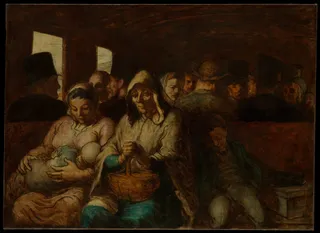
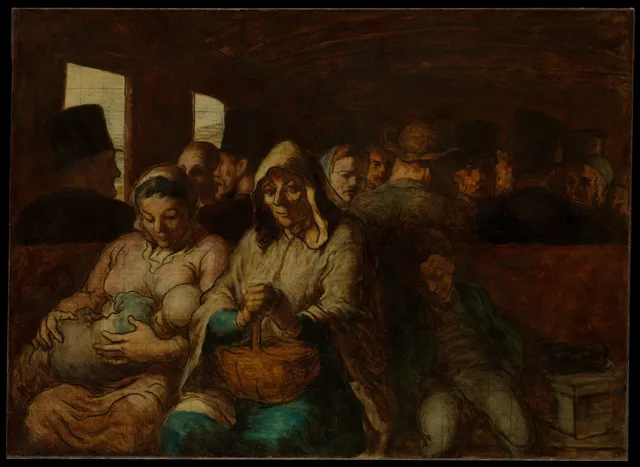
Meanwhile he worked harder at painting. The Third-Class Carriage dates from 1864. On the left a young mother nurses her baby. In the middle an old woman grips the handle of a basket with both hands. On the right a boy sleeps with his head tipped down. Thin grid lines, drawn to copy the design, still show through the skin and the window.
 Painted around this timeThe Third-Class Carriage
- 1874Valmondois
Since the mid-1860s Daumier had rented a small house in Valmondois, a village north of Paris. His eyes were failing, and money was short. In February 1874 he finally bought the house. Of the 13,000 francs it cost, more than half was raised through the efforts of his friend, the painter Camille Corot.
A story later spread that Corot simply bought the house and gave it to him. But a deed of sale signed by Daumier himself still survives.
- 1878Paris
In 1878 friends stage Daumier's first solo exhibition, at the Durand-Ruel gallery in Paris, with the writer Victor Hugo as its president. It was a failure. Daumier, nearly blind by then, could not go. Eight years earlier he had turned down the Legion of Honor.
He died at his house in Valmondois on February 10, 1879. He was buried in the village, then moved to Père Lachaise cemetery in Paris, near Corot and Daubigny. The Third-Class Carriage came to the Metropolitan Museum in 1929, a bequest of Mrs. H. O. Havemeyer.
People around them
- Jean-Baptiste Daumierhis father, a glazier from Marseille who moved to Paris hoping to become a poet.
- Alexandre Lenoira friend of his father who gave the boy his first art lessons around 1822.
- Charles Philiponthe publisher of the satirical papers that printed his lithographs, jailed himself for insulting the king.
- Alexandrine Dassythe seamstress he married in 1846.
- Camille Corota painter friend who raised more than half the price of his house at Valmondois.
Works
Paintings by
Honoré Daumier on Pyeongye
More paintings by this artist will be added.
Hidden stories in Honoré Daumier's paintings