Pyeongye

Painters · 19th century
John Singer Sargent
1856–1925
An American born in Florence who made his name painting portraits in Paris and London, then, in his fifties, packed up his easel and went outdoors.
Scenes from a life
The life of John Singer Sargent,
scene by scene
- 1874Paris
In 1874 an eighteen-year-old John Singer Sargent walked into the Paris studio of the portrait painter Carolus-Duran and became his pupil. He had been born in Florence in 1856 to American parents and had grown up moving from one European city to the next. That same year he also enrolled at the École des Beaux-Arts.
A few years later the student turned his brush on the teacher. Sargent sent his portrait of Carolus-Duran to the Paris Salon of 1879, and it won an honorable mention.
- 1884Paris
At the Salon of 1884, visitors gathered in front of a woman in a black gown and started to whisper. The sitter was Virginie Amélie Avegno Gautreau, an American-born beauty of Paris society. Nobody had commissioned the picture. Sargent painted it with her cooperation, and he let the right strap of her dress slip off her shoulder.
The portrait drew more mockery than praise. After the Salon closed, he repainted the strap back in place and kept the canvas in his studio, rarely showing it for more than twenty years. When he sold it to the Metropolitan Museum in 1916, he asked that the sitter's name be kept off it. That is why we know it as Madame X.
- 1888Boston
Early in 1888, in Boston, the collector Isabella Stewart Gardner stood for Sargent in a black dress, ropes of pearls at her neck and waist. He had moved from Paris to London in 1886 and crossed to America the next year to paint portraits. Gardner paid him 3,000 dollars.
The portrait went on show at Boston's St. Botolph Club. But people talked, and her husband, Jack Gardner, asked her not to show it in public again. Until Isabella died in 1924, it could be seen only by invitation.
- 1889Fladbury
In the summer of 1889 Sargent was staying at Fladbury, a village in Worcestershire, England. His old friend from Paris, the French artist Paul Helleu, came to visit with his young wife, Alice. Sargent painted the two of them sitting in the grass, Paul sketching and Alice beside him. That picture now hangs in the Brooklyn Museum.
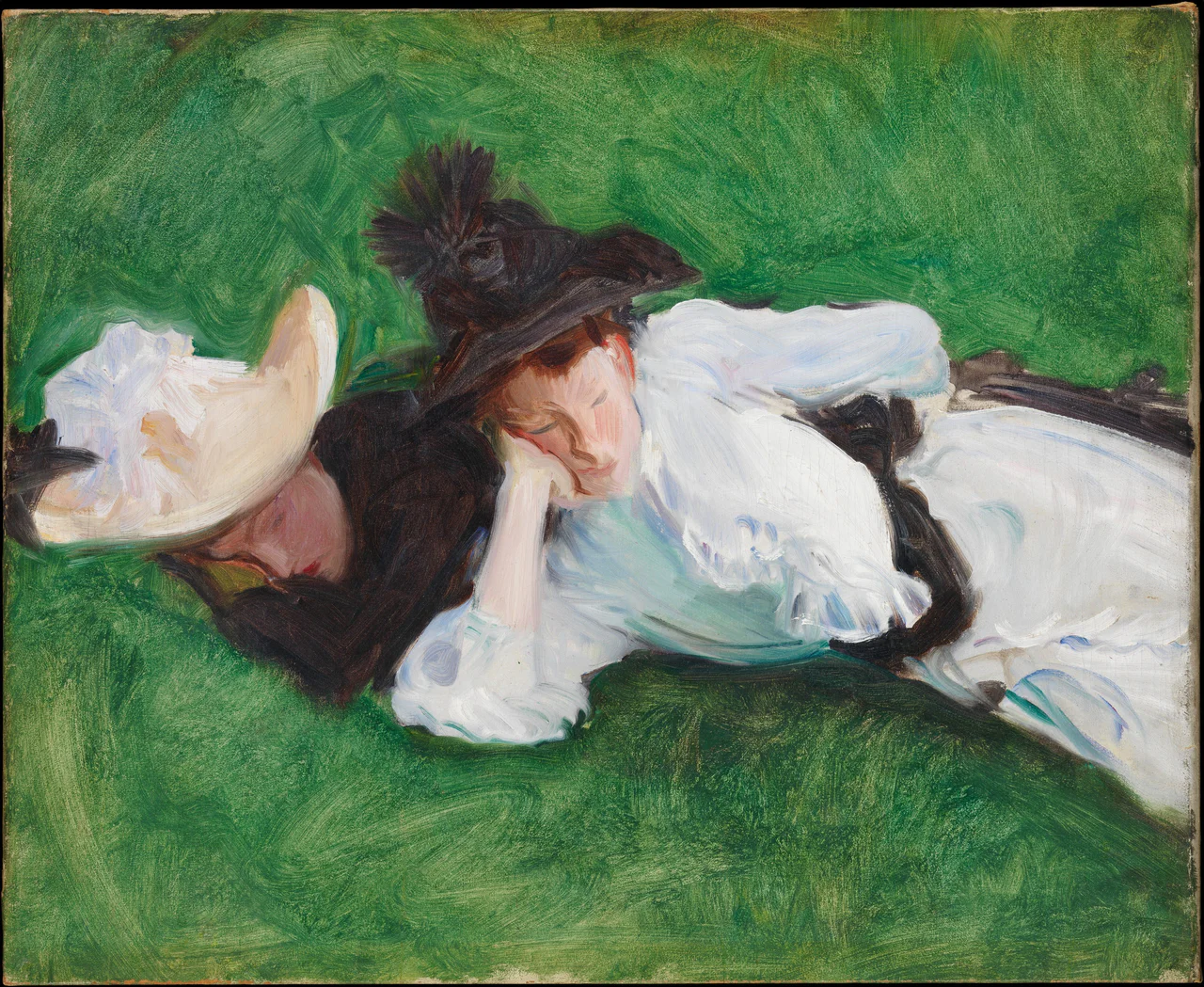
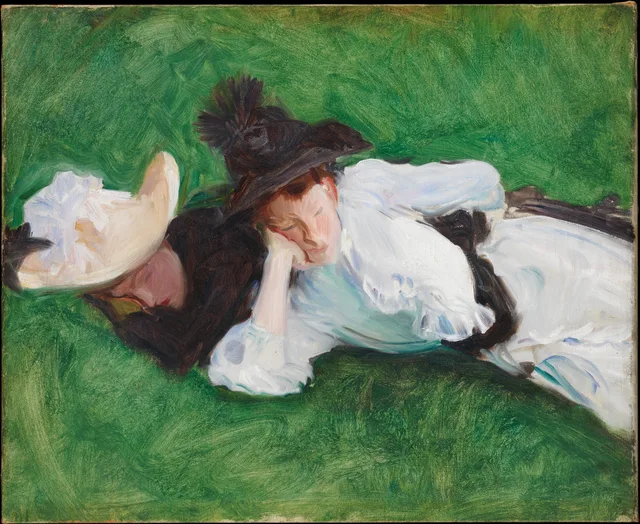
The Metropolitan Museum believes Two Girls on a Lawn was probably painted that same summer at Fladbury Rectory. Green grass fills almost the whole canvas. Two girls lie side by side; one rests her cheek on her hand with her eyes closed, and the other hides under the wide brim of a white hat.
 Painted around this timeTwo Girls on a Lawn
- 1891Egypt
In 1890 Sargent was given the job of decorating walls in the new Boston Public Library. He decided his murals would trace where Western religion came from, and soon set off for Egypt, Greece, and Turkey to gather material. Through the winter of 1890 to 1891 he filled sketchbooks and canvases in Cairo.
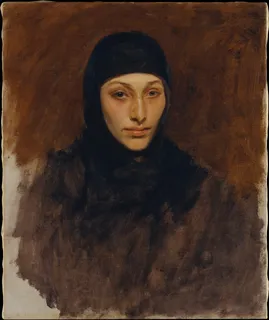
Egyptian Woman comes from that trip. A woman with a black cloth over her head looks straight back at us. Her face is carefully modeled, but below the shoulders there are only loose brown strokes, and at the lower left the bare canvas shows through. The murals themselves were painted in England, shipped across the ocean, and fixed to the library walls in four stages between 1895 and 1919.
 Painted around this timeEgyptian Woman
- 1907Frascati
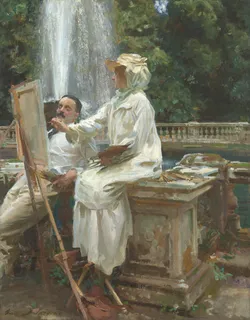
In 1907, at fifty-one, Sargent walked away from oil portraits, the work that had made him sought after, and turned to painting outdoors. That year he was in the garden of the Villa Torlonia at Frascati, near Rome, with his frequent traveling companions, the painters Wilfrid and Jane Emmet de Glehn.
In The Fountain, Villa Torlonia, Frascati, Italy, Jane sits in a white smock touching her brush to a canvas while Wilfrid leans back behind her. It looks dashed off. In fact rain kept interrupting him, so he finished it over several days, and his two friends had to hold their poses again and again.
 Painted around this timeThe Fountain, Villa Torlonia, Frascati, Italy
- 1918France
In the summer of 1918 Sargent, now sixty-two, was on the Western Front, sent by the British government to paint the war. His fellow artist Henry Tonks later wrote in a letter that the two of them heard about gas casualties and went to a dressing station on the Doullens road. It was just a few huts and some tents.
What Sargent saw there became Gassed, a canvas more than six meters wide. In it, soldiers with bandaged eyes walk in a line, each with a hand on the shoulder of the man in front. The painting belongs to the Imperial War Museum in London.
- 1925London
In April 1925 Sargent died in his sleep at his home on Tite Street in London. He was sixty-nine. He had been about to sail to Boston to see his last murals for the Museum of Fine Arts put in place.
The paintings left in his studio passed to his family. In 1950 his youngest sister, Violet, by then Mrs. Francis Ormond, gave Two Girls on a Lawn and Egyptian Woman to the Metropolitan Museum. A lawn in Fladbury and a black headscarf from Cairo ended up in the same museum.
People around them
- Carolus-Duranthe Paris portrait painter who taught Sargent.
- Virginie Amélie Avegno Gautreauthe sitter for Madame X.
- Isabella Stewart Gardnerthe Boston collector who sat for him in 1888.
- Paul Helleua French artist and close friend from his Paris years.
- Wilfrid and Jane Emmet de Glehna married pair of painters who often traveled with him.
- Violet Sargent Ormondhis youngest sister, who gave his paintings to the Metropolitan Museum.
Works
Paintings by
John Singer Sargent on Pyeongye
Contemporaries