 Pyeongye
Artwork · 20th century · John Singer Sargent
LeoTurn on Magnifier at the lower right and move slowly across the painting.
Full screen opens it edge to edge.Tap the painting to fill the screen.
Spread two fingers to look closer.
At a glance
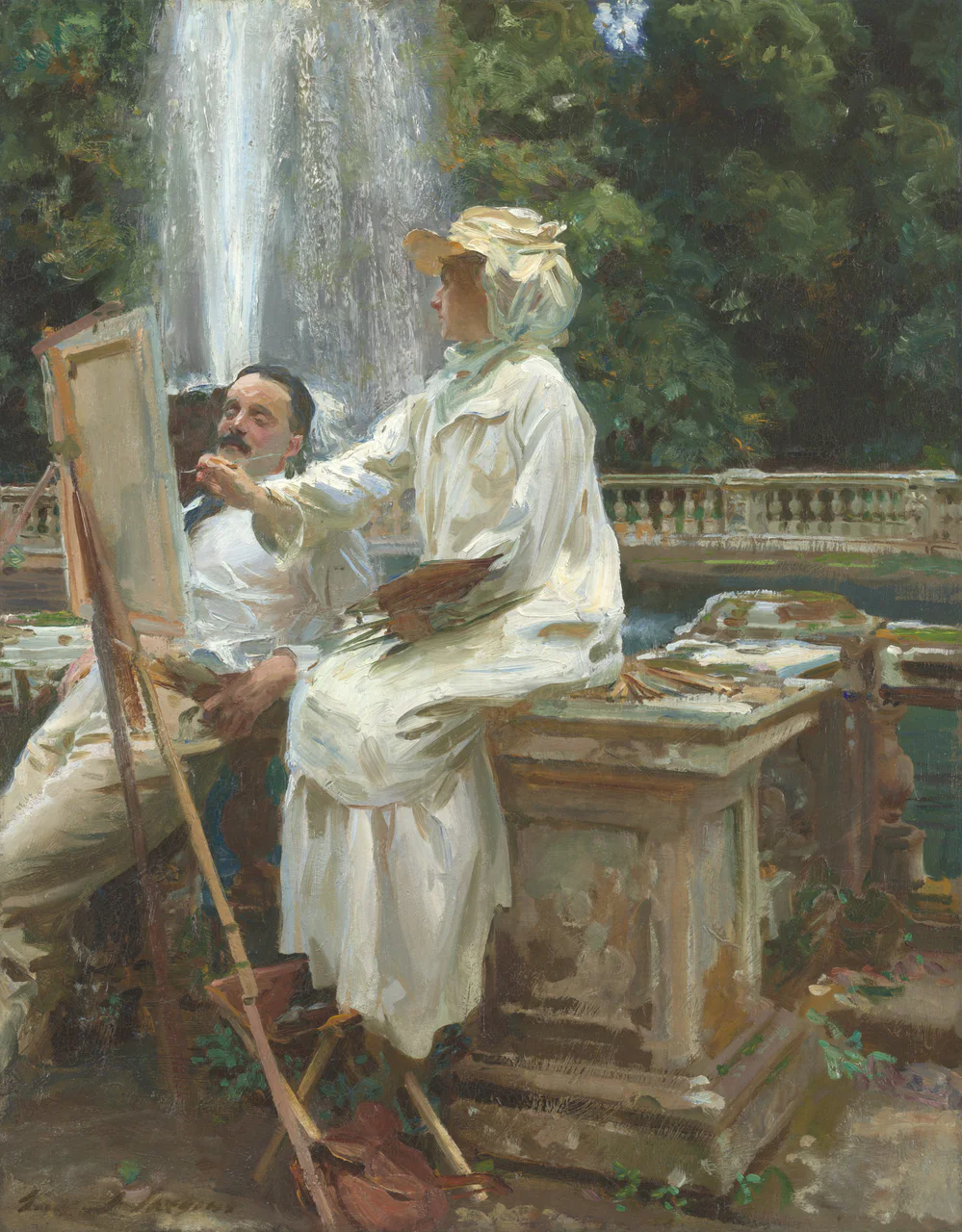
- In a villa garden in Italy, a woman dressed in white paints at an easel while a man in white leans back behind her, with a tall fountain rising over them.
- John Singer Sargent painted it in oil in 1907. The two sitters are his friends Wilfrid and Jane Emmet de Glehn, both working artists.
- It comes from the year Sargent was turning away from portrait commissions, and it mixes a portrait of friends with a landscape in one picture.
Reading the picture
4 places to look closer
Tap a number on the painting to jump to its note, or a close-up to see that spot in the whole picture.
Start at the top, with the fountain. A column of water shoots up and falls back in a white rush. Up close there is not a single drop of water here, only paint: long vertical strokes and quick dabs of white and pale blue. Step back, and you can almost hear it.
Now look at Jane's face in profile. She wears a wide-brimmed hat with a white cloth tied over it and hanging down her back. Sargent painted the sunlit brim a warm orange and kept her face in brown shadow. Her eyes are not on the canvas at her fingertips. She looks farther off to the left.
Follow her arm. She reaches out and touches the tip of her brush to the canvas. Right behind her hand is the face of Wilfrid. He leans back with his eyes half closed. Is he studying her brushwork, or drifting off in the warm air? The picture lets you decide.
Drop down toward her lap. A brown palette and a bundle of long brushes rest there, painted with just a few strokes of brown and green. Look at her white smock too. It is not one white. Broad strokes of cream, gray, and pale green split it into sunlight and shade.
When it was painted
In 1907 Sargent was fifty-one, and he was in Italy again. Born in Florence in 1856 to American parents, he had spent much of his childhood moving around Europe, and Italy felt like familiar ground. His companions on this trip were two painters, Wilfrid and Jane de Glehn. Wilfrid, an English artist, had worked as Sargent's assistant on his murals for the Boston Public Library. Jane, an American painter, had married him in 1904.
That year Sargent made a big decision. He was a much sought-after portrait painter in London, yet he stopped taking commissions for portraits in oil. People who still wanted a likeness could get a quick charcoal drawing instead. The time he won back went into traveling with friends and painting outdoors.
So in the garden of the Villa Torlonia in Frascati, a hill town southeast of Rome, his sitters were friends, not clients. In a letter to her sister Lydia, Jane called the picture Sargent was painting of her very amusing and wildly funny. She described herself as dressed all in white, with a white painting smock and a pale blue veil around her hat. Rain kept interrupting the work. Sargent finished it over several days, and his friends had to settle back into their poses again and again.
The Art Institute of Chicago already listed the painting in its 1910 catalogue, and it entered the collection in 1914. Sargent died in London in 1925. In 2018 the museum included it in its exhibition John Singer Sargent and Chicago's Gilded Age.
Go back to the painting now. Look for the pale blue Jane mentioned in the veil wrapped around her hat. And remember that those two relaxed poses were rebuilt, day after day, between showers.
The painter
John Singer Sargent
1856–1925
When painting this, the artist was about 51 years old
All paintings by John Singer Sargent →More by the same painter
Questions to think about
- Look for itHow many colors that are not white can you find in Jane's smock and in the falling water?
- Why?Why do you think Sargent shows us the painter at work but never lets us see what is on her canvas?
- What about you?If you stepped away from work you were known and paid for, to do the work you really wanted, what would you lose and what would you gain?
Same period
Painted around the same time,
somewhere else
Too good to keep to yourself
This painting,
for someone who comes to mind
They open it at full size
and see every brushstroke.
About this work
- Artist
- John Singer Sargent · 1856–1925
- Date
- 1907
- Medium
- Oil on canvas
- Size
- 71.4 × 56.5 cm
- Culture
- Frascati
- Collection
- The Art Institute of Chicago
- Image
- Original long edge 5659px · shown at 2560px
- Original
- View on the museum's website ↗