Pyeongye

Painters · 19th century
Katsushika Hokusai
1760–1849
A painter from Edo who changed his name again and again over a life of nearly ninety years and never stopped drawing waves, Mount Fuji, and ordinary people going about their day.
Scenes from a life
The life of Katsushika Hokusai,
scene by scene
- 1760Edo
Katsushika Hokusai was born in 1760 in Edo, today's Tokyo, in the Katsushika district across the Sumida River on the city's east side. The Katsushika he would put in front of his names was the name of this home ground. From childhood, by his own later account, he copied the shapes of whatever he saw.
- 1779Edo
At about eighteen he became a pupil of Katsukawa Shunshō, known for prints of kabuki actors. The next year he put out actor prints of his own under the name Shunrō. Over his life he went on to use more than thirty artist names. Hokusai was only one of them. Each new name seemed to come with a fresh start in his art.
- 1814Nagoya
A Nagoya publisher brought out the first volume of Hokusai Manga. Its pages are crammed with sketches dashed off with the brush: people laughing, tumbling, wrestling, along with fish, birds, and ghosts. It was a model book for pupils and anyone who wanted to learn to draw, and more volumes kept appearing for decades.
- 1830–32Edo
Now past seventy, Hokusai published Thirty-six Views of Mount Fuji, a series of prints showing the mountain from many places. One of them is Under the Wave off Kanagawa. A huge wave, its foam breaking into white claws, rears over three boats, and far below sits Mount Fuji, a small triangle. The series used Prussian blue, a deep blue pigment imported from Europe. The signature at upper left means "Hokusai, changing his name to Iitsu."
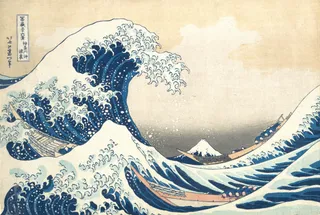 Painted around this timeUnder the Wave off Kanagawa (Kanagawa oki nami ura), also known as The Great Wave, from the series Thirty-six Views of Mount Fuji (Fugaku sanjūrokkei)
- 1834Edo
He published a picture book, One Hundred Views of Mount Fuji, and added a short afterword. He wrote that he had loved copying the shapes of things since he was six, but that nothing he drew before seventy was worth much. At seventy-three, he said, he had begun to grasp how birds, beasts, insects, and fish are built and how plants grow. And he wrote that by the age of one hundred and ten, every dot and every line he drew would seem alive.
- 1845Obuse
Past eighty, Hokusai made several trips over the mountains to Obuse, a small town in Shinano province. There a wealthy admirer, Takai Kōzan, welcomed him. Hokusai painted swirling waves on the ceiling of a festival float for the town. A mountain village with no sea got waves of its own.
- 1849Edo
In 1849 Hokusai died in Edo at nearly ninety. According to a biography written later, near the end he said that if heaven would give him just five more years, he could become a true painter. The one who looked after him in his last years, and painted alongside him, was his daughter Ōi, herself a painter.
In their own words
七十年前画く所は実に取るに足るものなし
"Nothing I painted before the age of seventy is worth counting." This line comes from the afterword to One Hundred Views of Mount Fuji, written in 1834. By then he had already made the Great Wave.
People around them
- Katsukawa Shunshōthe teacher who took young Hokusai as a pupil and taught him to draw actors.
- Katsushika Ōihis daughter, a painter in her own right, who worked beside him in his last years.
- Takai Kōzanthe wealthy patron in Obuse who welcomed the old artist to his town.
- Nishimuraya Yohachithe Edo publisher of Thirty-six Views of Mount Fuji.
Works
Paintings by
Katsushika Hokusai on Pyeongye
More paintings by this artist will be added.