Pyeongye

Painters · 18th century
Jacques Louis David
1748–1825
A painter whose stern scenes from ancient Greece and Rome gripped Paris on the eve of the Revolution, and who then lived through the Revolution and the reign of Napoleon and painted their faces.
Scenes from a life
The life of Jacques Louis David,
scene by scene
- 1774Paris
Jacques-Louis David was born in Paris in 1748. When he was nine, his father was killed in a duel. Through François Boucher, a painter and distant relative, he became a pupil of Joseph-Marie Vien. For several years running he competed for the Prix de Rome, the prize every young French painter wanted, and lost. In 1774 he finally won it, and with it a place in Rome.
- 1784Rome
He arrived in Rome in 1775 and spent years drawing ancient sculpture and ruins. Back in Paris he married, and then he returned to Rome to paint one big picture: The Oath of the Horatii, finished in 1784. Three brothers stretch out their arms to swear on the swords their father holds up, while beside them the women slump in grief. Shown at the Paris Salon the next year, it caused a sensation.
- 1787Paris
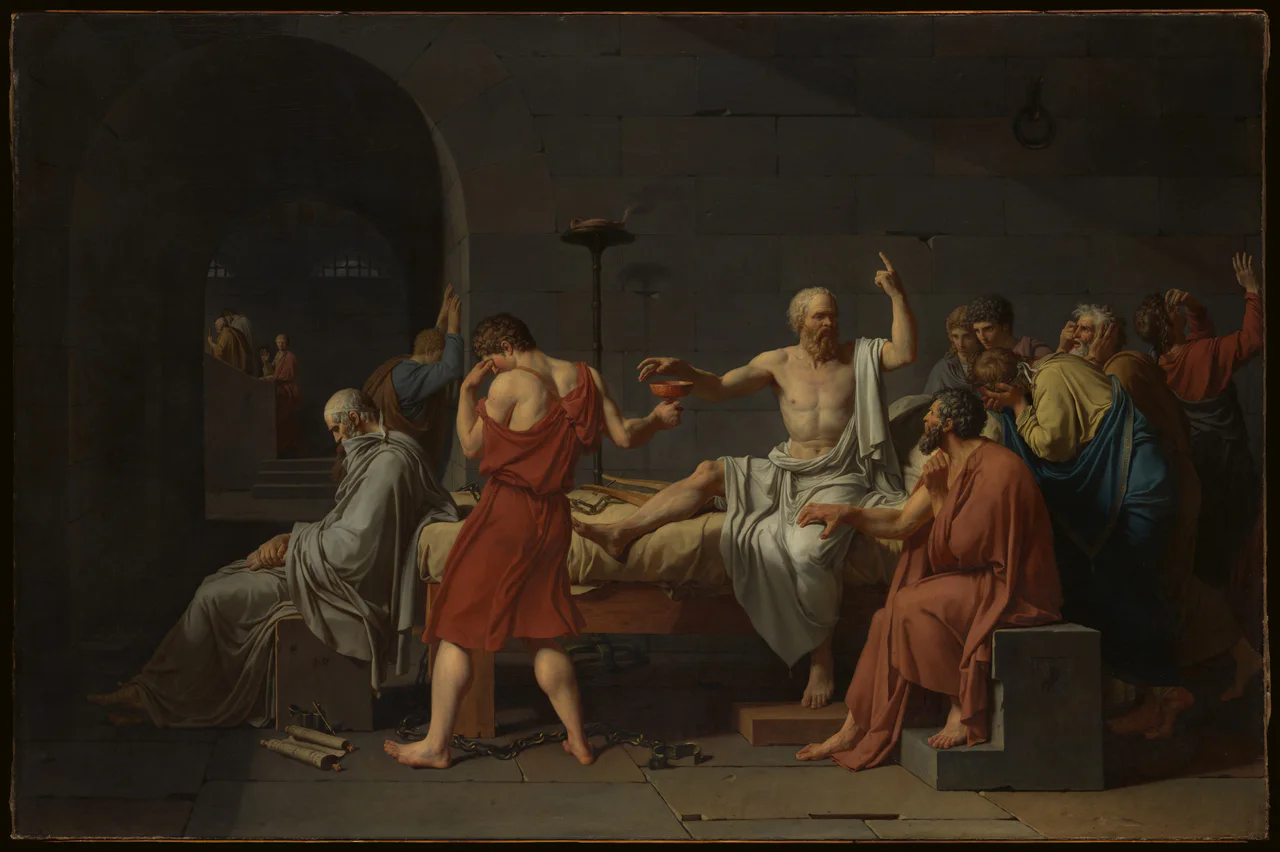
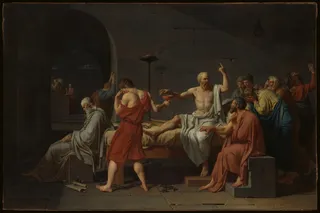
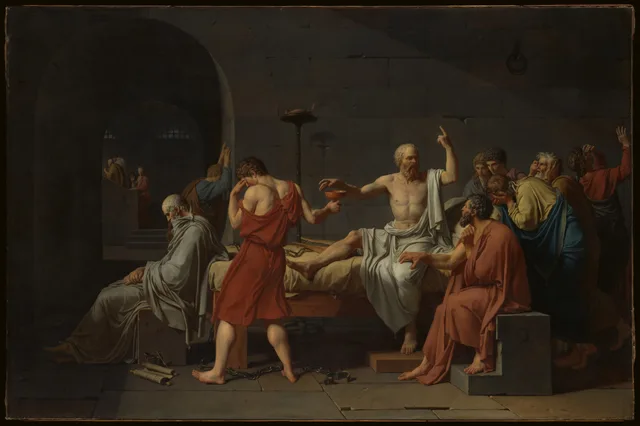
The Death of Socrates went on show at the Salon. Socrates sits on his prison bed, one hand raised toward the sky, the other reaching for the cup of poison. The young man in red who hands it to him cannot bear to look and covers his face. At the foot of the bed an old man sits with his back turned and head bowed. On the floor lie loosened chains. It is a picture of a man who keeps thinking even as he faces death.
 Painted around this timeThe Death of Socrates
- 1788Paris
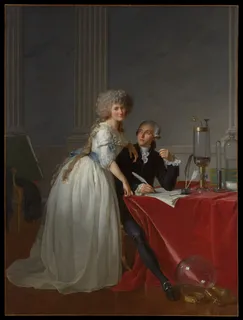
David painted the chemist Antoine Lavoisier and his wife, Marie-Anne. She had studied drawing with David. She leans on her husband's shoulder and looks straight at us; he holds a quill and gazes up at her. On the red tablecloth and on the floor, glass flasks and brass instruments catch the light. The portrait was meant for the Salon of 1789, but in the tense political climate of that revolutionary year it was not shown.
 Painted around this timeAntoine Laurent Lavoisier (1743–1794) and Marie Anne Lavoisier (Marie Anne Pierrette Paulze, 1758–1836)
- 1793Paris
David threw himself into the Revolution. He was elected to the National Convention, and in January 1793 he voted for the execution of King Louis XVI. That same year he painted the revolutionary Marat, stabbed to death in his bath. He also designed the processions and stage sets of the great revolutionary festivals.
- 1794Paris
In May 1794 Lavoisier went to the guillotine, condemned for having been a tax collector under the old regime. He was the man David had painted six years earlier. A little over two months later Robespierre fell, and David himself was arrested and locked up. From his prison window he painted the view of the Luxembourg Gardens. His wife, Marguerite-Charlotte, had divorced him during the Revolution, but afterward she married him again.
- 1805Paris
Napoleon made David his First Painter. Beginning in 1805, David spent years putting the 1804 coronation at Notre-Dame onto a canvas more than nine meters wide. It holds a huge crowd, and David included himself, sketching from a gallery.
- 1825Brussels
When Napoleon fell and the monarchy returned, those who had voted for the king's death were banished from France. In 1816 David went into exile in Brussels and kept painting there. He died in Brussels in December 1825. France refused to let his body come home.
People around them
- Joseph-Marie Vienhis teacher, with whom he traveled to Rome in 1775.
- Marguerite-Charlotte Pécoulhis wife from 1782, who divorced him during the Revolution and later remarried him.
- Antoine Lavoisierthe chemist whose double portrait David painted in 1788, executed in 1794.
- Marie-Anne LavoisierLavoisier's wife and David's drawing pupil.
- Napoleon Bonapartethe emperor who made David his First Painter and gave him the coronation picture.
- Jean-Auguste-Dominique Ingresone of the many pupils trained in David's studio.
Works
Paintings by
Jacques Louis David on Pyeongye
 The Death of Socrates1787Antoine Laurent Lavoisier (1743–1794) and Marie Anne Lavoisier (Marie Anne Pierrette Paulze, 1758–1836)1788
Hidden stories in Jacques Louis David's paintings