Pyeongye
Painters · 18th century
Goya
1746–1828
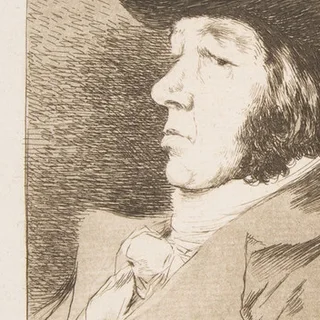
Born in 1746 in Fuendetodos, a small village in Aragon, he became painter to the kings of Spain, lost his hearing, and kept painting people, news, and nightmares until he died in Bordeaux in 1828.
Scenes from a life
The life of Goya,
scene by scene
- 1771Parma
In 1771 the art academy of Parma, in Italy, held a painting contest. The subject was Hannibal on the heights of the Alps, looking down at Italy for the first time. A 25-year-old Goya sent in a canvas. First prize went to the Italian painter Paolo Borroni, but Goya earned six votes and a special mention.
It was not his first contest. Back in Spain, he had entered the contests of the Royal Academy in Madrid in 1763 and again in 1766, and won nothing either time. The 1766 prize went to Ramón Bayeu, a painter from Zaragoza. A few years later Goya married into that same Bayeu family.
- 1781Zaragoza
In March 1781 the building committee of the Pilar cathedral in Zaragoza turned down Goya's sketches. They were for the corners below his dome, the Queen of Martyrs. The committee felt his brushwork was rough and his figures looked unfinished. The man in charge of the whole project was his brother-in-law, Francisco Bayeu.
Goya had married Bayeu's sister Josefa in 1773, and Bayeu was the senior painter with standing at court. On March 27 Goya sent the committee a heated written protest. In the end he redid the sketches anyway.
- 1787Madrid
On January 30, 1787, the Bank of San Carlos in Madrid paid Goya 10,000 reales. The receipt lists portraits of the king, the Count of Altamira, and the Marquis of Tolosa. The year before, Goya had been named painter to the king, and now, at 40, he had a steady stream of portrait orders from Madrid's nobility.
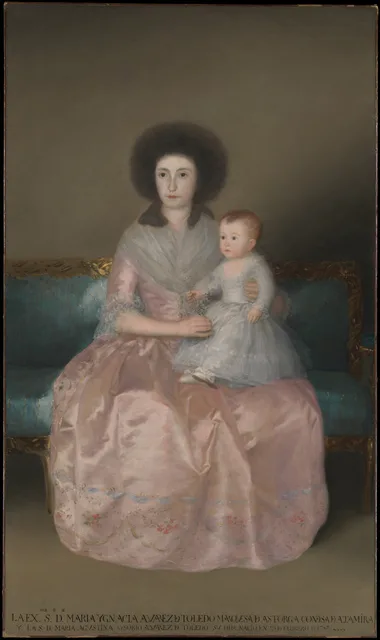
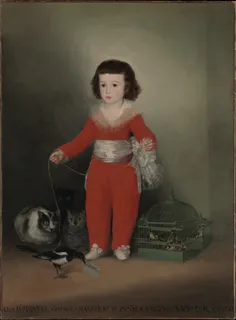
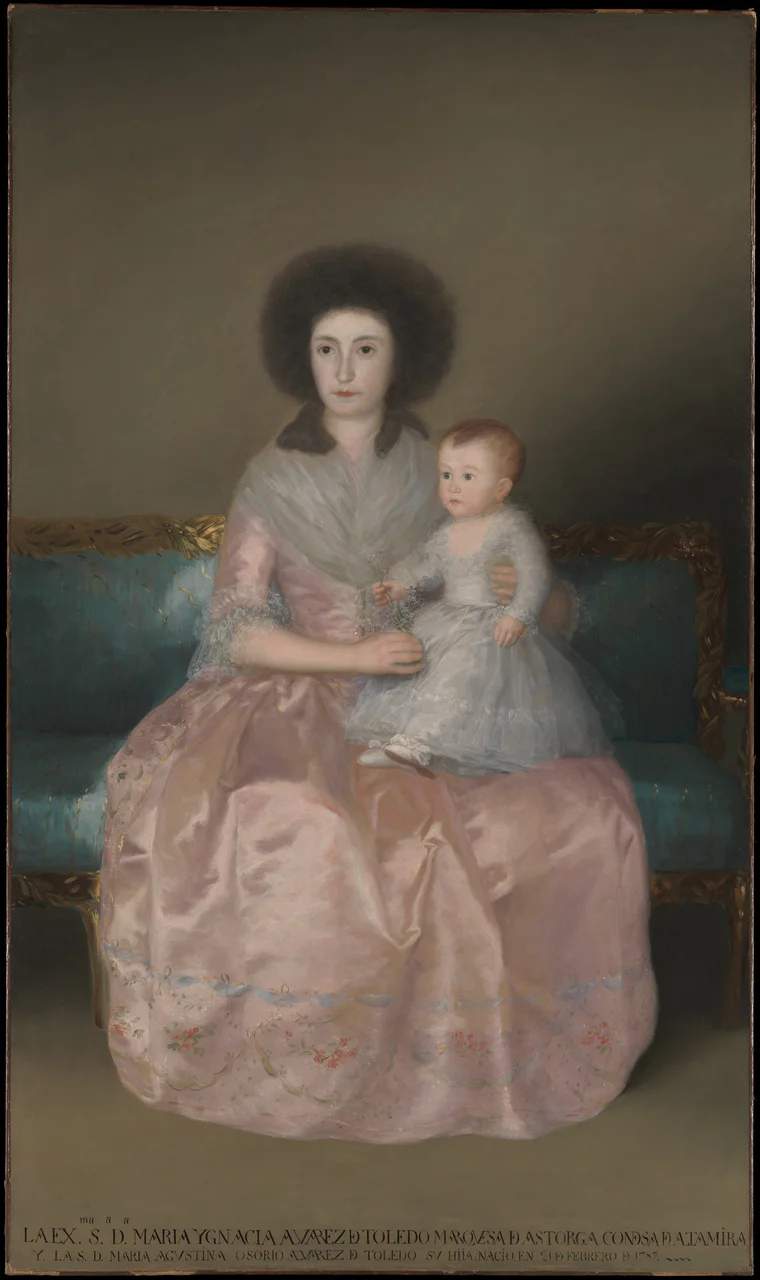
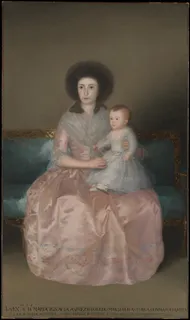
The Count of Altamira was one of the bank's directors. Soon he asked Goya to paint his family too. One canvas shows the countess with her baby daughter on her lap. Another shows their son Manuel in a red suit, with a magpie on a string and three cats staring at it from the shadows.
 Painted around this timeCondesa de Altamira and Her Daughter, María Agustina
- 1793Cádiz
In the winter of 1792, on a trip to Andalusia, Goya fell gravely ill. He spent months recovering in Cádiz at the home of his friend Sebastián Martínez, a wealthy collector. The dizziness and weakness slowly passed. His hearing never came back, and from then on he lived in silence.
In January 1794 he sent a group of small paintings to the Royal Academy in Madrid. In a letter to Bernardo de Iriarte, an academy official, he explained that these pictures let him make observations that commissioned work rarely allows, with room for fancy and invention. The paintings were shown to the academy members.
- 1799Madrid
On February 6, 1799, a Madrid newspaper ran an ad. It offered a set of prints on fanciful subjects, invented and etched by Francisco de Goya. These were the 80 plates of Los Caprichos, full of donkey doctors, flying witches, and vain people fooling themselves. Within a short time Goya pulled the set from sale.
That October he was named first court painter. In 1803 he gave the copper plates, along with 240 unsold sets, to King Charles IV. In return he asked for a pension for his son Javier.
- 1806Madrid
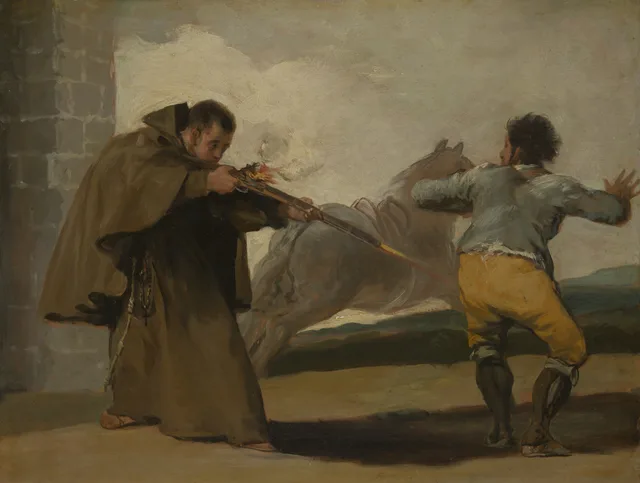
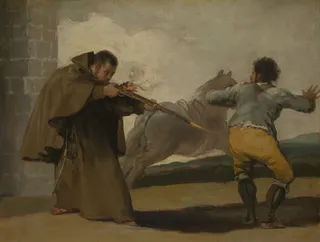
In the summer of 1806, all of Spain was talking about a friar. An escaped bandit called El Maragato had taken a family hostage. Brother Pedro de Zaldivia, a Franciscan who had stopped by to beg for alms, grabbed the bandit's gun and shot him in the thigh. Newspapers, pamphlets, ballads, and prints spread the tale everywhere. Goya, then 60, painted it as six small panels, like a comic strip.
In the fifth panel, the friar in his brown habit crouches and fires. The bandit, in yellow breeches, throws his arms wide and staggers. His gray horse bolts, painted in just a few sweeps of the brush. The six panels still belonged to Goya in 1812, when an inventory was drawn up after his wife Josefa died.
 Painted around this timeFriar Pedro Shoots El Maragato as His Horse Runs Off
- 1814Madrid
In February 1814, with the French army gone from Madrid, the 67-year-old Goya wrote to the Regency government. He asked to record with his brush the heroic moments of the uprising against the tyrant. The government agreed and paid for the work. The result was two large paintings of Madrid on May 2 and May 3, 1808.
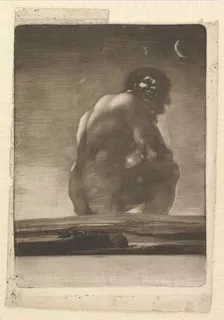
Around the same years he made the print Seated Giant, finished by 1818. It is an aquatint, a way of building tone on a copper plate. Under a dark sky, a huge figure sits at the edge of the land with his back to us and turns to look over his shoulder. A thin crescent moon hangs in the upper right.
 Painted around this timeSeated Giant
- 1824Bordeaux
In the summer of 1824 Goya, now 78, arrived in Bordeaux, France. The king had given him leave to take the waters at the spa of Plombières. His old friend, the playwright Leandro Fernández de Moratín, was already there. Moratín wrote that Goya had come deaf, old, and weak, without a word of French, and yet very happy.
Goya lived in Bordeaux with Leocadia Zorrilla, who joined him there, and died in April 1828 at 82. In 1888 the Spanish consul had his grave opened and found the skeleton without its skull. His remains went back to Spain and in 1919 were buried in the church of San Antonio de la Florida in Madrid. His pictures scattered too, some as far as New York and Chicago, which is where the four Goyas on this site come from.
In their own words
El sueño de la razón produce monstruos
The sleep of reason brings forth monsters. (Goya etched these words onto plate 43 of Los Caprichos.)
People around them
- Josefa Bayeuhis wife, married in 1773, who died in 1812.
- Francisco Bayeuhis brother-in-law, a court painter who clashed with Goya over the Pilar cathedral work.
- Martín Zapatera school friend from Zaragoza and his longtime correspondent.
- Javier Goyahis only child to live to adulthood, for whom he asked the king for a pension.
- Leandro Fernández de Moratína playwright friend who was with him in Bordeaux in his last years.
- Leocadia Zorrillahis companion in his final years, who lived with him in Bordeaux.