Pyeongye
Painters · 20th century
William James Glackens
1870–1938
An American painter who learned to catch a scene fast as a newspaper sketch artist, then used that quick hand to fill canvases with bright color and the crowded rooms and streets of New York.
Scenes from a life
The life of William James Glackens,
scene by scene
- 1892Philadelphia
Picture a young man at a desk in a newspaper art department. Printing photographs in a daily paper was still hard, so artists rushed out to where the news was happening and drew what they saw. Glackens did this job at the Philadelphia Press, working alongside John Sloan, George Luks and Everett Shinn.
The young illustrators gathered at the Walnut Street studio of Robert Henri, a painter a few years older than they were. They argued about new painting and even put on amateur theatricals together. Sloan already knew Glackens well: they had been classmates at Central High School.
- 1895Paris
In 1895 Glackens sailed for Europe with Henri. In Holland he studied the Old Masters, and in Paris the two friends shared a studio. He also went bicycling through Europe.
When he came home in 1896, he did not go back to Philadelphia. He settled in New York and earned his living drawing for newspapers and magazines.
- 1898Cuba
When the Spanish-American War broke out, McClure's Magazine sent Glackens to cover it. He traveled with American troops from Florida to Cuba, sketching soldiers on the march and under fire. His drawings illustrated an article on the fight for Santiago in the magazine's October issue.
He came down with malaria on the trip. A few of the small sketches he made in the field now belong to the Metropolitan Museum of Art.
- 1905New York
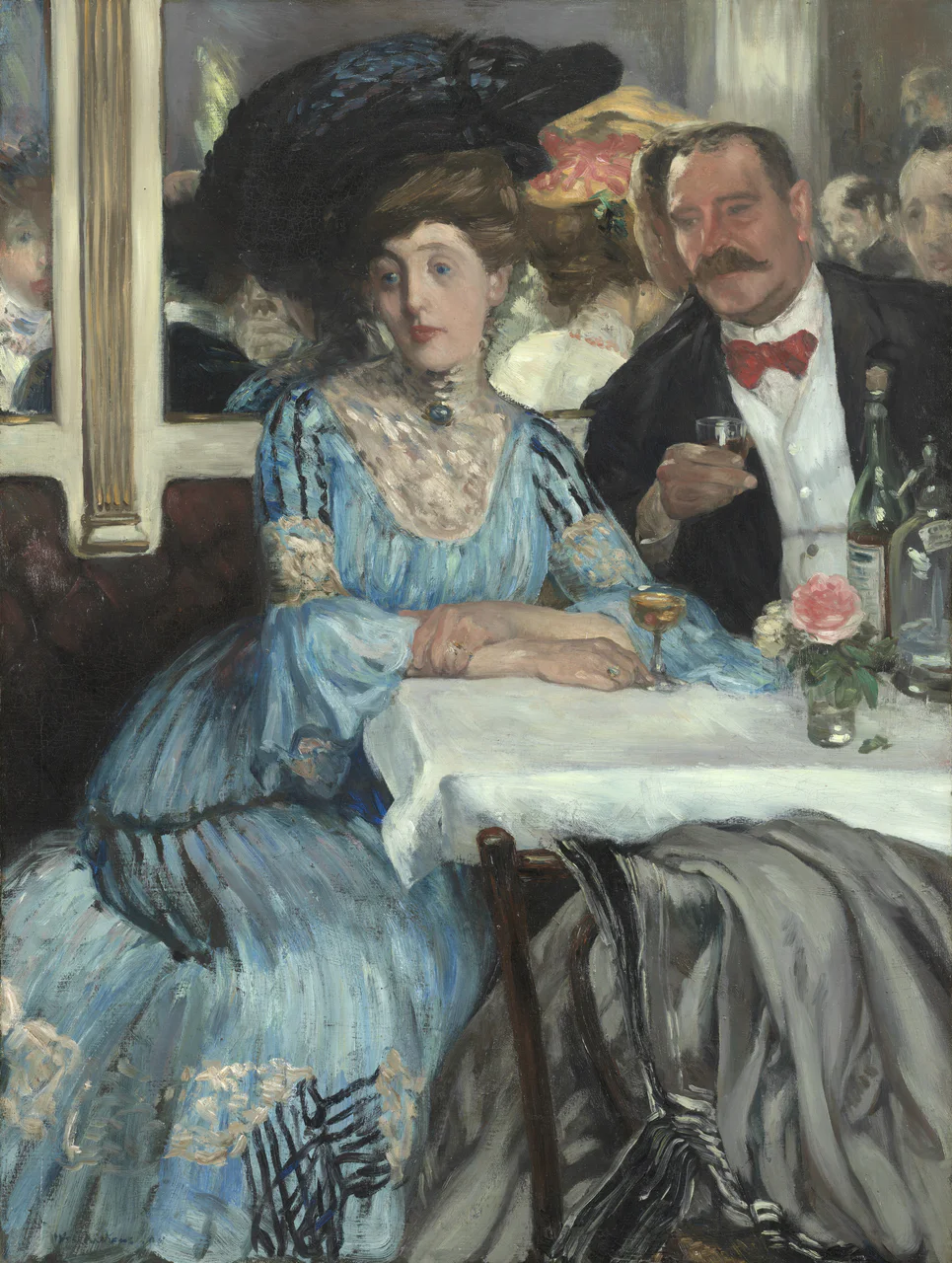
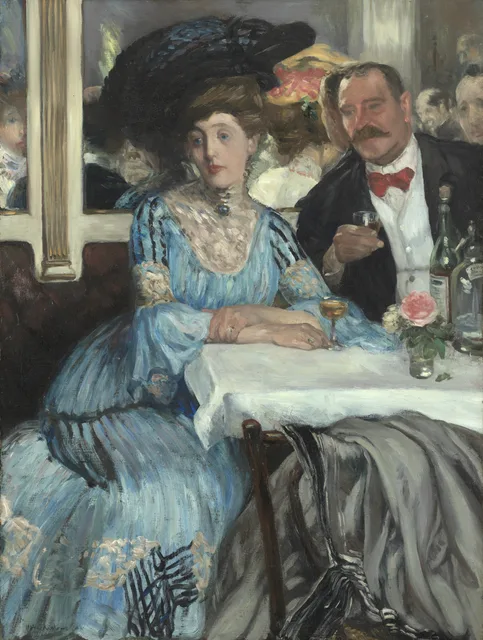
In February 1904 Glackens married Edith Dimock, a painter herself, at her family's mansion in Hartford, Connecticut. The next year he painted Mouquin's, a New York restaurant where he and his friends liked to meet. In At Mouquin's, the front seats go to Jeanne Mouquin, the owner's wife, and James B. Moore, a wealthy man about town.
She wears a pale blue dress and a huge black feathered hat, her hands folded beside a glass. In the mirror behind them you can find Edith and the critic Charles FitzGerald. That November the painting was shown at the Carnegie Institute's annual exhibition in Pittsburgh.
 Painted around this timeAt Mouquin's
- 1908New York
On February 3, 1908, eight painters hung their work at the Macbeth Galleries in New York. Henri, Sloan, Luks, Shinn and Glackens were among them. They had organized the show themselves instead of waiting on the academy's juries, and the group became known as The Eight. At Mouquin's was on the wall.
The most important buyer was the sculptor and collector Gertrude Vanderbilt Whitney. She bought four paintings, and they are still in the Whitney Museum of American Art. That fall the show set off on a tour, starting in Chicago.
- 1912Paris
Albert Barnes, Glackens's old Central High classmate, had grown rich selling a medicine and now wanted to collect modern pictures. In February 1912 Glackens sailed to Paris with 20,000 dollars of Barnes's money and chose the paintings himself.
On April 2 Barnes opened the crates in Philadelphia and unpacked 33 works. Among them were Van Gogh's portrait of a postman and paintings by Picasso, Cézanne and Renoir.
- 1913New York
In February 1913 the Armory Show opened in the 69th Regiment Armory in New York. It put a flood of new European art in front of American crowds. Glackens chaired the committee that picked the American entries.
Four years later the Society of Independent Artists held its first show, open to anyone who paid the fee, with no jury. Glackens was its first president. At that very show Marcel Duchamp submitted a urinal signed R. Mutt, and the society's board refused to display it.
- 1938Westport
On May 22, 1938, Glackens died suddenly while visiting his friend Charles Prendergast in Westport, Connecticut. He was sixty-eight. Edith wrote down an account of that day, and it survives in the Prendergast Archive and Study Center at the Williams College Museum of Art.
At Mouquin's had already found its home. In 1925 the Art Institute of Chicago bought it from the Kraushaar Gallery in New York, and Edith, with her red lips, still sits at the left edge of the mirror.
People around them
- Edith DimockHis wife from 1904 and a painter in her own right, reflected in the mirror of At Mouquin's.
- Robert HenriThe painter who led Philadelphia's young newspaper artists and shared a Paris studio with Glackens in 1895.
- John SloanHis Central High classmate and newspaper colleague, and a fellow member of The Eight.
- Albert BarnesHis Central High classmate, who sent him to Paris in 1912 to buy paintings.
- Charles PrendergastBrother of the painter Maurice Prendergast of The Eight, at whose Westport home Glackens died.
Works
Paintings by
William James Glackens on Pyeongye
More paintings by this artist will be added.