 Pyeongye
Artwork · 20th century · William James Glackens
LeoTurn on Magnifier at the lower right and move slowly across the painting.
Full screen opens it edge to edge.Tap the painting to fill the screen.
Spread two fingers to look closer.
At a glance
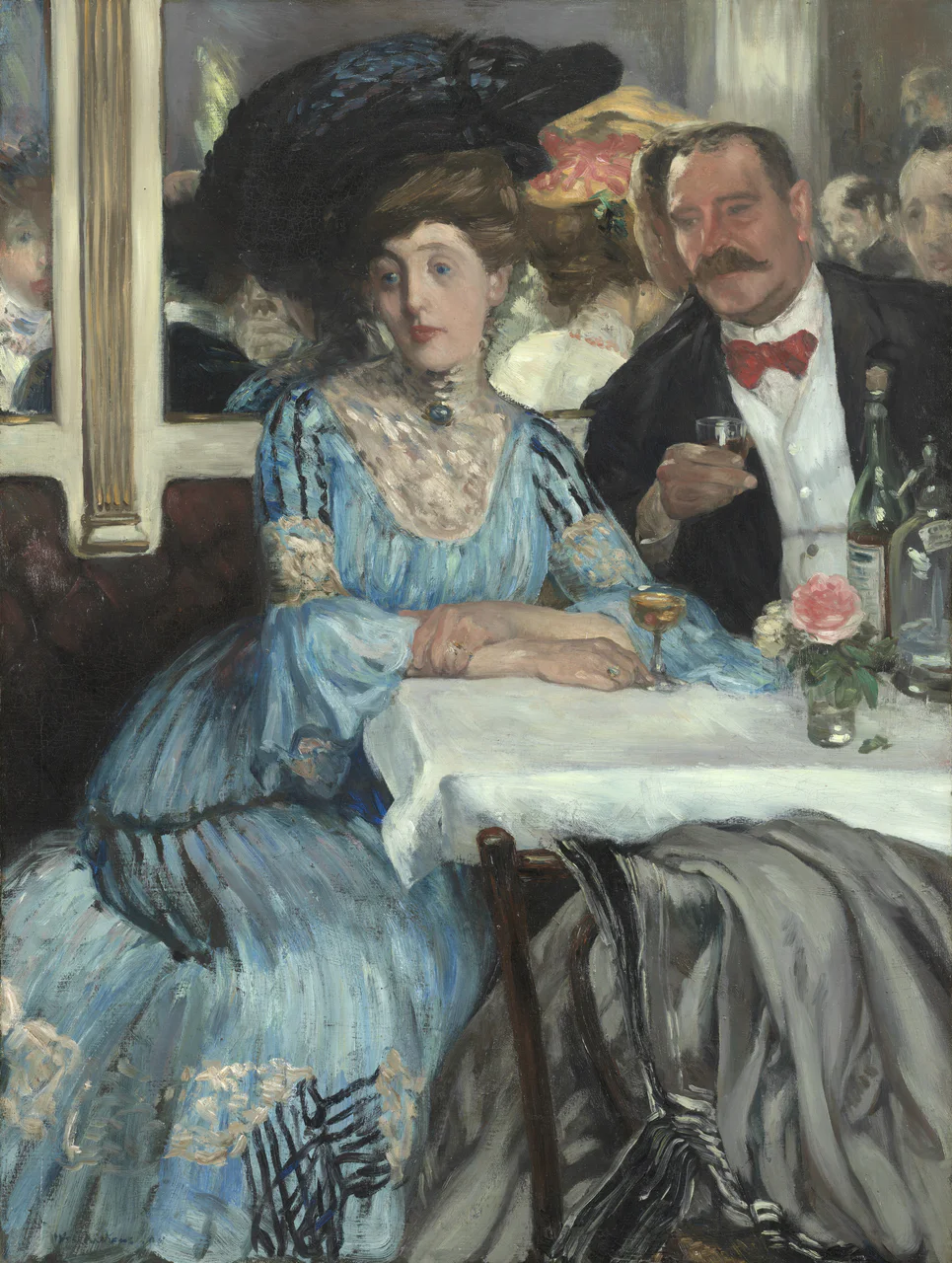
- At Mouquin's, a French restaurant in New York, a woman in a huge feathered hat and a man with a big mustache sit at a table with their drinks.
- Painted by the American artist William James Glackens in 1905.
- The two people at the table belonged to Glackens's circle, and the mirror behind them even catches his wife and a friend.
Reading the picture
5 places to look closer
Tap a number on the painting to jump to its note, or a close-up to see that spot in the whole picture.
Zoom in on the woman's face. Under the black feathered hat, her blue eyes gaze steadily out toward us. A blue jeweled brooch sits at her throat. She is Jeanne Mouquin, wife of the restaurant's owner. We cannot tell what she is thinking, and that look gives the whole scene a quiet tension.
Now look at the man on the right. He has a bushy mustache, a red bow tie, a white shirt and a black evening jacket. He holds a small glass and leans toward her. He is James B. Moore, a wealthy man about town who also ran restaurants.
Zoom in beside the pale column at the upper left. It looks like a window frame, but it is a mirror. On the left of the column you can see a woman with red lips, and on the right a man in dark clothes. They are the painter's wife, Edith, and the art critic Charles Fitzgerald. Glackens tucked his friends into the reflection.
Look at the woman's hands resting on the table. Rings glint on her fingers, and a glass of golden drink stands beside them. Above, her pale blue sleeve is built from thick, fast sweeps of the brush. Up close, every stroke is still alive on the surface.
Zoom in on the pink rose at the far right of the table. A few quick strokes and the petals open. Behind it stand labeled bottles. On the white tablecloth, this little vase holds still one moment in a busy dining room.
When it was painted
In 1905 Glackens was thirty-five and living in New York. A year earlier he had married Edith Dimock, a painter herself, and the two were just starting their life together. He had begun as a newspaper illustrator in Philadelphia, and in 1898 a magazine sent him to Cuba to draw the Spanish-American War. Those years taught his hand to catch a scene fast.
By now, Mouquin's was where he and his painter friends liked to gather. Glackens took that familiar room, seated people he knew in it, and turned it into a large oil painting. In November of the year he finished it, the picture went on view at the Carnegie Institute's annual exhibition in Pittsburgh.
In February 1908 it stepped onto a bigger stage. Glackens, Robert Henri, John Sloan and five other painters put on their own show at the Macbeth Galleries in New York. They staged it in defiance of the strict juries of the art academy, and the group went down in American art history as The Eight.
The show then went on the road. That fall the painting hung at the Art Institute of Chicago, and then it traveled on to Detroit, Indianapolis, Cincinnati and Pittsburgh. In 1925 the Art Institute of Chicago bought it from the Kraushaar Gallery in New York. Seventeen years after its brief visit as a guest, it came back to stay.
Now look again at the mirror at the upper left. Edith, with her red lips, sits inside the reflection. A year into their marriage, Glackens tucked his wife quietly into a corner of their favorite restaurant.
The painter
William James Glackens
1870–1938
When painting this, the artist was about 35 years old
All paintings by William James Glackens →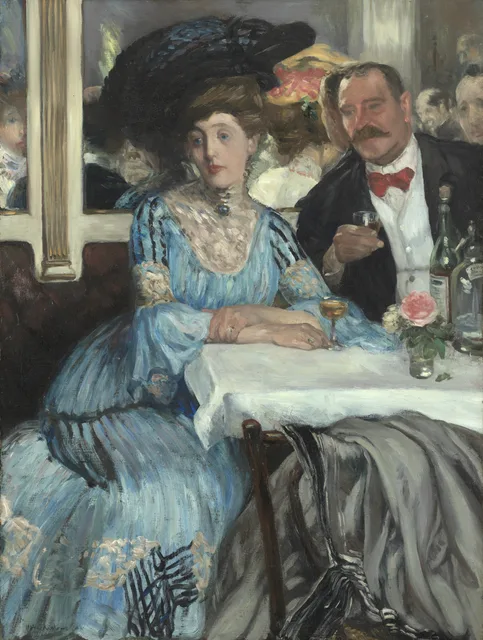
Questions to think about
- Look for itCounting the mirror, how many faces can you find in this painting?
- Why?Why do you think Glackens put his wife and his friend in the mirror instead of at the front?
- What about you?Have you ever sat with someone in a crowded place and still felt alone? How different are our nights out today from this one?
Same period
Painted around the same time,
somewhere else
Too good to keep to yourself
This painting,
for someone who comes to mind
They open it at full size
and see every brushstroke.
About this work
- Artist
- William James Glackens · 1870–1938
- Date
- 1905
- Medium
- Oil on canvas
- Size
- 122.4 × 92.1 cm
- Culture
- United States
- Collection
- The Art Institute of Chicago
- Image
- Original long edge 5835px · shown at 2560px
- Original
- View on the museum's website ↗