Pyeongye
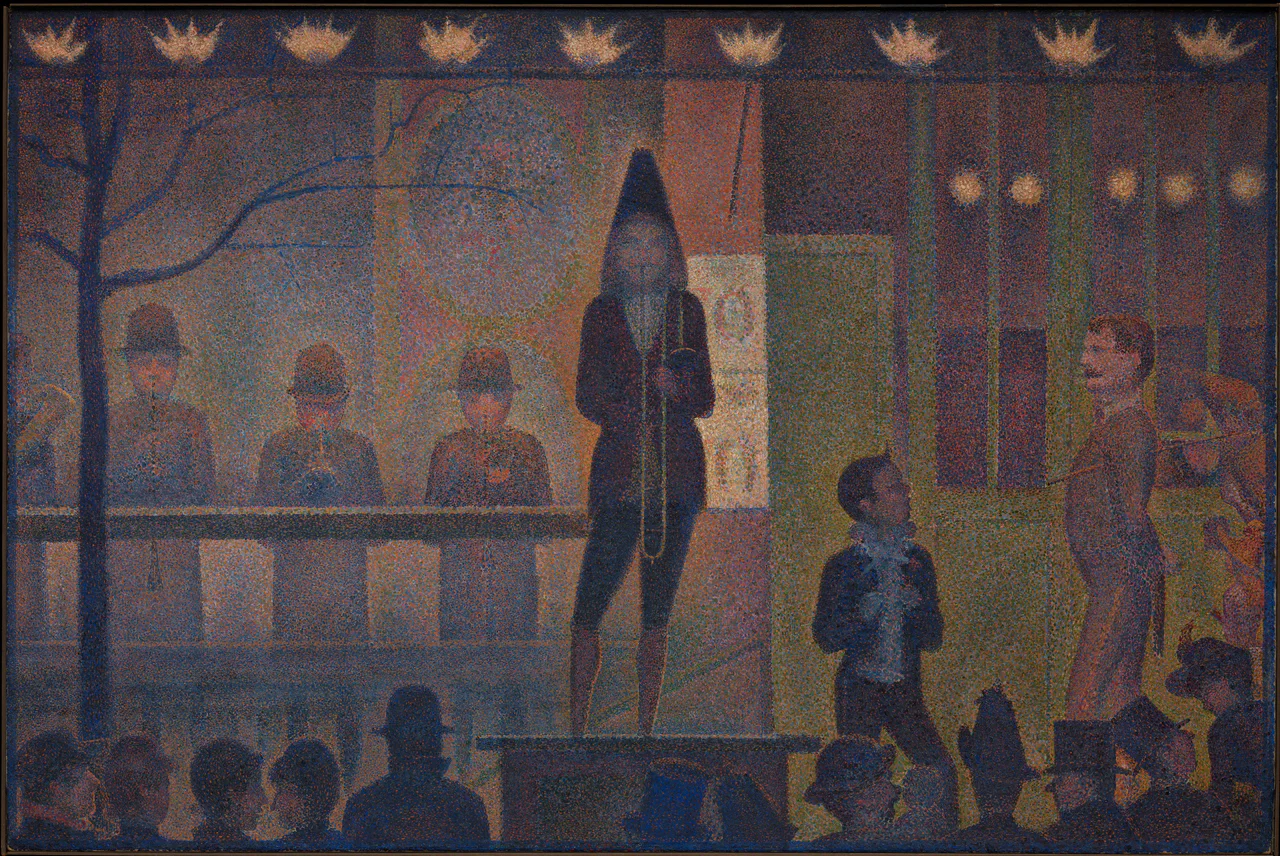
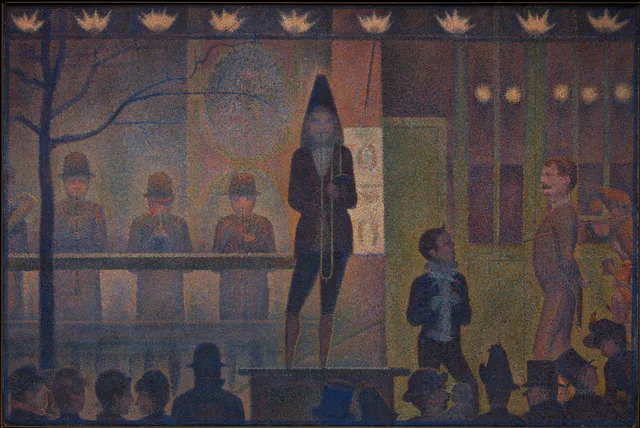
It is night. Musicians stand in a row on a stage in front of a circus tent. In the middle, a figure in a tall pointed hat holds a trombone. Below, a crowd in hats has turned into dark shapes looking up. Step close to the canvas, though, and the whole scene breaks apart into dots.
Georges Seurat painted Circus Sideshow over 1887 and 1888. Its French title, Parade de cirque, names a custom of the time. A parade was a short free show performed outside the tent. The idea was to stop people in the street and get them to buy a ticket and come inside.
Start at the very top of the painting.
Against a deep blue band floats a single flame, split at the top like a little crown. The flame itself is made of short strokes of pale orange and white. The darkness around it is built from blue dots mixed with orange ones. Nine of these flames run along the top edge, lighting the stage.
Seurat did not blend his colors on the palette. He set small dots of color side by side on the canvas. From a few steps back, your eye mixes them into a single color. This method is usually called pointillism.
A few years earlier, Seurat had shown the method in a huge painting, A Sunday on La Grande Jatte. That picture was full of afternoon sun on a riverbank. This one is night. Now the same dots had to make darkness and artificial light.
Look at the trombone player in the center.
Under the pointed hat, where a face should be, there is only a soft blur. No clear eyes, no nose, no mouth. The body rises like a long shadow, made of purple and dark blue dots. Only the trombone in the figure's hands catches the light, in thin yellowish lines.
Up on the right side of the stage are five more lights, round this time. They are not drawn as neat circles either. Each is a cluster of short strokes and dots, and the dark dots crowd right up to their edges.
Now drop to the bottom of the picture.
This is the back of a man in a round hat. There is no face and there are no folds in his coat. He is a silhouette filled with blue dots, with specks of orange scattered inside. We are standing just behind him, watching the same stage.
Seurat died in 1891 at the age of thirty-one, only a few years after finishing this painting. In that short time, dot by dot, he completed several large canvases like this one.