 Pyeongye
Artwork · 18th century · Jean-Baptiste Greuze
LeoTurn on Magnifier at the lower right and move slowly across the painting.
Full screen opens it edge to edge.Tap the painting to fill the screen.
Spread two fingers to look closer.
At a glance
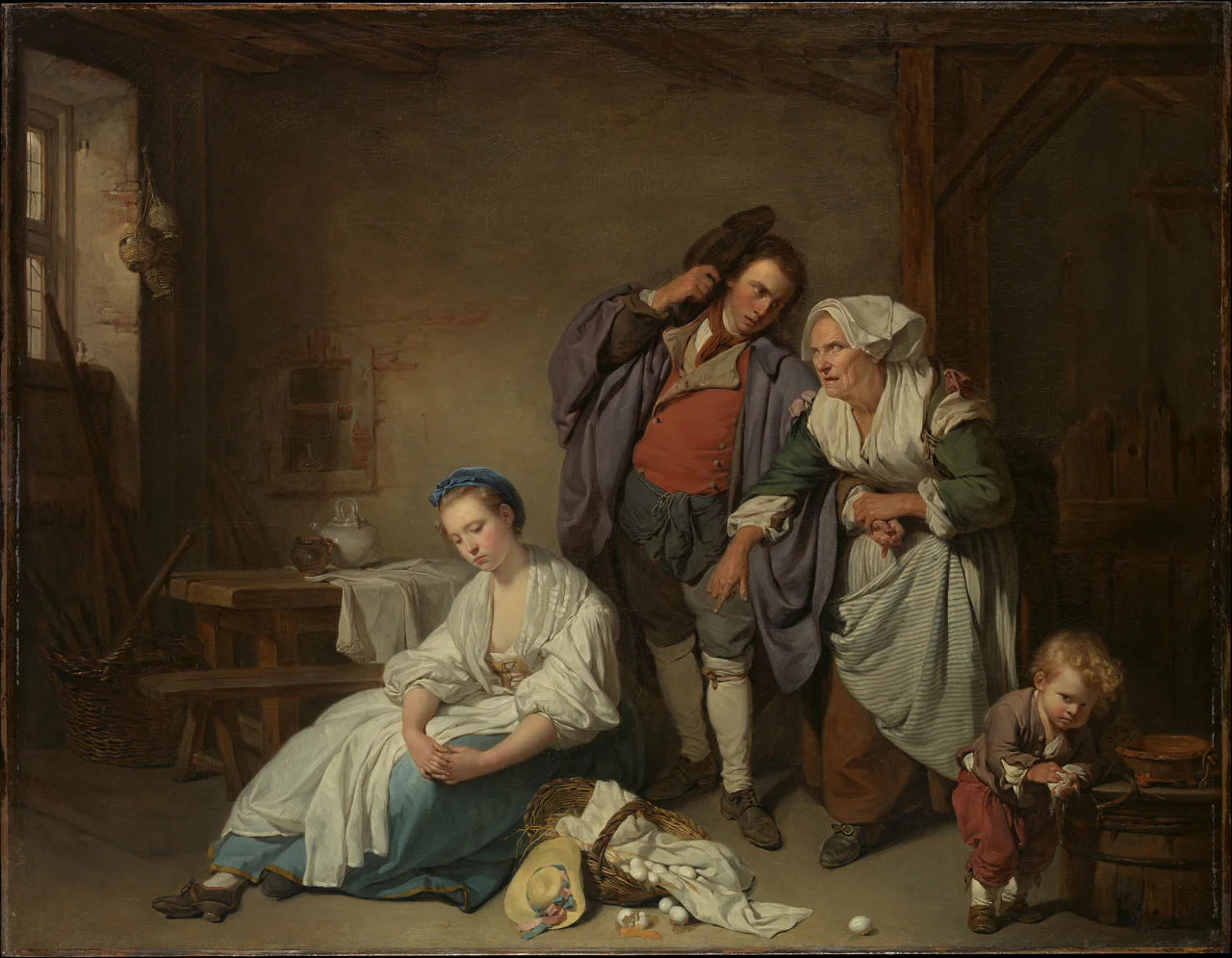
- In a country kitchen, a basket of eggs lies spilled on the floor, an old woman grabs a young man by the arm, and a young woman sits with her head bowed.
- Jean-Baptiste Greuze painted it in oil on canvas in 1756.
- No one in the picture says a word, yet by following their hands and eyes you can work out what has just happened.
Reading the picture
5 places to look closer
Tap a number on the painting to jump to its note, or a close-up to see that spot in the whole picture.
Zoom in on the basket at the bottom center. White eggs have rolled out of the tipped basket, and beside a cracked shell the yolk runs across the floor. Next to them lies a straw hat with pink and pale blue ribbons. This is the center of all the trouble.
Look at the faces of the old woman and the young man. In her white cap, she opens her mouth and glares off to the side, eyes wide. He scratches his head with one hand and watches her out of the corner of his eye. Their glances never meet.
Zoom in on the old woman's hand. A wrinkled hand stretches out one finger and points down at the broken eggs. With her other hand she grips the young man's hand tight. The gesture says plainly: this is your doing.
Look at the young woman sitting on the left. She wears a blue head scarf, folds her hands in her lap, and keeps her eyes down. Her neckline is loose and rumpled, and she looks at no one.
Zoom in on the little boy at the lower right. In red breeches, he clutches something in both hands, and liquid drips down between his fingers. It looks like he is holding a broken egg. He gives us a sulky sideways look.
When it was painted
Paris, 1755. Greuze, about thirty years old, suddenly had people talking. His painting of a father reading the Bible to his children was a hit at the Salon, and the Royal Academy accepted him as a provisional member. Not bad for a young man from Tournus, a small town in Burgundy, who had learned his trade in Lyon.
That same autumn he packed up and left for Italy, traveling with the Abbé Gougenot, an art lover. In those days French painters were expected to go to Rome and study the old masters. Yet what Greuze painted in Rome was not a myth or a saint. It was this little kitchen drama in a country house.
The picture went on show at the Paris Salon in 1757. Scenes like it, ordinary family moments staged like a play with a moral lesson, made Greuze even more popular. Viewers of his time read broken eggs as a sign that a young woman had lost her innocence. One tipped basket did the work of a whole paragraph.
A few years later the writer Denis Diderot praised Greuze again and again in his reviews of the Salon. But Greuze wanted to be ranked as a history painter, the kind of painter the Academy prized above all others. In 1769 he submitted a scene from Roman imperial history, and the Academy admitted him only as a painter of genre scenes. Stung, he stayed away from the Salon for many years.
The painting came to the Metropolitan Museum of Art in New York in 1920. Look again at the little boy at the lower right. While the grown-ups argue, he clutches what looks like a broken egg and glances out at us. In all that noise, he is the only one who meets our eyes.
The painter
Jean-Baptiste Greuze
1725–1805
When painting this, the artist was about 31 years old
All paintings by Jean-Baptiste Greuze →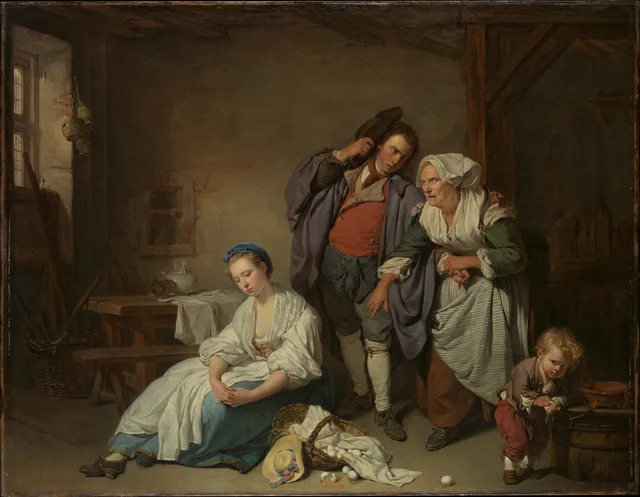
Hidden stories in this painting
Questions to think about
- Look for itWhat color are the ribbons on the straw hat lying on the floor?
- Why?Why do you think Greuze showed what happened through broken eggs instead of spelling it out?
- What about you?In this picture the young woman hangs her head, while the young man only scratches his. When something goes wrong today, do blame and shame still fall more heavily on one side?
Same period
Painted around the same time,
somewhere else
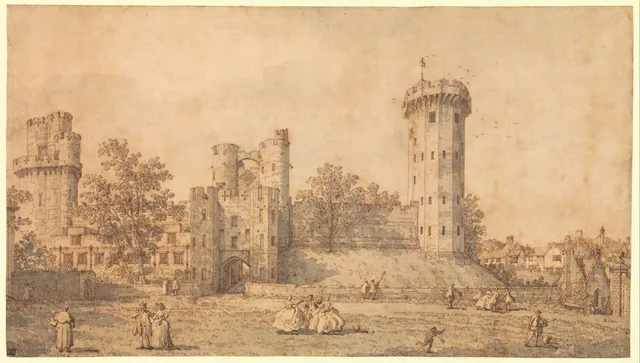 Warwick Castle: The East FrontCanaletto1752
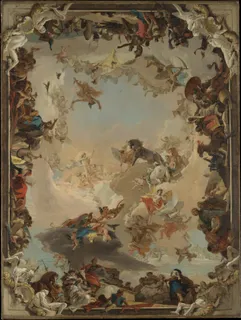 Allegory of the Planets and ContinentsGiovanni Battista Tiepolo1752
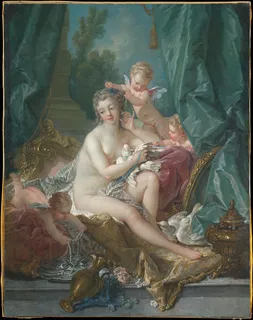 The Toilette of VenusFrançois Boucher1751
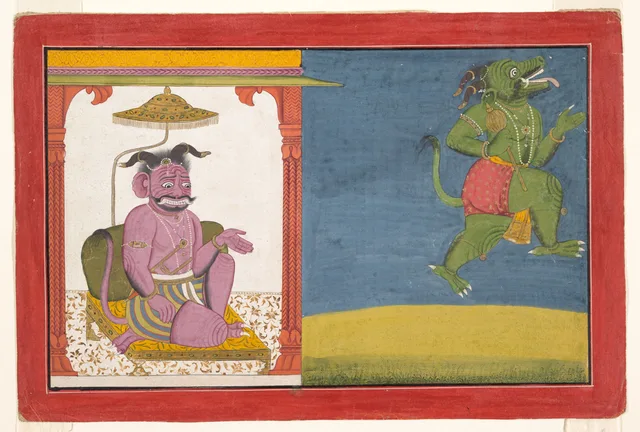 The Demon Hiranyaksha Departs the Demon Palace: Folio from a Bhagavata Purana SeriesUnknown artist · Northern India, Guler, Himachal Pradeshca. 1740
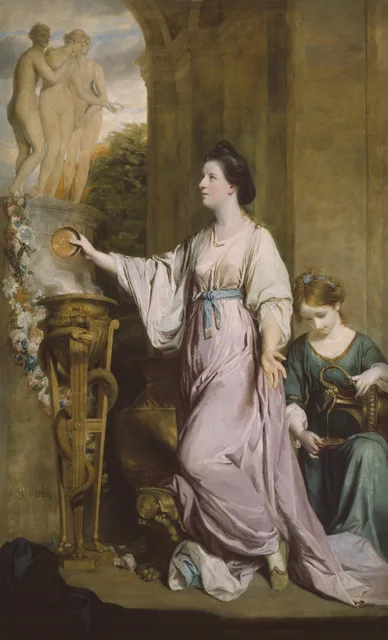 Lady Sarah Bunbury Sacrificing to the GracesSir Joshua Reynolds1763–65
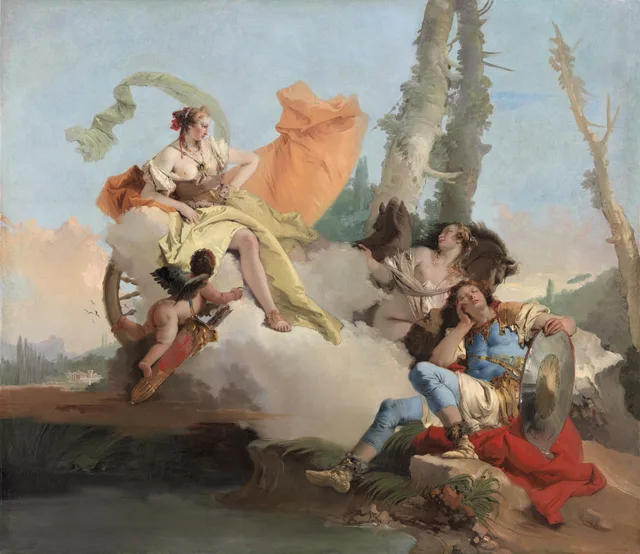 Armida Encounters the Sleeping RinaldoGiovanni Battista Tiepoloc. 1742–45
Too good to keep to yourself
This painting,
for someone who comes to mind
They open it at full size
and see every brushstroke.
About this work
- Artist
- Jean-Baptiste Greuze · 1725–1805
- Date
- 1756
- Medium
- Oil on canvas
- Size
- 73 × 94 cm
- Collection
- The Metropolitan Museum of Art
- Image
- Original long edge 3919px · shown at 2560px
- Original
- View on the museum's website ↗