Pyeongye
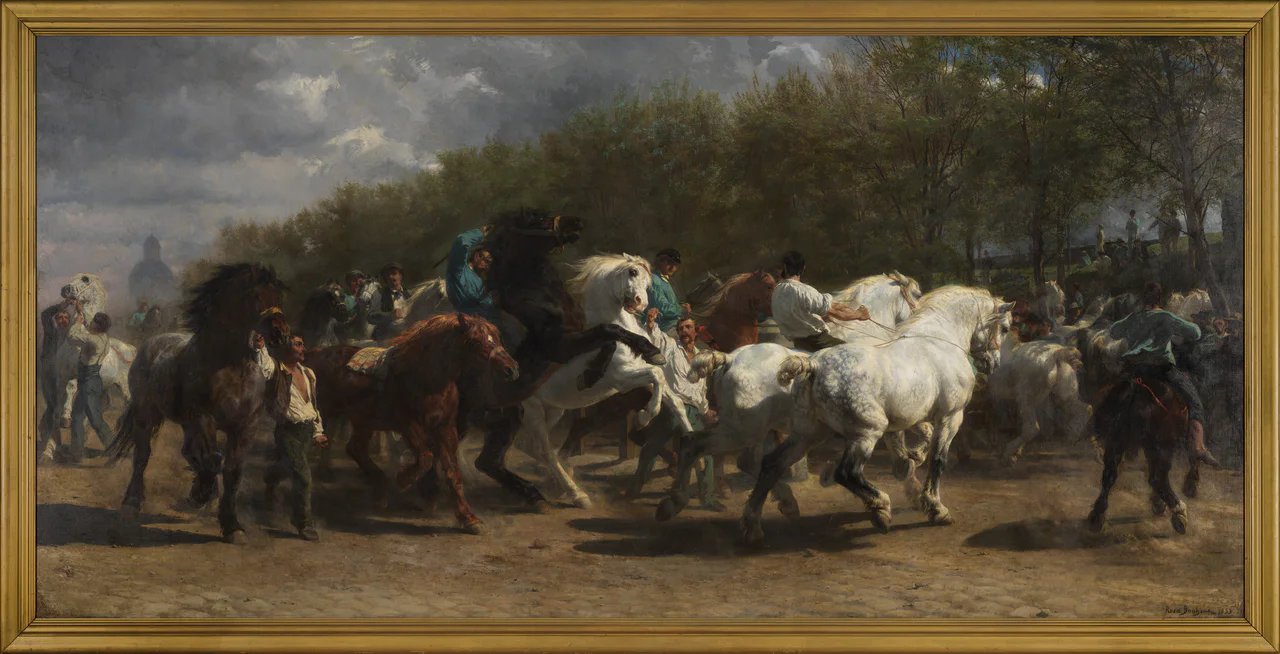
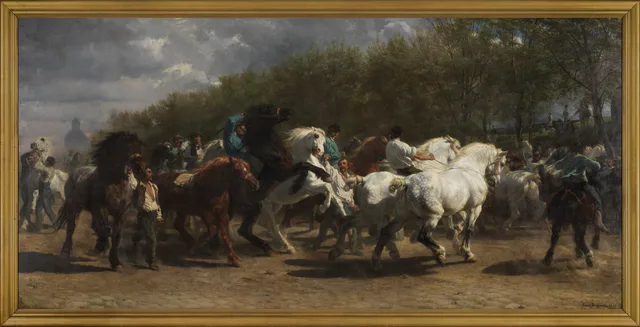
Dust flies up. Horses thunder past in a long line, and men haul on halters. A white horse rears up on its hind legs. Stand in front of this painting and you can almost hear the hooves. It is huge: more than eight feet tall and more than sixteen feet long.
The artist was Rosa Bonheur, a woman painting in nineteenth-century Paris. Before she could set up at the horse market to sketch, she needed something more important than paint or brushes. What was it?
Start with the middle of the picture.
The white horse has its forelegs in the air. A red strap on its bridle shows through the flying mane. Its eyes are wide and its mouth open. Just below, a man in a white shirt grips the lead rope and digs in. To the left, a black horse's hoof hangs in midair.
Behind them, on horseback, sits a figure in a black cap and a blue-green jacket. In all this chaos, this rider alone turns to look out at us. Now let your eye move to the right. A white horse with gray dapples scattered across its hindquarters charges ahead. Its tail is not hanging loose but tied up in a round knot. Behind it, another man in a white shirt sits on horseback and stretches out his arm to pull on the reins. Farther off, in the shade of the trees at upper right, small figures stand on higher ground and watch the commotion.
The painting is called The Horse Fair. The scene is the horse market of Paris, held on a broad, tree-lined boulevard in the southeast of the city. Now look at the upper left.
Through the haze of dust and cloud rises a dome, topped by a small lantern. It belongs to the Salpêtrière, the great hospital that stood near the horse market. A horse market was a man's world of dealers, grooms, and laborers. A woman in skirts with a sketchbook would stand out and draw unwanted attention. So Bonheur wore trousers, dressing like the men around her.
There was a catch. In France at that time, a woman needed permission from the police to wear trousers in public. Bonheur obtained an official permit from the Paris police allowing her to dress in men's clothing. With it, she could spend long hours at the market, watching and sketching the horses. To understand their bodies, she also went to slaughterhouses to study muscle and bone.
Finally, look down in the lower right corner.
In the dirt, in dark paint, is her signature: Rosa Bonheur, 1853. That year the painting hung at the Paris Salon and drew a great deal of attention. The museum dates it 1852 to 1855.
Later, the painting crossed the ocean. The American millionaire Cornelius Vanderbilt bought it and gave it to The Metropolitan Museum of Art in New York in 1887.