Pyeongye
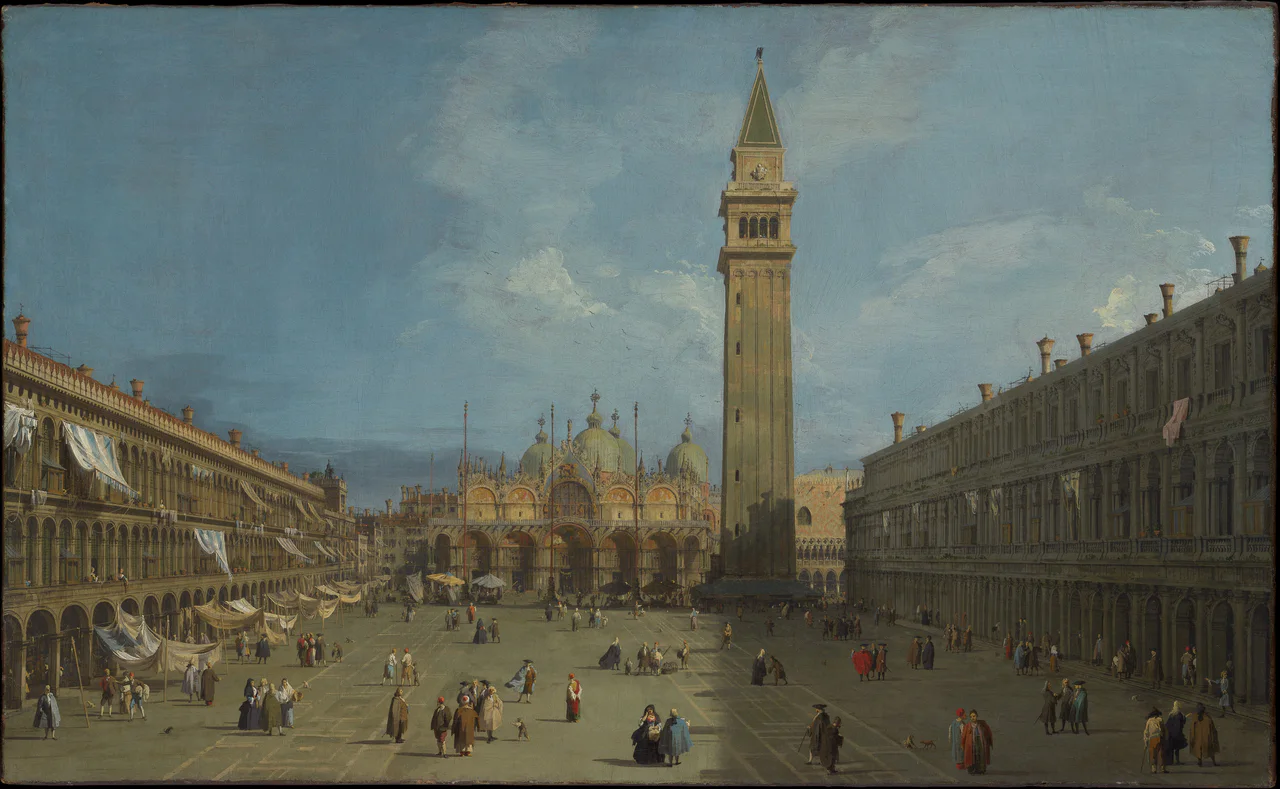
Think of a postcard from Venice. Your eye goes straight to the big buildings. This painting works the same way at first.
The domed church and the tall brick bell tower fill the view. But drop your eyes to the pavement. The square is sprinkled with people no bigger than a fingernail. Who are they, and what are they up to?
The painter is Canaletto, born in Venice as Giovanni Antonio Canal. He painted Piazza San Marco in the late 1720s. He made his name with careful, clear views of his home city.
We are standing at one end of the square, looking toward the Basilica of San Marco. Long arcaded buildings line both sides, arch after arch. Start with the windows on the left.
Small flowerpots sit on the sills. Striped cloths hang down from the windows. One person leans over a railing to watch the square below. At ground level, poles hold up cloth awnings in a row, and people pass in their shade.
Now step down into the middle of the square.
A few gentlemen in black three-cornered hats have stopped to talk. In front of them stand two men in red caps. On the right, a small child walks toward them with arms held out. Higher up, someone strides along with a blue cloak flying behind.
Canaletto painted these people with only a few touches of the brush. They barely have faces. Yet the color of a hat or the tilt of a body tells you who is in a hurry and who is just passing the time. In Italian, tiny figures like these in a view painting were called macchiette, or "little spots."
Next, go to the lower right.
Two men face each other in conversation. One wears a long red robe, the other a long blue one, and one has a red cap. Beside them, two dogs are sizing each other up. Loose, ankle-length robes like these call to mind the dress of the eastern Mediterranean.
For centuries Venice lived by sea trade with the eastern Mediterranean and the Ottoman Empire. Piazza San Marco was the city's front room. In Canaletto's square, many different styles of dress share the same pavement.
So is this exactly what the square looked like? Not quite. Canaletto often adjusted the position or proportions of buildings to make a better picture. It looks like a photograph, but it is not one.
There is a bigger difference, too. The bell tower in this painting collapsed in 1902. The tower you see in Venice today was rebuilt to look like the old one and finished in 1912. The bricks Canaletto painted now survive only in pictures.
His Venetian views were especially popular with wealthy young Englishmen traveling through Italy. They took paintings like this home as memories of the trip. Those memories held more than a famous church. They held flowerpots on a windowsill, a child with open arms, and two dogs meeting on the pavement.