Pyeongye
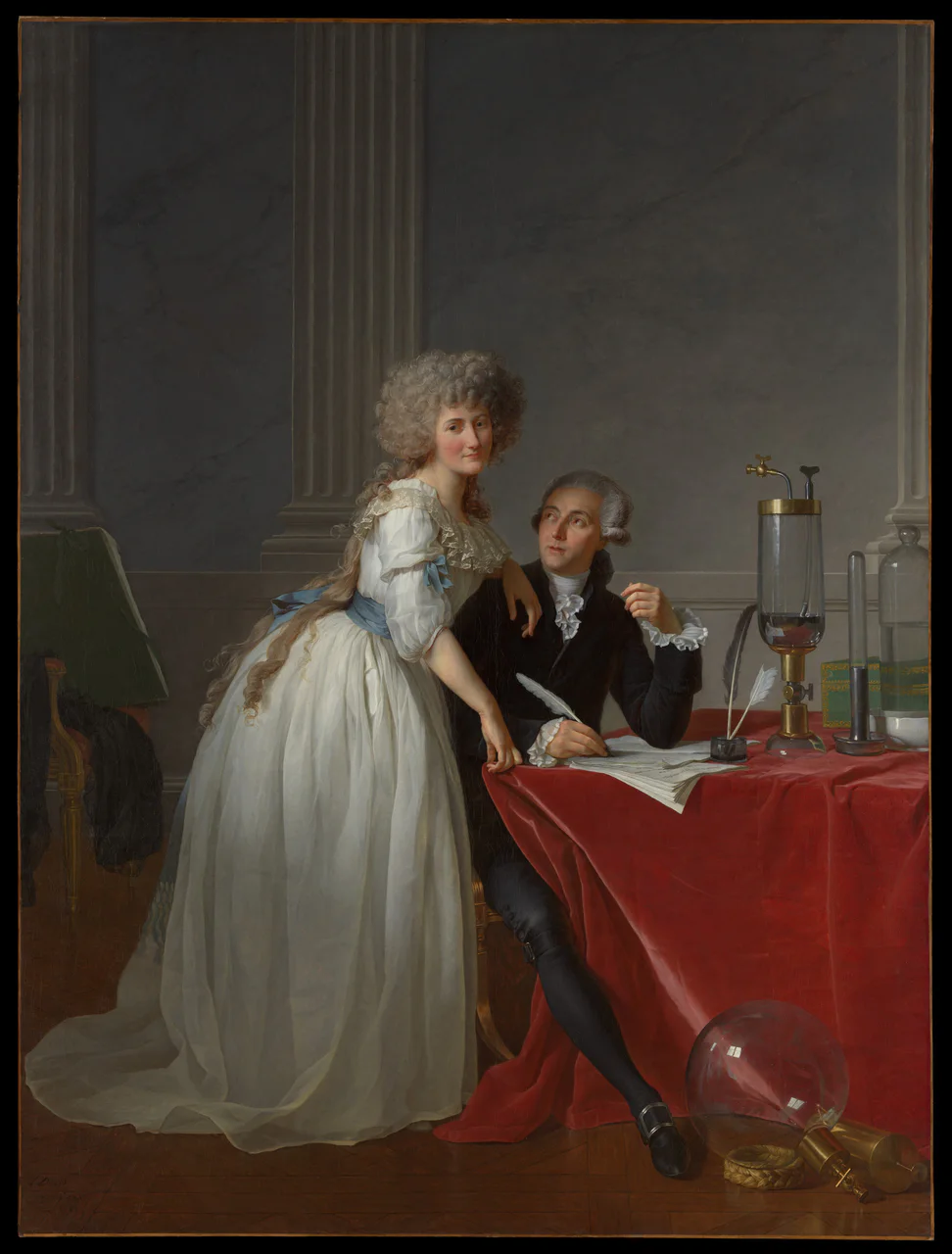
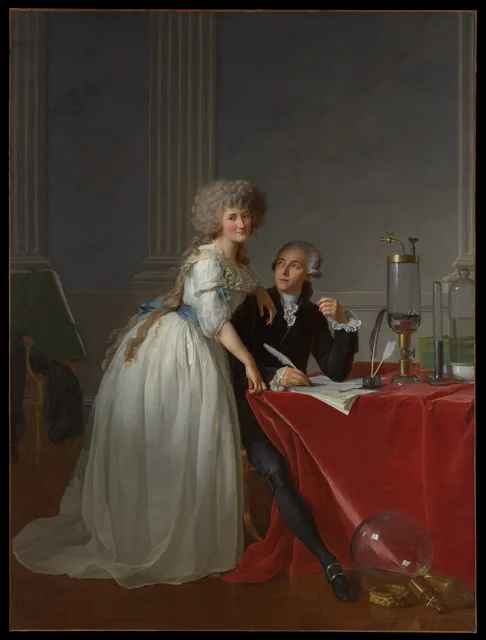
A woman in a white dress rests her arm on her husband's shoulder and looks straight at us. He holds a quill pen and tilts his head up toward her. Between them is a table draped in red cloth. On it, and on the floor below, glass and brass instruments catch the light.
These two are Antoine Laurent Lavoisier and Marie Anne Lavoisier. He was an eighteenth-century French chemist who studied the gases in air and showed that burning is a substance combining with oxygen. Jacques Louis David painted the couple in 1788.
Start at the right side of the table.
A tall glass cylinder stands in the middle, capped with brass. Two fittings stick out of the top. Dark liquid sits at the bottom of the glass. Next to it, a long, thin glass tube rises from a small dish. At the far right, a glass bell jar, partly filled with liquid, stands upside down.
Lavoisier weighed things carefully before and after he burned or mixed them. That patient weighing let him show that in a chemical reaction the total mass stays the same.
Now drop down to the floor.
A large round glass flask lies on its side. Two windows are reflected on its surface as small white squares. Beside it a brass instrument has tipped over, next to a ring of braided straw that serves as a stand. David put clear glass, bright brass, and rough straw side by side and made each one shine in its own way.
But were these instruments there from the start? Conservators at The Metropolitan Museum of Art recently examined what lies beneath the paint using scientific imaging. They found that the first version of the portrait had none of this equipment. Marie Anne was wearing a large, decorated hat. The scientific couple we see today was painted in afterward.
Now look at the far left edge of the picture.
A big dark-green portfolio stands propped on a gilded chair, the kind used to hold drawings. A black cloth spills down below it. It sits on the opposite side from the instruments, on Marie Anne's side.
Marie Anne studied drawing with David. She made the thirteen plates of laboratory equipment for Lavoisier's book Elementary Treatise of Chemistry, published in 1789. She also translated a chemistry essay from English into French. She was her husband's working partner in the lab. That is why many viewers read the portfolio as a sign of her part in the work.
She married Lavoisier in 1771, when she was thirteen. By the time of this portrait she was about thirty. Six years later, in 1794, during the Terror of the French Revolution, Lavoisier was executed. His crime was having served as a tax farmer, one of the private financiers who collected taxes for the crown. The museum's title for the painting records both of their lifespans.