Pyeongye
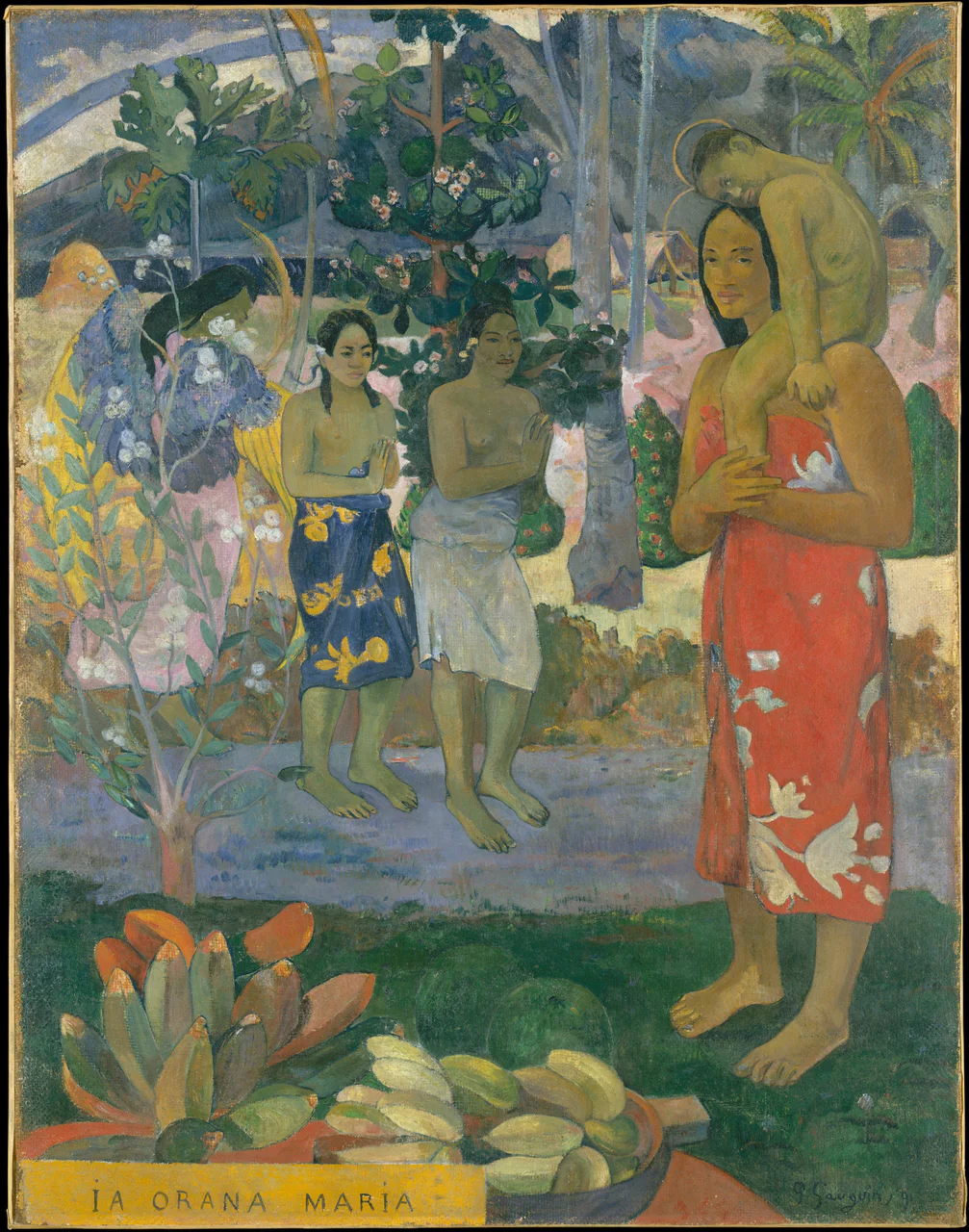
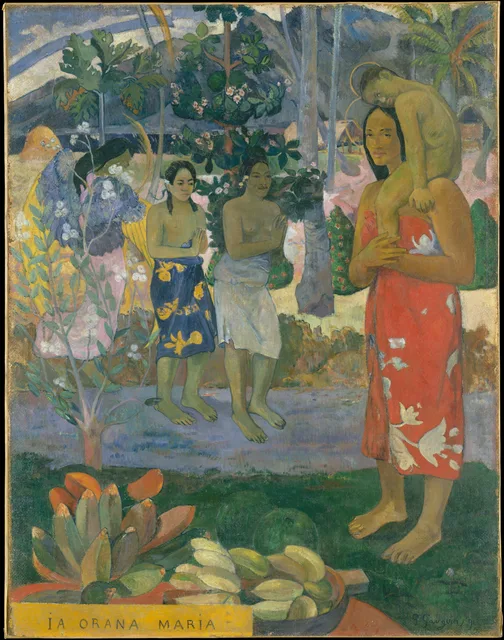
In the lower left corner of this painting there is a yellow strip. On it, in capital letters, are three words: IA ORANA MARIA. They are not French and not English. Most people try sounding them out and then frown. What does it say?
This is Ia Orana Maria, painted by Paul Gauguin in 1891. It measures about 45 by 34 1/2 inches. That spring Gauguin left France, and in June he reached Tahiti in the South Pacific. He painted this picture during his first year on the island.
Start by looking closely at the lettering.
The letters are brushed in dark paint, one by one, on an ocher yellow ground. Just above them, bananas are heaped in a pile. They are green, pale green, orange, and a reddish violet, and the tip of each one carries a dot of orange.
Ia orana is a greeting in Tahitian. Maria is Mary, the mother of Jesus. The museum gives the English title as Hail Mary. In the Bible, these are the first words the angel Gabriel says to Mary when he visits her. Gauguin turned that greeting into Tahitian.
So where is the Mary being greeted? Look to the right.
A woman wrapped in red cloth stands with a child riding on her shoulders. The child rests a cheek on her head. Thin golden rings circle both their heads. Those are halos, the sign painters used for holy figures. Mary and the infant Jesus appear here as a Tahitian mother and child.
Her red wrap is a pareu, the cloth Tahitians wound around the body. Big white leaf shapes are printed across the red. The two women in the middle wear pareus too, one blue with yellow designs, the other plain white. Both hold their hands together in front of their chests.
Their poses hide yet another faraway place. Gauguin owned photographs of the stone reliefs of Borobudur, a Buddhist temple on the island of Java. He borrowed the two women's joined hands and stance from figures in those carvings. So a Bible story from Europe, people of Tahiti, and temple sculpture from Java all overlap in one picture.
Now look behind the flowering bush on the left.
A figure in pink is half hidden behind the branches. Yellow wings open on either side of the body, and something like violet feathers covers the shoulders. It is the angel. When Gauguin described this painting in a letter, he mentioned an angel with yellow wings. The messenger who brought the greeting doesn't step forward. The angel waits quietly among the flowers.
By the time Gauguin arrived, Christianity was already deeply rooted in Tahiti. European missionaries had been bringing their faith to the island since the end of the 1700s. Gauguin retold a Bible scene through the faces and clothes of the islanders.
Down in the grass at the lower right, the signature reads P. Gauguin, 91, in dark paint. A Tahitian greeting in one bottom corner and a French painter's name in the other split the base of the picture between them.