 Pyeongye
Artwork · 19th century · Paul Gauguin
LeoTurn on Magnifier at the lower right and move slowly across the painting.
Full screen opens it edge to edge.Tap the painting to fill the screen.
Spread two fingers to look closer.
At a glance
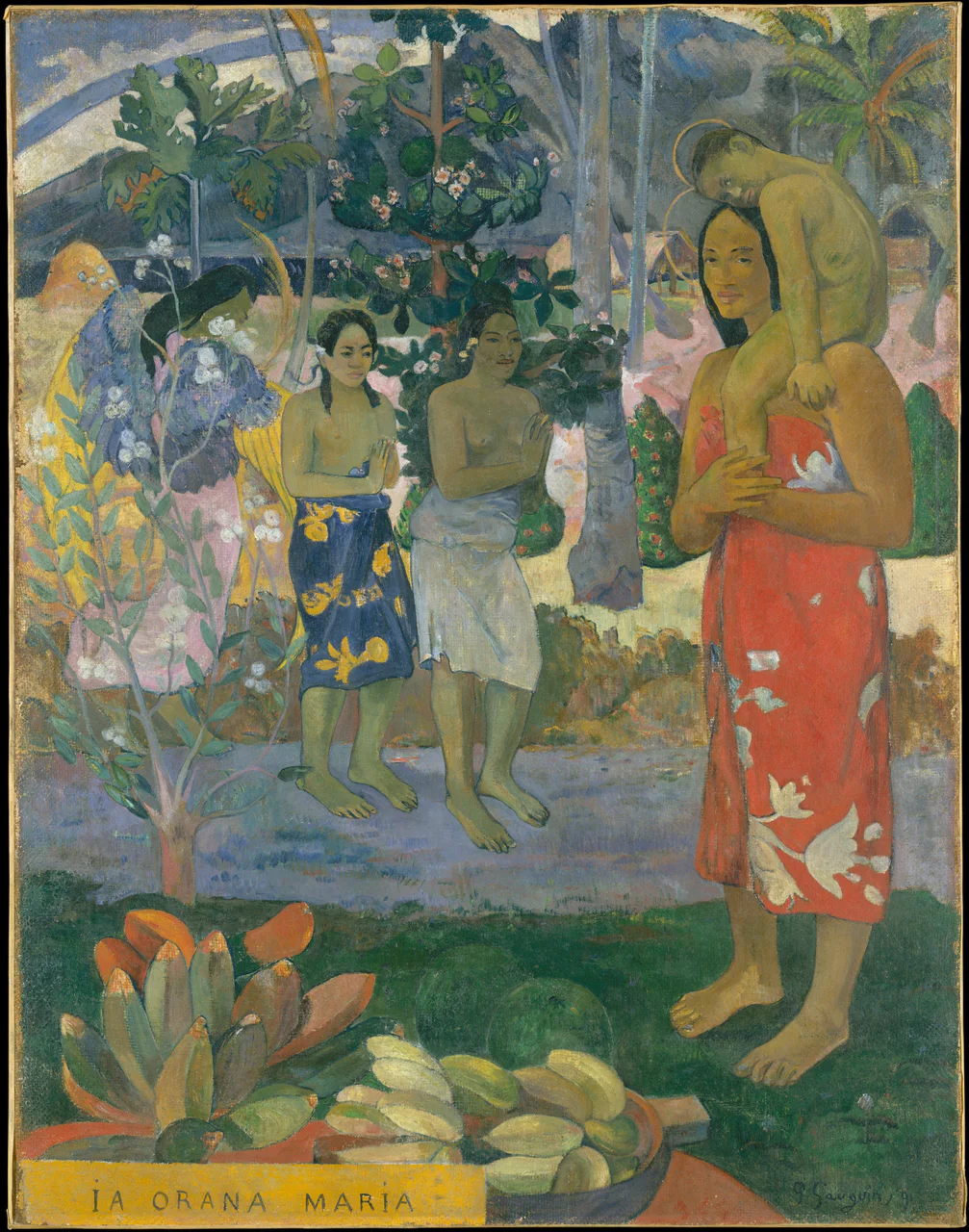
- A Tahitian woman in a red cloth stands with a child on her shoulder while two women greet them with joined hands. Thin gold rings float behind the heads of mother and child.
- Paul Gauguin painted it in 1891, the year he first sailed to Tahiti in the South Pacific.
- It moves the Christian story of the Virgin and Child into a Tahitian landscape, with Tahitian faces.
Reading the picture
5 places to look closer
Tap a number on the painting to jump to its note, or a close-up to see that spot in the whole picture.
Look behind the heads of the mother and child at upper right. Thin golden circles hover there. In European painting, these halos mark the Virgin Mary and the infant Jesus. Yet the faces, the cloth and the skin are all Tahitian.
Zoom in behind the flowering tree on the left. A figure with long dark hair is half hidden among the blossoms. Yellow wings stick out on either side. An angel has slipped into the forest.
Watch the hands of the two women in the middle. Both press their palms together in front of their chests. Gauguin borrowed these poses from a photograph of the carved reliefs at the temple of Borobudur in Java. The gesture could be a prayer, or simply a greeting.
Look at the bowl at the bottom center. It is heaped with pale yellow bananas. More fruit, red and green, is piled up on the left. Like an offering on a church altar, the island's food sits at the very front of the picture.
Read the yellow band at lower left. IA ORANA MARIA means Hello, Mary in Tahitian. These are the angel's words to Mary, the Ave Maria, turned into the language of the island.
When it was painted
In June 1891, a forty-three-year-old Gauguin stepped off the boat at Papeete, the port town of Tahiti. Years earlier he had walked away from a career in finance to paint, but his pictures were not selling. His Danish wife and their children were in Copenhagen. He had paid for the voyage by auctioning his own work in Paris that February.
He told himself he was escaping Western civilization. Yet the island was already a French colony, and missionaries had long since brought Protestant and Catholic Christianity there. Shortly after he arrived, Pōmare V, the last king of Tahiti, died. Disappointed by a capital full of French officials, Gauguin soon moved to Mataiea, a village on the south coast.
We know how he saw this painting, because he explained it himself. In a letter of March 1892, he described an angel with yellow wings showing Mary and Jesus to two Tahitian women, and he added that Mary and Jesus were Tahitians too. He had taken the Christian story the islanders now knew and retold it in their own faces and colors.
Gauguin returned to France in 1893. That November he showed his Tahitian paintings at the Durand-Ruel gallery in Paris, and he put this canvas first in the catalogue. The show was a disappointment. This was one of the few pictures that sold.
In 1895 he sailed for the South Seas again and never came back. He died in the Marquesas Islands in 1903. The painting came to the Met in 1951 as a bequest from the New York collector Sam A. Lewisohn.
Now look back at the flowering tree on the left. Those yellow wings poking out from the branches belong to the angel Gauguin described in his letter. It is still there, half hidden.
The painter
Paul Gauguin
1848–1903
When painting this, the artist was about 43 years old
All paintings by Paul Gauguin →
Hidden stories in this painting
Questions to think about
- Look for itCan you find Gauguin's signature and the year in the bottom right corner?
- Why?Why do you think Gauguin painted the title in Tahitian, not French, right into the picture?
- What about you?Gauguin borrowed the look of another people to tell his own story. When fashion or advertising borrows from other cultures today, where does respect end and a problem begin?
Same period
Painted around the same time,
somewhere else
Too good to keep to yourself
This painting,
for someone who comes to mind
They open it at full size
and see every brushstroke.
About this work
- Artist
- Paul Gauguin · 1848–1903
- Date
- 1891
- Medium
- Oil on canvas
- Size
- 113.7 × 87.6 cm
- Collection
- The Metropolitan Museum of Art
- Image
- Original long edge 3722px · shown at 2560px
- Original
- View on the museum's website ↗