Pyeongye

Painters · 19th century
Paul Gauguin
1848–1903
A Paris stockbroker who painted on Sundays, then bet everything on art and followed it from Brittany and Arles to the islands of the South Pacific, painting in bold outlines and hot, flat color.
Scenes from a life
The life of Paul Gauguin,
scene by scene
- 1849At sea, bound for Peru
A ship carrying a one-year-old boy named Paul is working its way around the tip of South America. His father, Clovis, a newspaper journalist, is taking the family to Peru to start over. He never arrived. Clovis died on the voyage and was buried on the coast of southern Chile.
His widow and children went on to Lima, where her wealthy relatives took them in. Paul's grandmother was Flora Tristan, a writer and activist whose father came from a noble Peruvian family. Paul lived in comfort in Lima until he was about six, then sailed back to France with his mother.
- 1873Paris
At twenty-five, Gauguin marries Mette Gad, a young woman from Denmark. After years at sea as a sailor, he now earns a good living in the Paris stock market. The job came through Gustave Arosa, who had become his guardian after his mother's death.
Arosa collected paintings, and in his house Gauguin looked hard at art. Soon he was painting on his days off. In 1876 one of his landscapes, a wooded view at Viroflay, was accepted for the official Paris Salon.
- 1885Copenhagen
Gauguin is packing up at his wife's family home in Copenhagen. The stock market had crashed in 1882, and the next year he quit finance to paint full time. Money ran out, so the family moved to Mette's home city. His pictures did not sell there either.
In June 1885 he went back to Paris, taking only his six-year-old son Clovis with him. To get by, he took work pasting advertising posters on the streets. He never again lived under the same roof as his wife and children.
- 1887Panama and Martinique
In April 1887 Gauguin boards a ship for Panama with his friend Charles Laval, a young painter. They hoped to live cheaply somewhere warm and paint. But Panama was crowded and booming with the canal works, nothing like the place he had imagined, and their money soon ran low.
In June the two men scraped together enough to leave for Martinique, an island in the Caribbean. There Gauguin fell ill with dysentery and malaria and was sick for months. Still, he came back to Paris late that year with paintings of the island's shore and its women gathering fruit.
- 1888Arles
On October 23, 1888, Gauguin arrives at the Yellow House in Arles, in the south of France. Vincent van Gogh had been begging him for months by letter to come and paint with him. Now the two men worked side by side, often painting the same views.
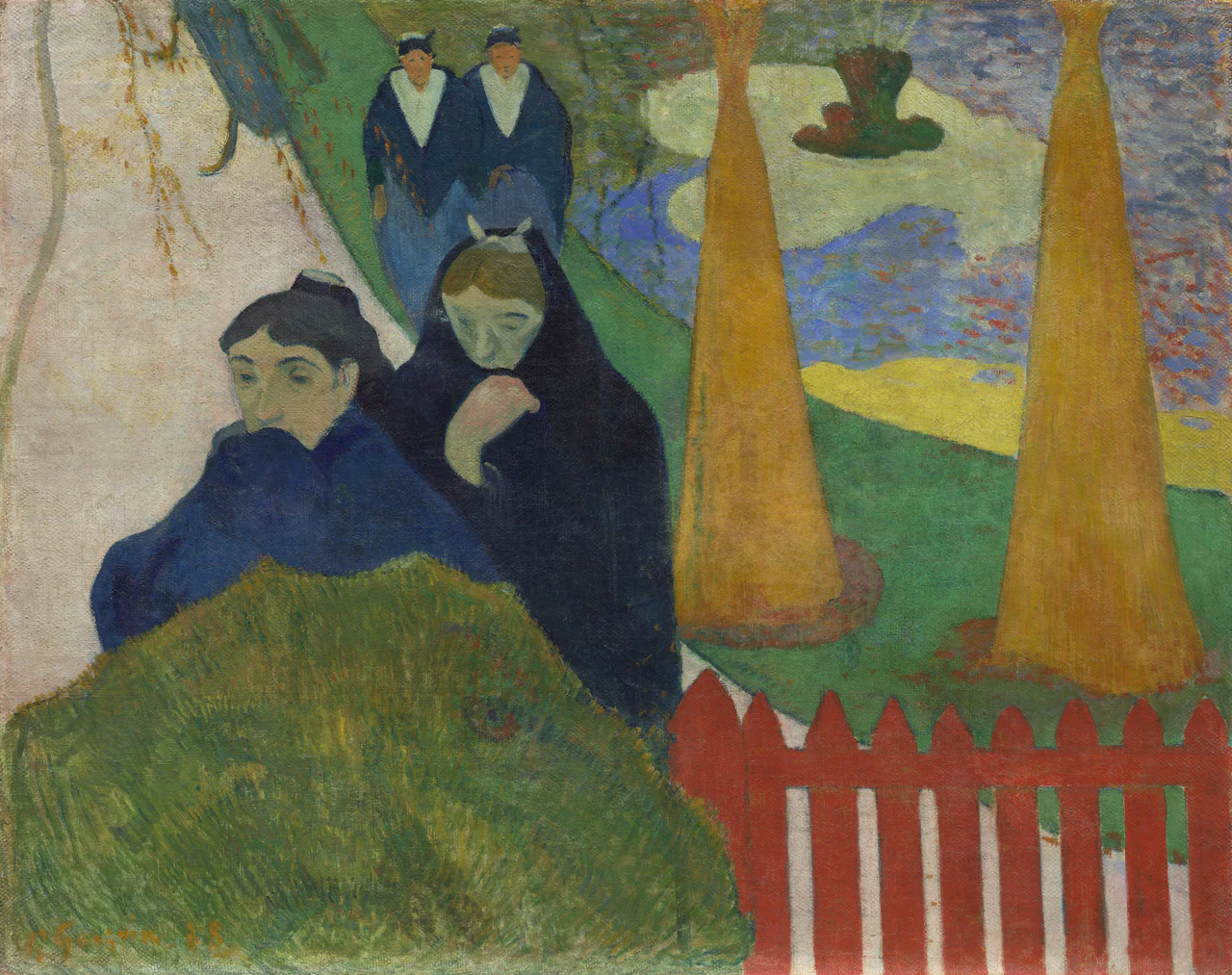
Right across the street from the house was a public garden. Arlésiennes (Mistral) shows it. Women wrapped in dark shawls cover their mouths against the cold. Two tall orange cones stand on the right, and a bright red fence cuts across the bottom.
The friendship grew tense. On the night of December 23, Van Gogh cut his own ear. Gauguin sent for Vincent's brother Theo and left Arles soon after. Their time together had lasted about two months.
 Painted around this timeArlésiennes (Mistral)
- 1891From Paris to Tahiti
On February 23, 1891, Gauguin's paintings go under the hammer at the Hôtel Drouot auction house in Paris. He needed the money for his passage to the South Seas. The poet Stéphane Mallarmé helped him prepare the sale.
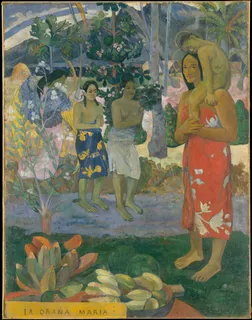
A month later, on March 23, friends threw him a farewell banquet at the Café Voltaire. Painters and writers gathered, and Mallarmé raised a toast to the departing artist. Gauguin left France in early April and reached Tahiti in June. That year he painted Ia Orana Maria, with Mary and the Christ Child as Tahitians.
 Painted around this timeIa Orana Maria (Hail Mary)
- 1893Tahiti and Paris
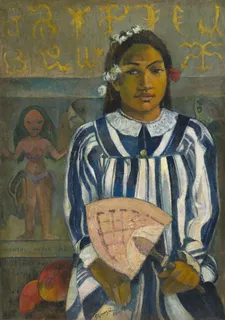
In the summer of 1893 Gauguin sails home to Marseille, his luggage packed with island paintings. One of them, painted in Tahiti that year, is Merahi metua no Tehamana. The museum identifies the girl as thirteen-year-old Tehamana and notes that Gauguin turned her into an image of his own desire.
Look at her. She wears a striped missionary dress, holds a fan, and looks straight back at us. Yellow signs run across the wall behind her, and mangoes sit at the lower left.
That November his Tahiti show opened at the Durand-Ruel gallery in Paris, but few works sold. Still, the older painter Edgar Degas acquired Gauguin's The Moon and the Earth from him around this time and kept it until his death.
 Painted around this timeMerahi metua no Tehamana (Tehamana Has Many Parents or The Ancestors of Tehamana)
- 1903Atuona, Hiva Oa
In March 1903 a local court on Hiva Oa, in the Marquesas Islands, hands down its sentence. Gauguin is found guilty of libeling a gendarme and given three months in prison and a fine. He had often taken the islanders' side against the colonial officials.
He planned to appeal in Papeete, on Tahiti, and began raising money for the trip. But on the morning of May 8, before the appeal was heard, he died in the two-story house he had built with help from his neighbor Tioka and named the House of Pleasure. He was fifty-four. His paintings later scattered to museums around the world; the three on this site are now in New York and Chicago.
People around them
- Mette Gadhis Danish wife, married in 1873, who raised their children in Copenhagen after he left.
- Gustave Arosahis guardian after his mother's death, who found him his stock market job and showed him paintings.
- Camille Pissarrothe older painter who coached the Sunday painter and brought him into the Impressionist exhibitions.
- Charles Lavalthe young painter who traveled with him to Panama and Martinique in 1887.
- Vincent van Goghthe painter he lived and worked with in the Yellow House in Arles for about two months in 1888.
- Stéphane Mallarméthe poet who raised a toast to him at his farewell banquet in 1891.
Works
Paintings by
Paul Gauguin on Pyeongye
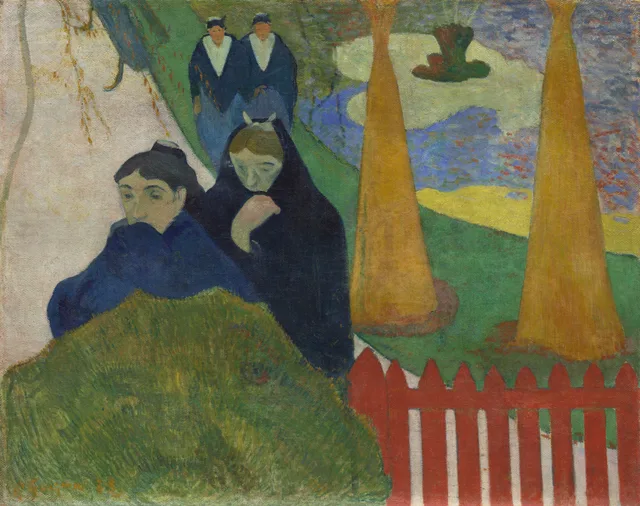 Arlésiennes (Mistral)1888Ia Orana Maria (Hail Mary)1891Merahi metua no Tehamana (Tehamana Has Many Parents or The Ancestors of Tehamana)1893
Hidden stories in Paul Gauguin's paintings