Pyeongye
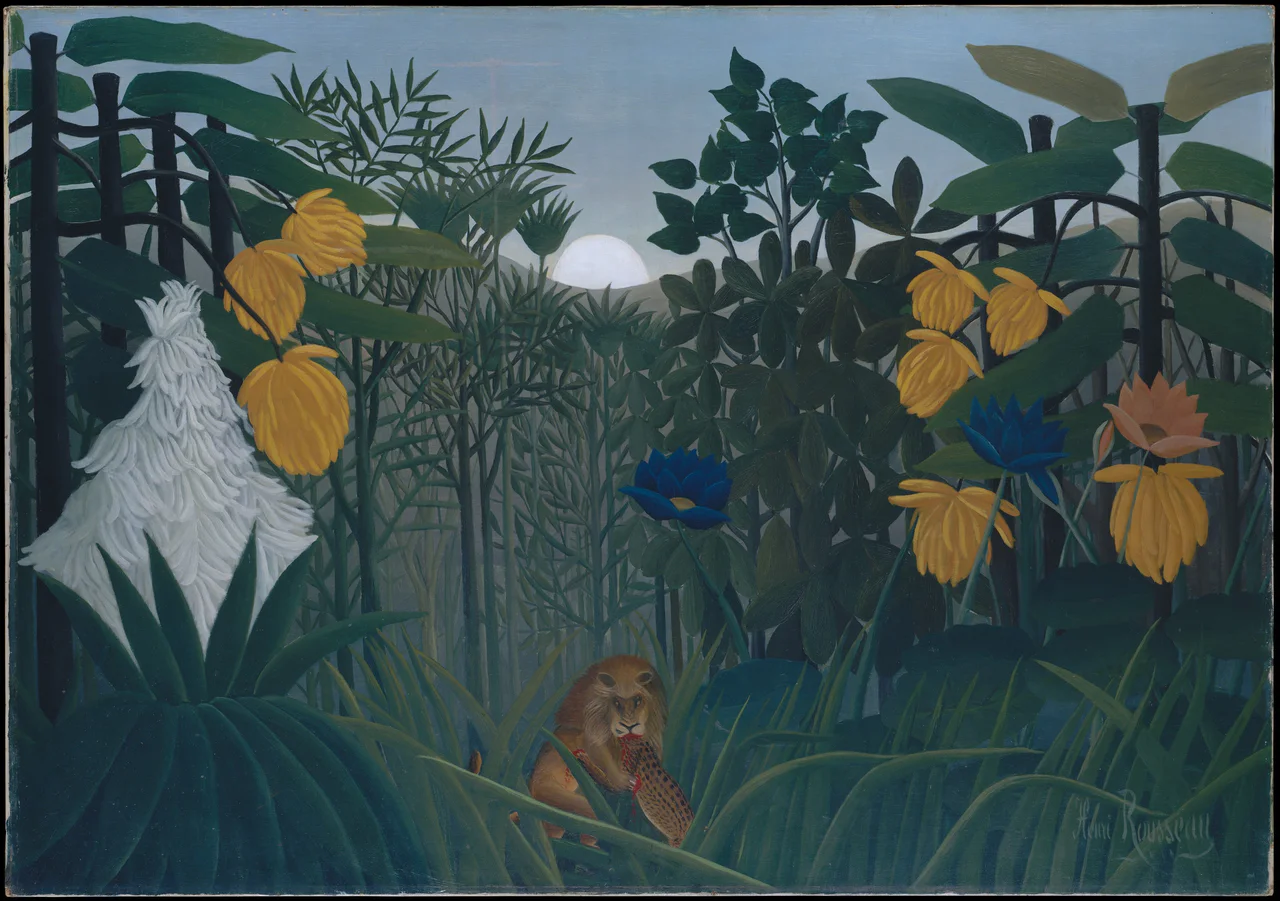
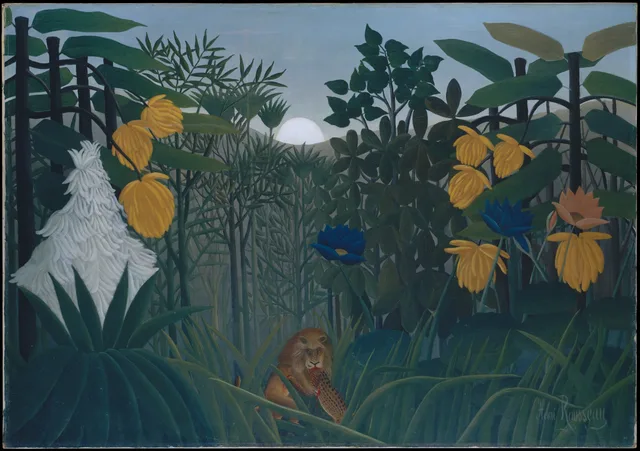
The title is The Repast of the Lion, but you have to hunt for the lion. Huge leaves fill the canvas, along with clusters of yellow fruit, blue blossoms, and a white plant as fluffy as a feather duster. A pale round light hangs in the middle of the sky. The lion is down at the very bottom, half hidden in the grass.
Henri Rousseau painted this around 1907. It is big, about 45 by 63 inches, wider than many living room sofas, and every inch of it is packed with forest.
Let's find the lion first. Look low and toward the center.
A lion with a thick mane grips a spotted animal and bites into it. Red paint runs from its mouth and down the prey's neck. It should be terrifying, yet the lion's face looks oddly calm. Round ears, clear eyes, a mane that looks almost combed. It feels less like a hunt and more like a scene frozen in place.
Here is the surprise. The man who painted this tropical forest never saw the tropics. Rousseau never left France in his whole life. A story once went around that he had served in Mexico as a young man, but it turned out not to be true.
His nickname was le Douanier, the customs officer. For years he worked at the Paris toll office that taxed goods coming into the city. He never went to art school. He taught himself to paint, and only after he retired in 1893 could he give painting his full time.
So where did the jungle come from? From the middle of Paris. Rousseau loved to visit the great glass greenhouses of the Jardin des Plantes, the city's botanical garden, where tropical trees and flowers grew. The garden had a zoo, too. He also borrowed animals from pictures in illustrated books and magazines.
Now look at the blue flower near the center.
Deep blue petals open layer upon layer around a yellow center. Each petal is smoothly painted with a crisp edge. The leaves behind it aren't one green, either. Dark green, gray green, and blue green shift slightly from leaf to leaf.
This isn't a copy of the greenhouse. The blue flower is bigger than the lion's head, and the grass towers far above him. Leaves of the same shape stack up in rows, front to back, like painted flats on a stage. Rousseau took a potted plant here and a book illustration there and built a forest of his own.
In his day many people laughed at pictures like this. The perspective was off, they said, and it looked like a child's work. Rousseau kept sending paintings to the Salon des Indépendants, an exhibition with no jury where anyone could show. Over time, young artists such as Pablo Picasso began to take him seriously, and in 1908 Picasso threw a banquet in his studio in Rousseau's honor.
Finally, look among the grass blades at lower right.
There, in a pale color close to the grass itself, is the name Henri Rousseau. It hides between the thick blades, so only people who look for a while will find it.